Aesthetics as Lived Ontology and the Recovery of Implacement
Aesthetics as Lived Ontology and the Recovery of Implacement
Aesthetics as Lived Ontology and the Recovery of Implacement

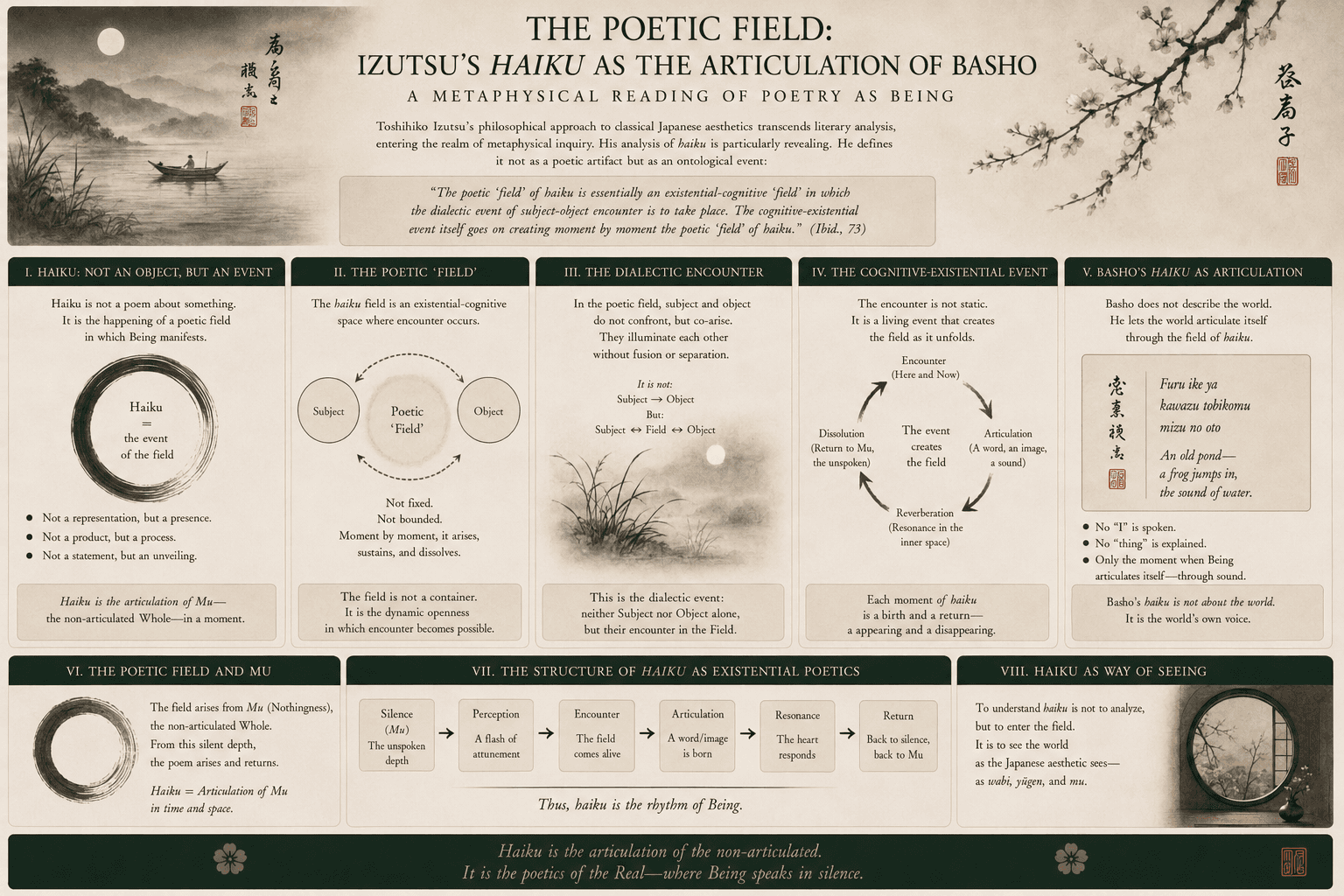
The profound interweaving of Nishida and Izutsu, as demonstrated through the haiku, reveals that the classical Japanese aesthetic tradition is not merely a collection of artistic sensibilities or stylistic preferences. It is a rigorous, lived ontology—a way of being in a world understood as a creative, self-determining, and implaced whole. Izutsu’s meticulous phenomenology of beauty finds its necessary ground and explanation in Nishida’s topological metaphysics of the basho.
This synthesis offers a decisive resolution to the dualisms that have long beset Western thought. The perennial gap between subject and object, between the meaning in the mind and the thing in the world, is revealed as a derivative effect within a prior, unified field. Beauty, in this light, is not a subjective projection onto an objective world, but the signature of the world’s own self-articulation, perceived in the state of muga.
Furthermore, this topological-aesthetic vision possesses urgent contemporary relevance. We live in an age of philosophical and cultural dislocation, characterized by a pervasive sense of uprootedness and fragmentation. Nishida’s topology, validated and illuminated by Izutsu’s aesthetics, offers a path to recover a sense of implacement. Our home is not a fixed point to be possessed, but a dynamic, relational, and endlessly generative field to which we fundamentally belong. To understand the haiku as Izutsu and Nishida allow us to is to learn the art of dwelling within this interweaving whole—to see our finite perceptions and creations not as isolated acts, but as the very way the formless ground of reality lights itself up, in and through our conscious, participatory being.
Thus, providing the Nishidian foundation for Izutsu’s project does more than complete a scholarly picture; it unlocks a vital philosophical resource. It presents Japanese aesthetics not as a remote cultural study, but as a compelling ontological map for navigating the dislocations of the twenty-first century, guiding us toward a non-dual, ecological, and profoundly implaced mode of existence.