


Izutsu’s Haiku as the Articulation of Basho
The Poetic Field
The Poetic Field
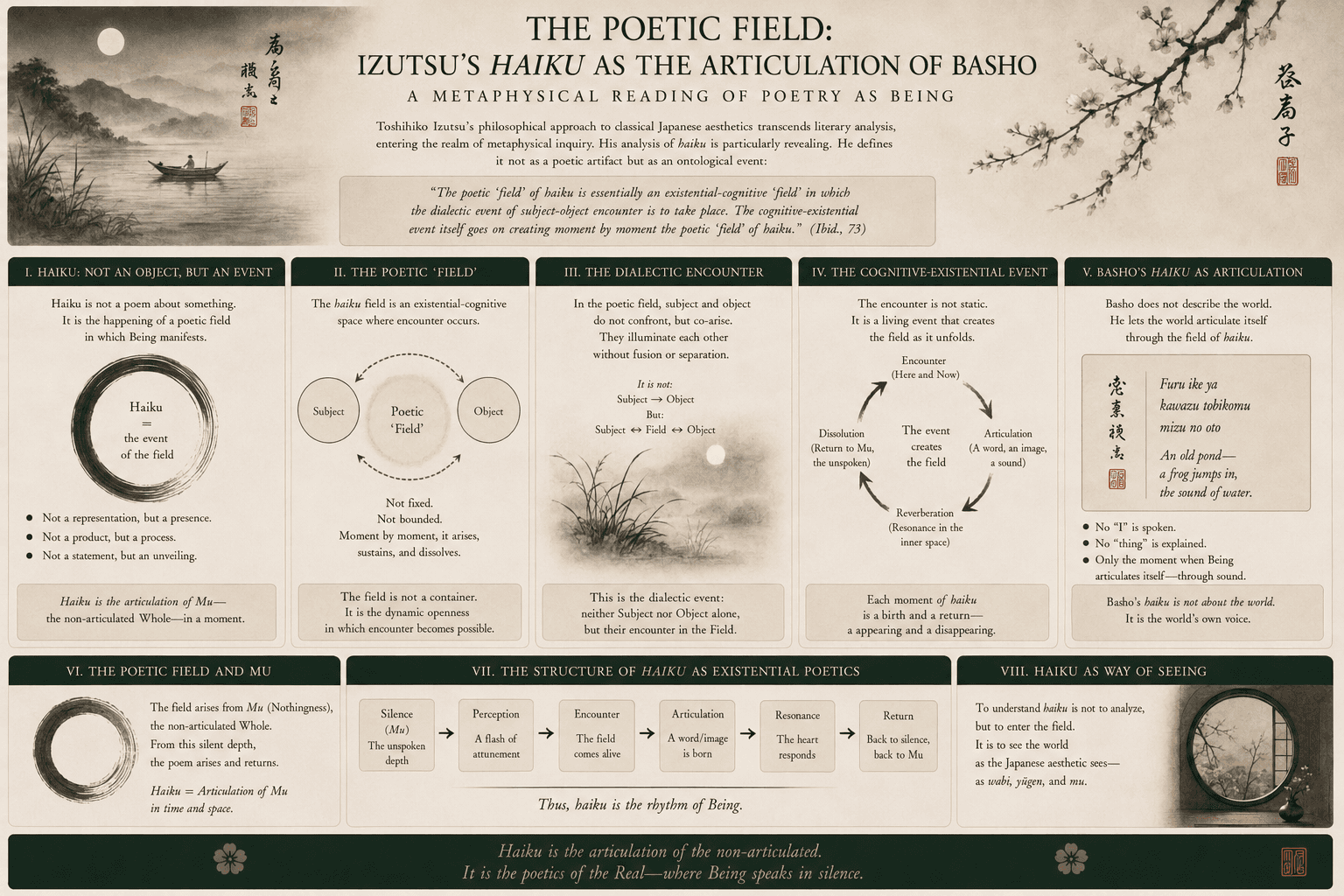
Toshihiko Izutsu’s philosophical approach to classical Japanese aesthetics transcends literary analysis, entering the realm of metaphysical inquiry. His analysis of haiku is particularly revealing. He defines it not as a poetic artifact but as an ontological event:
“The poetic ‘field’ of haiku is essentially an existential-cognitive ‘field’ in which the dialectic event of subject-object encounter is to take place. The cognitive-existential event itself goes on creating moment by moment the poetic ‘field’ of haiku.” (Ibid., 73)
This formulation is decisive. The haiku is not a fixed object describing an experience, but the very becoming of a poetic space—a field. It is “existential” because it grounds itself in a lived moment of awareness; it is “cognitive” because it involves a moment of semantic articulation, the arising of meaningful perception from a formless ground. Izutsu’s emphasis on moment-by-moment creation suggests the haiku does not emerge from the imposition of external form but arises spontaneously from the unfolding of awareness. Each haiku becomes a singular “event-being,” wherein the distinction between subject and object is neither fully established nor fully dissolved. This field is not pre-existing; it is born with the encounter and vanishes with it, disappearing into mu—the non-phenomenal field of Nothingness.
Here, the connection to Nishida’s philosophy becomes inescapable. The haiku’s power to instantiate a ‘cognitive-existential field’ is rooted in the foundational principle Nishida articulated as ‘pure experience’—the direct, unified ground of awareness before the subject-object split. For Izutsu, the haiku does not describe this unified reality; it enacts it. Where Nishida provided the abstract structure of the self-determining basho, Izutsu, through Bashō, reveals its lived, poetic form.
The mechanism of this enactment is captured in Izutsu’s own central metaphysical principle: “semantic articulation is immediately ontological articulation.” This formula provides the dynamic engine that bridges Nishida’s structure and aesthetic phenomenon. The haiku is not a description but a performance of this principle. The poet’s intuitive glance (muga) is the threshold where the “non-articulated” ground of experience—the silent, undifferentiated basho—articulates itself simultaneously as a phenomenal event (the frog leaping, the water’s sound) and a semantic event (the poem’s seventeen syllables). The “sound of water” is both a thing that happens and a meaning that emerges; in the haiku, they are ontologically identical. The poem is thus an event of articulation: a momentary crystallization of the formless basho into form-and-meaning, before it collapses back into formlessness.
Through this synthesis, we see that Izutsu’s phenomenological “field” and Nishida’s metaphysical “field” are not analogies but designations of the same reality from complementary perspectives. The haiku is the basho momentarily and poetically determining itself.


