The Aesthetics of Yo-jō and Yo-haku in the Classical Japanese Poetic Field
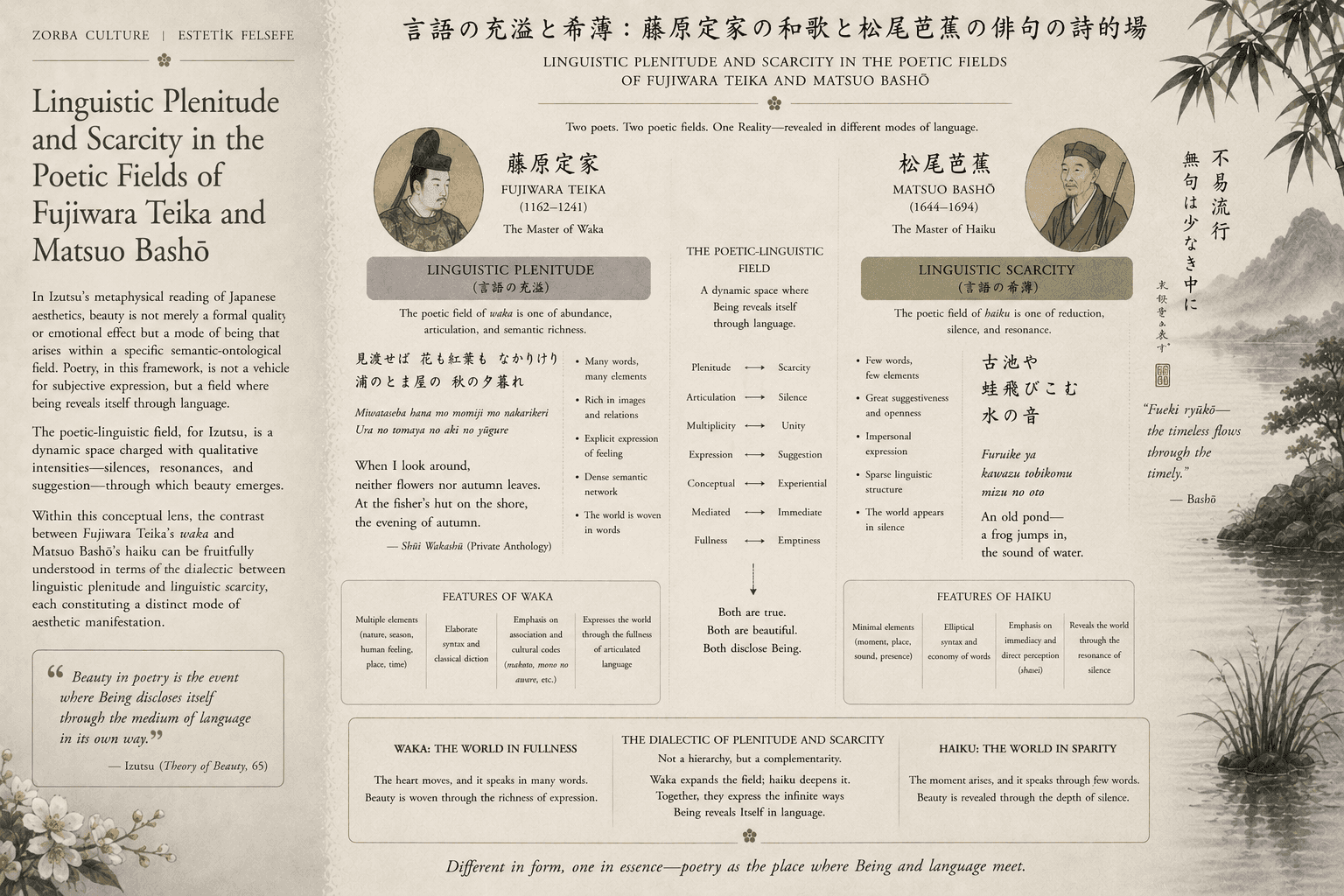
In the intricate fabric of classical Japanese aesthetics, as elucidated by Izutsu, the concepts of yo-jō and yo-haku emerge as two distinct yet intimately related modes of expressing the non-articulated Whole through the vehicle of language. Both terms designate forms of beauty grounded in the fundamental interplay between articulation and the non-articulated totality. However, their modes of manifestation within the linguistic field differ profoundly, aligning respectively with the aesthetic worlds of waka and haiku.
Yo-jō, according to Izutsu, may be described as a "state of mind" positively actualized in the poetic field as a semantic overflow. It refers to the emotional and imaginal afterglow that radiates from within a completed linguistic expression. In a waka, the linguistic articulation -though finite and composed within the rigid thirty-one syllable form- is so saturated with kokoro (heart-mind) that it spills beyond its own boundaries, evoking an unspoken, resonant feeling that continues to unfold in the mind of the reader. Yo-jō thus belongs to a trans-linguistic dimension: it is not embedded within the literal semantic structure of the words themselves but arises in the liminal space between what is said and what is suggested, as an invisible surplus of meaning. It is an inward, emotionally inflected reverberation -a silent continuity of being awakened through the lyrical articulation.
In contrast, yo-haku designates a more radical phenomenon: it is not a surplus flowing from within articulation, but rather the background blankness -the void ground (mu)- against which any linguistic articulation stands out. In haiku, with its extreme semantic minimalism, the few words offered to the reader do not saturate the poetic field; instead, they gesture toward an immense surrounding silence, a not-yet-articulated totality from which they momentarily emerge. Here, beauty arises from the tension between the minimal articulation and the vast, invisible Whole that remains unsaid. Yo-haku belongs not to an emotional or imaginal overflow, but to a primordial ontological openness: the very field of non-articulated Being that silently supports and transcends all possible articulation.
Izutsu thus sees yo-jō and yo-haku as aesthetically and ontologically complementary. In the case of waka, yo-jō is dominant: the poet's linguistic articulation of a personal sentiment or perception -whether the fading of flowers, the loneliness of autumn, or the ephemeral encounter with a beloved- is rich enough to give rise to an invisible excess, a continued semantic-emotional resonance that lives beyond the poem’s verbal closure. The field is emotionally and imaginatively full, though the words themselves are suggestive rather than exhaustive. The non-articulated Whole, while present, is primarily felt through the emotional echo that language awakens.
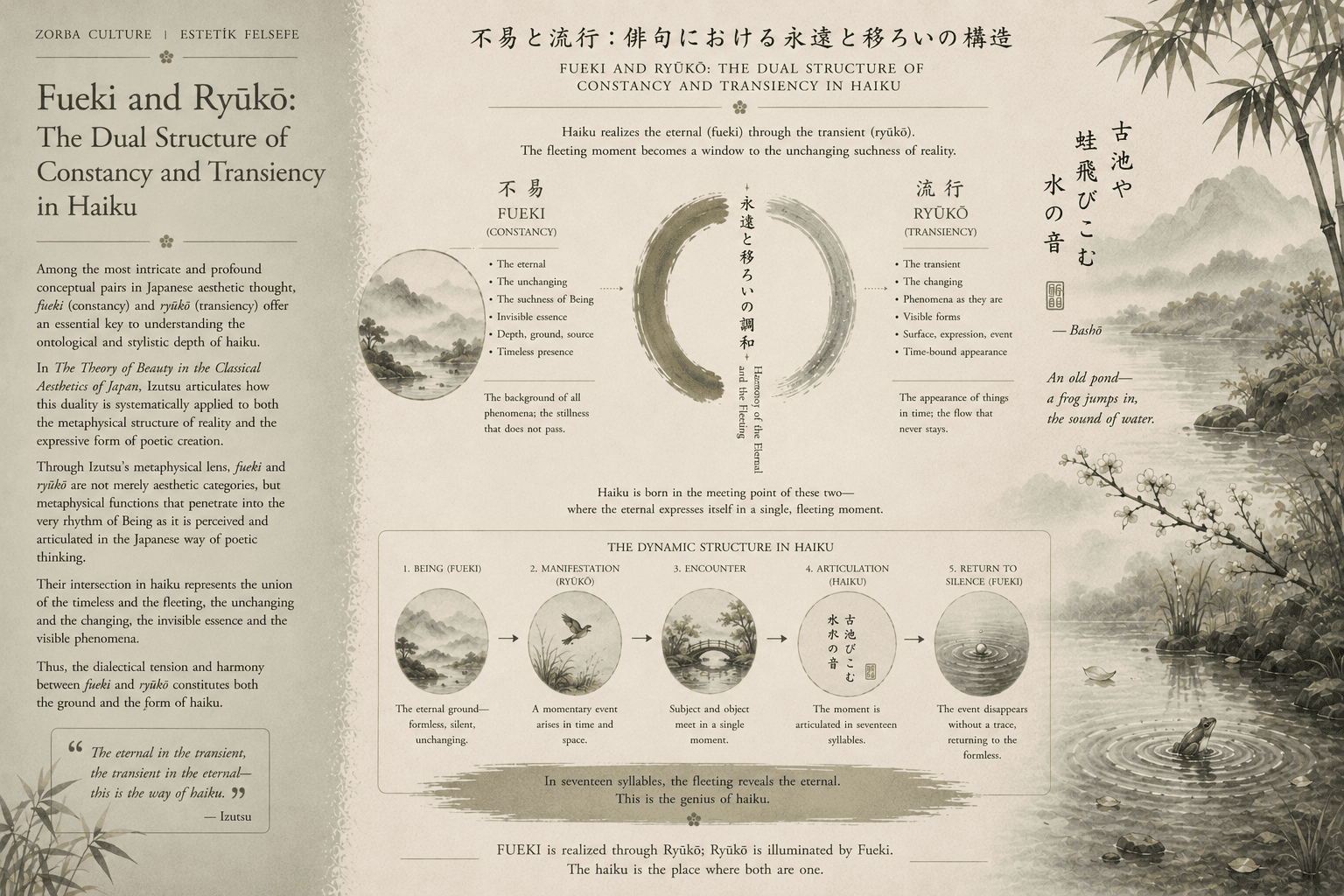
In the case of haiku, by contrast, yo-haku governs the field: language is pared down to the bare minimum, and the few articulated signs serve only as sparks that illuminate, for a fleeting instant, the abyssal void of the non-articulated totality. Subjectivity, which still lingers subtly in waka through emotional colouring, dissolves almost completely in haiku; the poet becomes transparent before the silent unfolding of nature itself. The old pond, the jumping frog, the sound of water -such images, in their radical simplicity, do not seek to elaborate feeling but to open a direct doorway into the field of Being, where articulation and silence meet.
Thus, in Izutsu’s framework, yo-jō and yo-haku are not merely stylistic devices or technical features of poetic composition. They are, more deeply, metaphysical functions of the Japanese poetico-aesthetic consciousness. Yo-jō expresses the overflowing activity of kokoro, articulating the human being's affective unity with the transitory world; yo-haku expresses the silent embrace of the non-articulated Whole, revealing the background emptiness (mu) from which all phenomena arise and into which they return. Each constitutes an essential aesthetic value: yo-jō shaping the lyrical fullness of waka, yo-haku shaping the contemplative sparseness of haiku.
Through this lens, the evolution from waka to haiku in Japanese literary history may be seen not simply as a formal condensation, but as a profound metaphysical movement: a movement from the emotional fullness of articulated thought toward the ontological minimalism of immediate being. In both cases, however, the highest ideal remains the same: to awaken, through the delicate interplay of language and silence, an intuition of the infinite Whole that transcends all linguistic articulation -the eternal ground of beauty that lies quietly behind the veil of words.