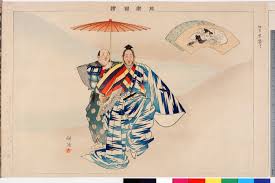
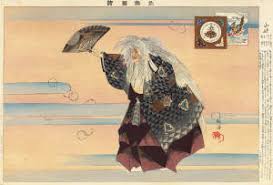
Japanese and Western aesthetics emerge from distinct, though occasionally overlapping, perceptual logics. While generalizations always risk simplification, certain patterns stand out. These patterns are direct expressions of the different structures of consciousness (Ishiki) we have begun to explore. In Japanese tradition, the boundary between subject and object often dissolves -perception becomes a reciprocal interplay, a participation in the world’s unfolding. This is vividly present in practices like Zen ink painting (sumi-e), where the artist’s self-effacement allows nature to manifest directly through the brush. The self does not impose form upon the world; it becomes a conduit through which the world reveals itself.
By contrast, Western aesthetics has historically privileged a more distanced mode of perception, marked by the separation of observer and observed. This is evident in the fixed-point geometry of Renaissance perspective, and in Kant’s notion of “disinterested contemplation.” Yet even here, ruptures and counter-currents emerge. Consider Johann Wolfgang von Goethe’s 1810 Theory of Colours: where Newton reduced light to pure optics, Goethe experienced color as emotional encounter. He wrote that colours are “the deeds and sufferings of light.” His sensual, intuitive approach -later inspiring Turner’s storm-laden seascapes and Kandinsky’s spiritual abstractions- reminds us that Western art, too, contains moments of participatory vision that blur the very subject-object divide it is often said to uphold.
These divergent logics also shape how each tradition engages with time. Japanese aesthetics often finds beauty in impermanence (mujō) and decay -central to concepts like wabi-sabi, where transience deepens aesthetic presence. Western art, though historically inclined toward permanence and ideal form -as in the classical pursuit of symmetry or the “Golden Ratio” -has also deeply engaged with temporality. Baroque vanitas paintings, Romantic odes to mortality, and elegiac music forms mourn the fragility of existence, even as they attempt to preserve it.
Form, likewise, reveals contrasting priorities. Japanese aesthetics often privileges evocation (yūgen) and omission (ma) -the unsaid as potent as the said. It cultivates ambiguity and openness, allowing the viewer’s intuition to complete what is left unstated. Western aesthetics, by contrast, has long leaned toward declaration and structure, producing canonical ideals of clarity and proportion. Yet here too, the tradition bends: Minimalist painters like Rothko dissolve boundaries and embrace the ambiguous, the ineffable.
These differing aesthetic visions are rooted in distinct modes of knowing. Japanese art frequently draws on intuition, empathy, and relational awareness -what mono no aware names as a “sensitivity to things.” Western aesthetics has emphasized rational analysis, formal critique, and conceptual articulation. Yet again, this is not a strict division. Goethe’s theory of color stands as a quiet revolt within the Western canon, insisting that perception is not analytical alone but poetic -a truth intuited rather than measured. In that regard, his vision resonates with the mysterious depths of yūgen.
In essence, Japanese art often allows the world to speak through the medium, while Western art has historically voiced the mind of the artist—celebrating individual mastery over material. But both traditions, in their finest moments, reveal humility as well as assertion. These differences are not oppositions; they are variations in emphasis, sensibility, and historical trajectory. From Hokusai’s influence on Monet to contemporary hybrid forms, the traditions have long been in dialogue. They reveal complementary dimensions of aesthetic truth: one does not supplant the other—they illuminate one another.