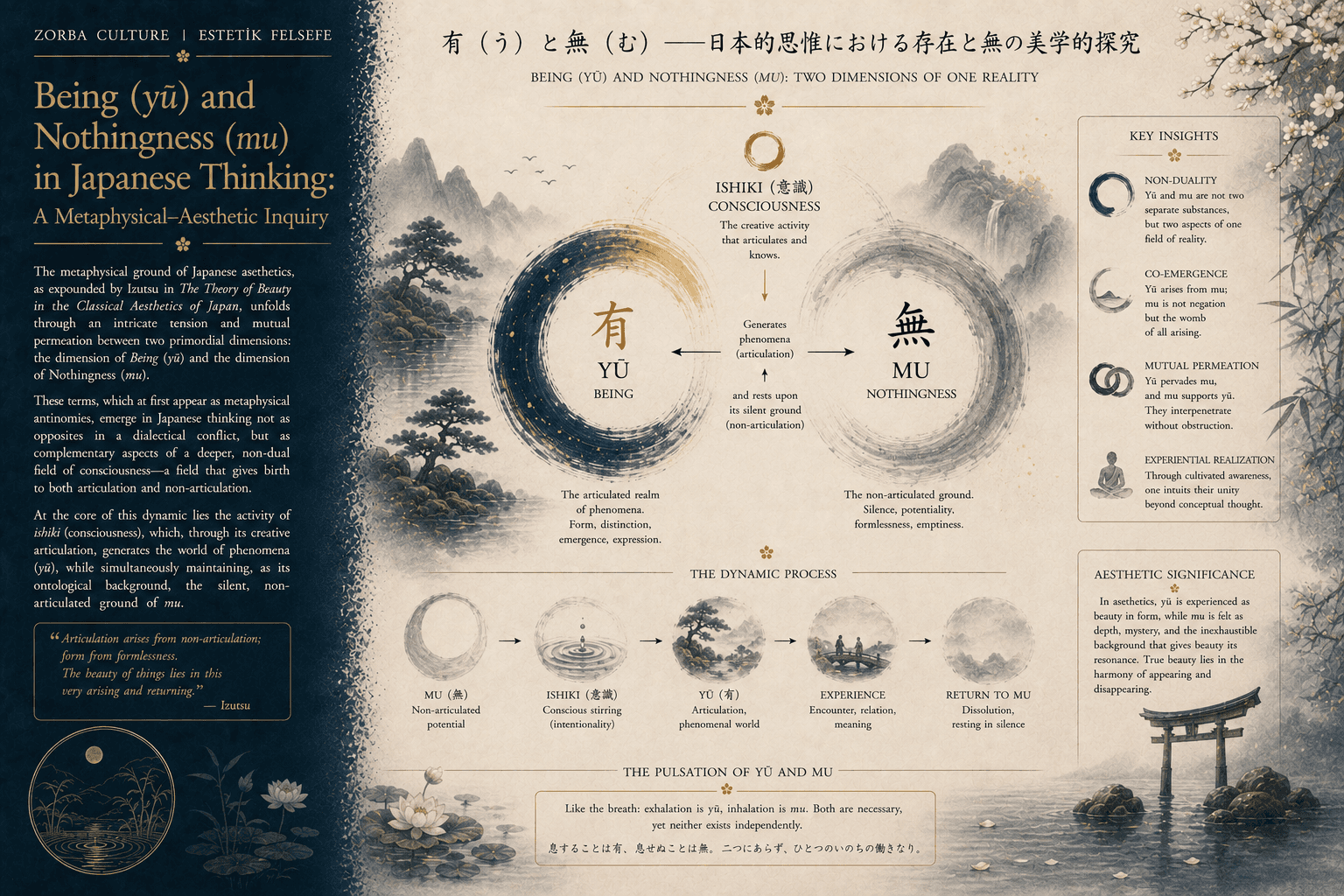
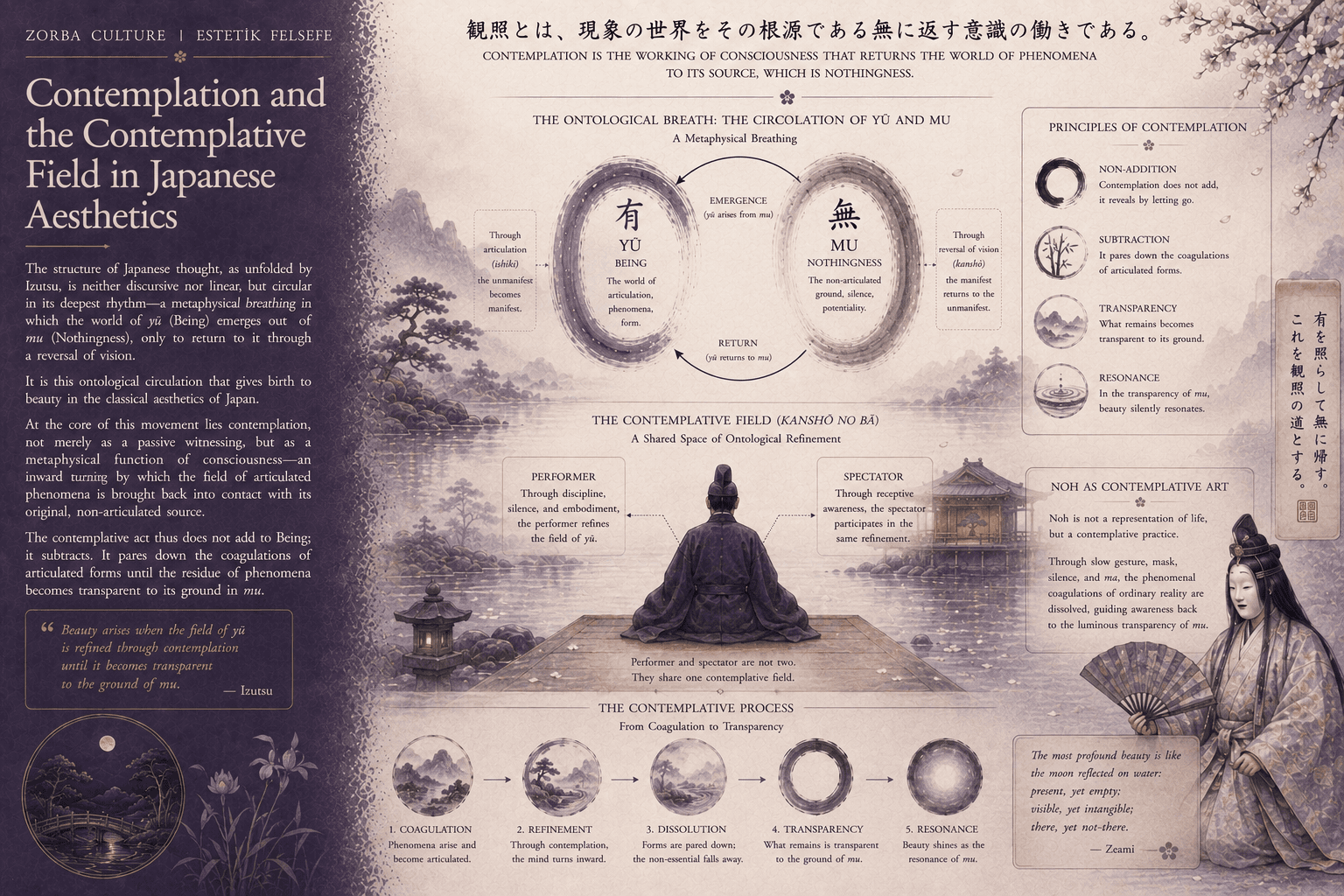
The metaphysical ground of Japanese aesthetics, as expounded by Izutsu in The Theory of Beauty in the Classical Aesthetics of Japan, unfolds through an intricate tension and mutual permeation between two primordial dimensions: the dimension of Being (yū) and the dimension of Nothingness (mu). These terms, which at first appear as metaphysical antinomies, emerge in Japanese thinking not as opposites in a dialectical conflict, but as complementary aspects of a deeper, non-dual field of consciousness -a field that gives birth to both articulation and non-articulation. At the core of this dynamic lies the activity of ishiki (consciousness), which, through its creative articulation, generates the world of phenomena (yū), while simultaneously maintaining, as its ontological background, the silent, non-articulated ground of mu.
In the traditional terminology of Japanese thought, as Izutsu emphasizes, mu –Nothingness- is not mere negation, void, or absence in a nihilistic sense. Rather, it designates the primordial non-articulated whole that lies before, or beyond, conceptual distinction and phenomenal individuation. Conversely, yū, or Being, is the field of articulated existence, the empirical manifestation of things (mono) and events (koto) brought forth by the inner act of semantic and existential articulation carried out by human consciousness. In this metaphysical-aesthetic structure, Being is not a fixed ontological category but the luminous disclosure of mu, its rhythmic articulation through poetic or contemplative perception.
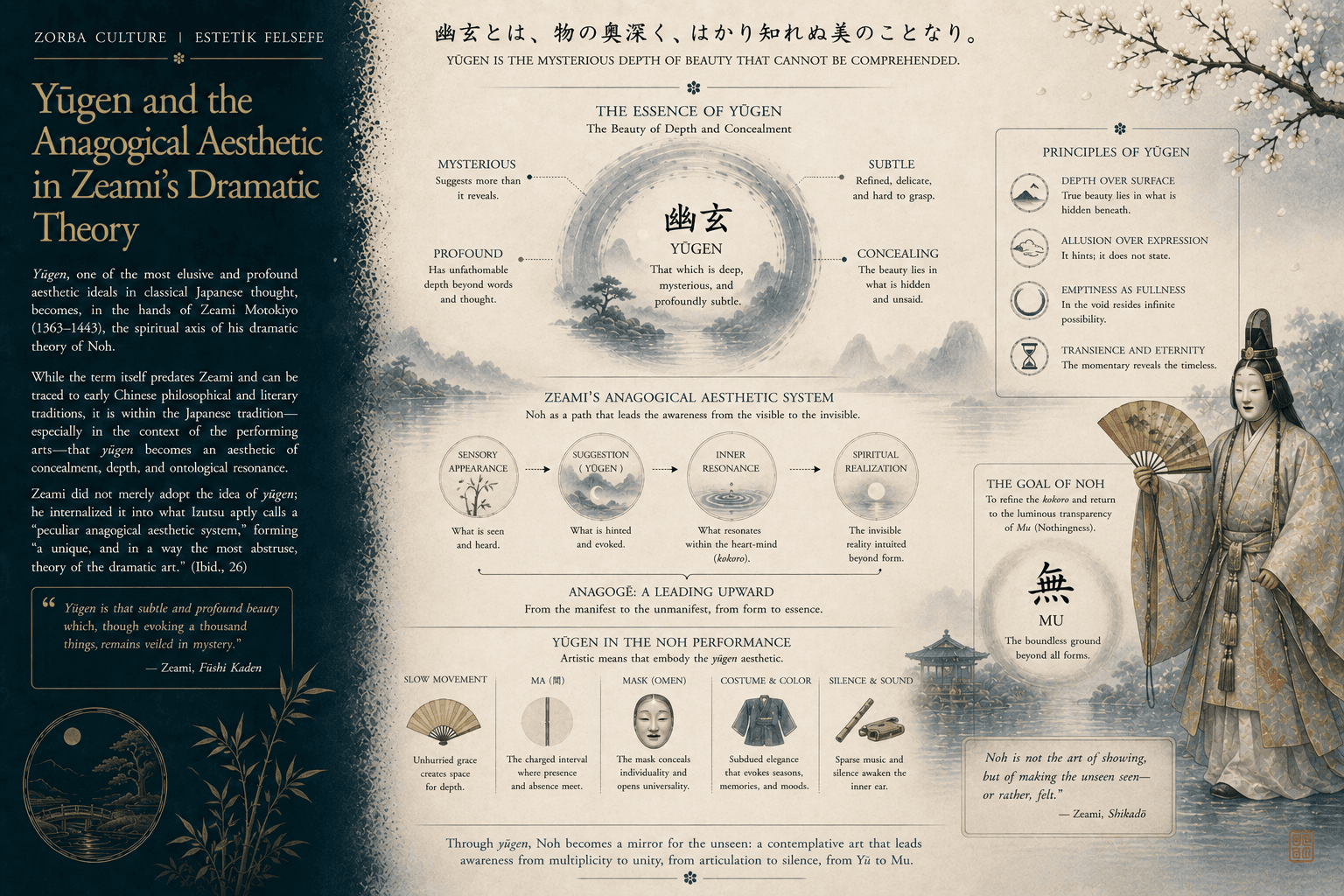
Izutsu’s analysis of Japanese beauty unfolds precisely within this metaphysical polarity. Classical Japanese aesthetics, rooted in Shinto, Buddhist, and Zen traditions, presupposes a worldview in which beauty is not a property of objects but an event of appearance -a moment in which the formless depth of Nothingness unveils itself in the form of a transient presence. The experience of beauty, therefore, is fundamentally the experience of mu becoming yū, of the non-articulated momentarily becoming articulated without losing its original non-duality. This aesthetic moment is exemplified in the sensibility of yūgen -the subtle, hidden profundity that hints at what cannot be fully grasped or named. Yūgen is the trace of mu within yū, the resonance of the invisible within the visible, the unspoken within the spoken.
Consciousness (ishiki), as Izutsu argues, plays a central role in mediating these dimensions. It is the creative agent that, through its semantic activity, brings Being into appearance. Yet, this articulation is never absolute. It always bears the imprint of what remains unsaid -the ineffable dimension of mu. In Japanese poetics, especially in waka and haiku, this metaphysical rhythm is carefully cultivated. A waka poem, with its compact form and semantic suggestiveness, does not aim to describe an object fully, but rather to evoke the silent depth behind it. In this evocation, the poem becomes a site where mu breathes through yū, where absence is made present not through direct representation but through allusion, emptiness, and the beauty of the incomplete.
This understanding also extends into the aesthetics of Noh theatre. The actor’s restrained gestures, the use of ma (the empty interval), and the presence of the mask all point to a metaphysics of concealment and suggestion. What is not expressed becomes more expressive than what is shown. The stage, as Izutsu might say, becomes a field in which mu subtly flows into yū, and the audience is drawn not into a narrative, but into a contemplative awareness of the formless behind the form. Beauty arises as a gentle pulsation of yū on the surface of mu, like the shimmer of moonlight on a dark pond -visible, yet pointing always beyond itself.
The traditional tea ceremony (chanoyu) is another profound instantiation of this metaphysical aesthetic. The silence of the tea room, the simplicity of its tools, and the slow, deliberate rhythm of the ritual all resonate with a conscious return to the non-articulated. The tea master’s movements are not meant to display anything; they arise from a deep alignment with mu. Every articulated gesture is rooted in a silent non-doing, a metaphysical restraint that brings Being into harmony with Nothingness.
Thus, to speak of Being and Nothingness in Japanese thinking is not to invoke a Western ontological dualism, but to enter a metaphysical field of subtle transformation, where the non-articulated and the articulated do not stand in opposition but in an intimate and dynamic correspondence. As Izutsu beautifully formulates:
“The articulated is thus none other than the dimension of 'being' as the empirical field of life produced by the activity of the 'existential' articulation of human consciousness.” (Ibid., 31)
Yet this empirical field is never self-sufficient -it constantly emerges from, and dissolves back into, the silent depths of mu.
In this sense, Japanese aesthetics, through Izutsu’s lens, can be seen as a metaphysical poetics: a way of thinking Being and Nothingness not as static entities but as dynamic dimensions of consciousness. The experience of beauty is not merely aesthetic; it is ontological and contemplative. It is the moment in which the boundaries between self and world, word and silence, articulation and non-articulation, Being and Nothingness dissolve into a single, ineffable event -the appearance of the Real.