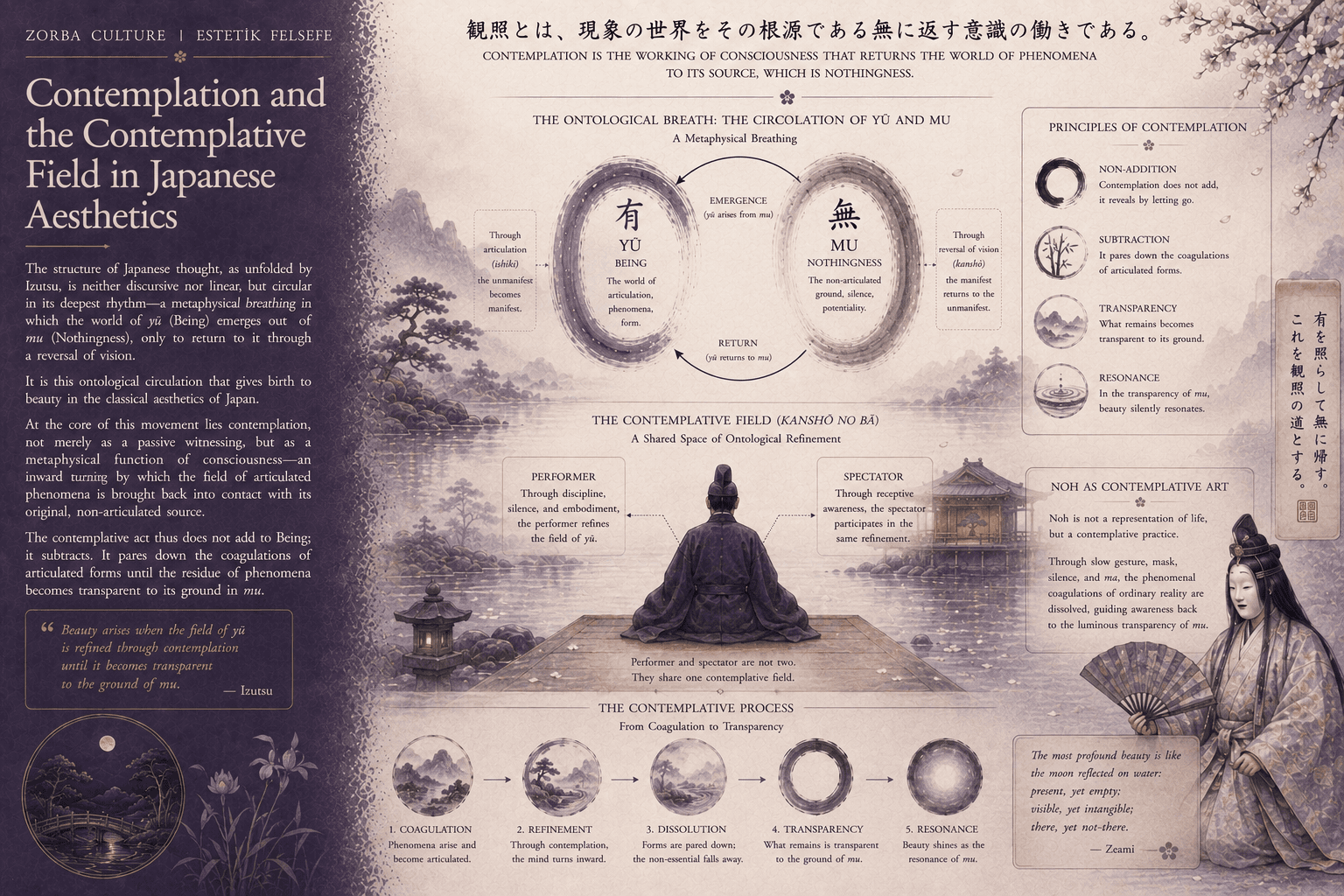
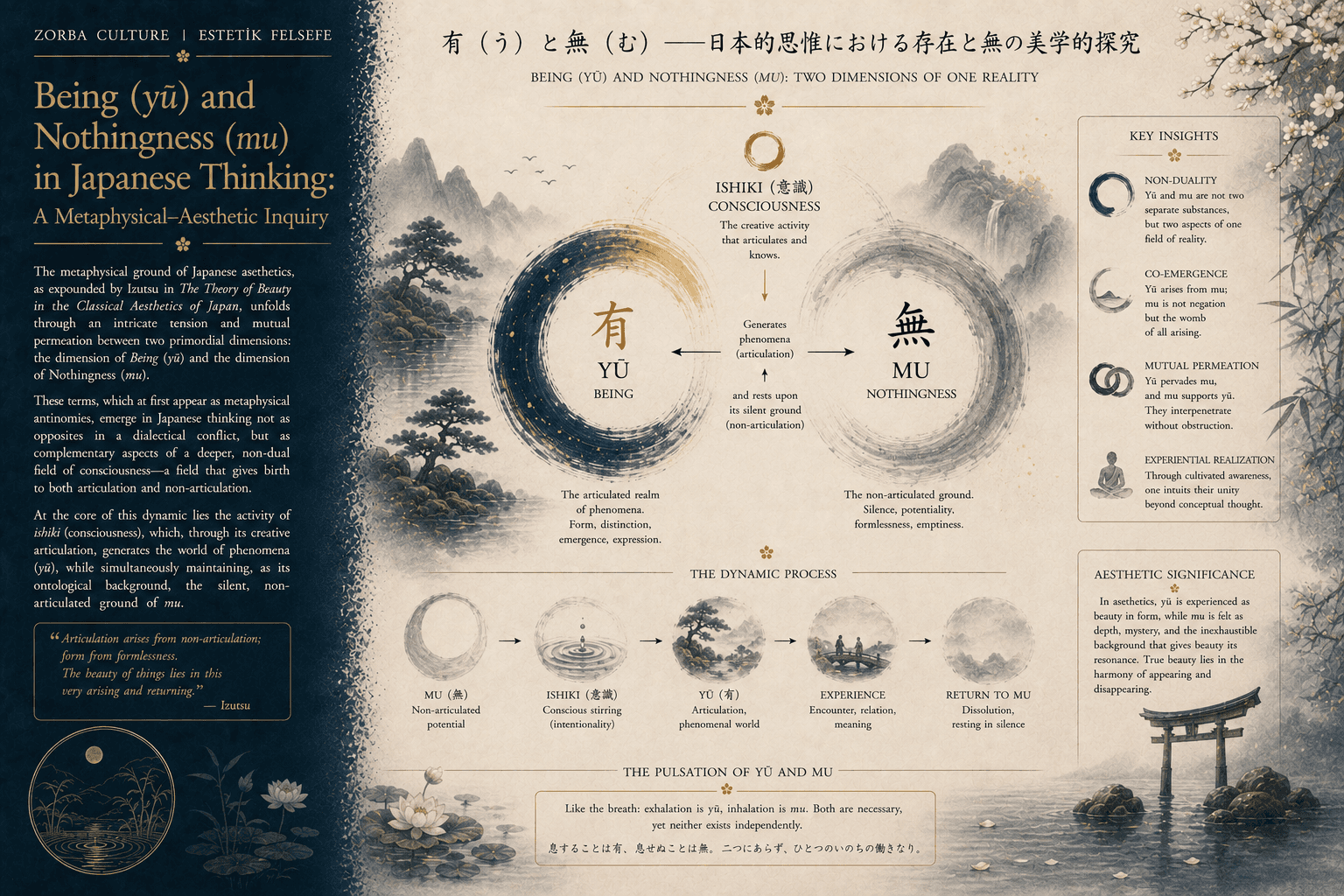
The structure of Japanese thought, as unfolded by Izutsu, is neither discursive nor linear, but circular in its deepest rhythm -a metaphysical breathing in which the world of yū (Being) emerges out of mu (Nothingness), only to return to it through a reversal of vision. It is this ontological circulation that gives birth to beauty in the classical aesthetics of Japan. At the core of this movement lies contemplation, not merely as a passive witnessing, but as a metaphysical function of consciousness -an inward turning by which the field of articulated phenomena is brought back into contact with its original, non-articulated source. The contemplative act thus does not add to Being; it subtracts. It pares down the coagulations of articulated forms until the residue of phenomena becomes transparent to its ground in mu.
Izutsu writes:
“The dimension of 'being' which has emerged out of Nothingness as its ground, is brought back to the vision of the original Nothingness through contemplative experience, dissolving its own phenomenal coagulations that have been produced by articulation.” (Ibid., 31)
This is no mere philosophical metaphor. Rather, it designates the very heart of Japanese aesthetic metaphysics: a field of consciousness in which the articulated form collapses into the unbroken continuity of the non-articulated whole. To contemplate is not to interpret; it is to dissolve the layers of semantic construction through a silent, inward seeing—a vision that does not frame but flows with the pulse of the real.
This contemplative field is not psychological but ontological. It is not a state within the subject, but a dimension of reality itself—an invisible field in which the subject and object, the seer and the seen, begin to merge in their mutual transparency. In this space, Being (yū) is seen as a luminous manifestation, a katachi (form) momentarily lifted from the darkness of mu, which is not void in the nihilistic sense, but the non-articulated, infinite plenitude of the Real. What Izutsu calls “phenomenal coagulations” are not errors of perception; they are necessary crystallizations of the semantic activity of consciousness (ishiki). Yet, when aesthetic or contemplative awareness deepens, these coagulations begin to melt back into their ground -not through violence, but through stillness. Beauty, then, is the moment when a thing reveals its nothingness -not as absence, but as its truest form.
This is the spiritual function of contemplation in Japanese aesthetics: it de-coagulates the phenomenal. It does not seek to explain or clarify, but to see through -to strip away the superfluity of Being until the underlying mu becomes perceptible, not as concept but as felt presence. This presence is what gives rise to yūgen, the most refined expression of beauty in Japanese tradition: the “mystery and depth” that cannot be said, the echo of Nothingness trembling within form. The beauty of a withering leaf, of a pale moon half-concealed by mist, of a gesture in Noh that stops before completion—these are all contemplative gestures, through which the surface world begins to fade into its non-articulated origin.
Such contemplation requires a transformation in the structure of subjectivity itself. The contemplative subject is no longer a fixed ego but a kokoro emptied of self-reference -a vessel whose awareness is attuned to the non-dual rhythm of mu-yū. This is not a form of thinking (omoi), nor is it emotional response (jō); it is rather a pre-semantic, pre-affective openness, a field of pure receptivity in which the world discloses itself without being grasped. In waka poetry, this transformation is enacted through the extreme semantic compression of the verse. The poem does not “represent” an object, but enacts the subtle shift from object to field, from articulated image to silent resonance. A falling petal is not described—it is sensed in its fading, and in its fading, the contemplative field opens.
Noh theatre embodies this structure in its entirety. The actor moves not as a person, but as a metaphysical function. The mask does not conceal but reveals—by erasing the egoic face, it allows the presence of the invisible to manifest. The stage, surrounded on three sides by empty space, becomes a contemplative void. The slow, deliberate movements suspend time and dissolve narrative, returning both actor and audience to a place before speech, before meaning -a place of stillness in which Being hovers just above the threshold of disappearance. In this hovering lies the secret of Japanese beauty: not in the fullness of presence, but in its passing, its transience, its trace.
This aesthetic structure, as Izutsu insists, is not reducible to cultural habit or artistic taste -it is rooted in a metaphysical vision. It is the awareness that all things, even the most beautiful, are ultimately non-articulated, and that their beauty comes not from their form alone, but from the way they point beyond themselves, into the depths of mu. The tea ceremony, chanoyu, offers perhaps the most distilled form of this insight. Every object is chosen not for its perfection but for its imperfection, for its asymmetry, its muted tone, its quiet withdrawal. The space is empty not by accident but by design: the emptiness is what allows the fullness of the Real to be intuited. The water boils, the cup is lifted, the gesture is performed—and yet nothing is “done.” It is a pure contemplation in action, where Being fades back into its origin at every step.
In Izutsu’s metaphysical lexicon, then, the contemplative field is not a momentary state but a way of being in the world -a mode of perception that does not cling to things but lets them pass, not because they are meaningless, but because their meaning lies in their evanescence. To contemplate is to see with a vision purified of the need to possess. It is to dwell in the still point between articulation and silence, where the pulse of mu can be heard beneath the fragile architectures of yū. The aesthetic experience becomes, in this sense, a metaphysical path -one in which the world is not escaped, but seen through, and in being seen through, is returned to its sacred origin.
Thus, the dissolution of phenomenal coagulations is not a disappearance into nihilism, but a return to ontological clarity. The things of the world are not negated, but rendered transparent. Their articulated surface becomes a veil so fine that the unnameable depth of mu begins to shine through. In that moment, the contemplative subject becomes no longer a “self,” but a clear mirror—one that reflects the Real not as object, but as presence without form, beauty without grasping, Being in the act of vanishing.