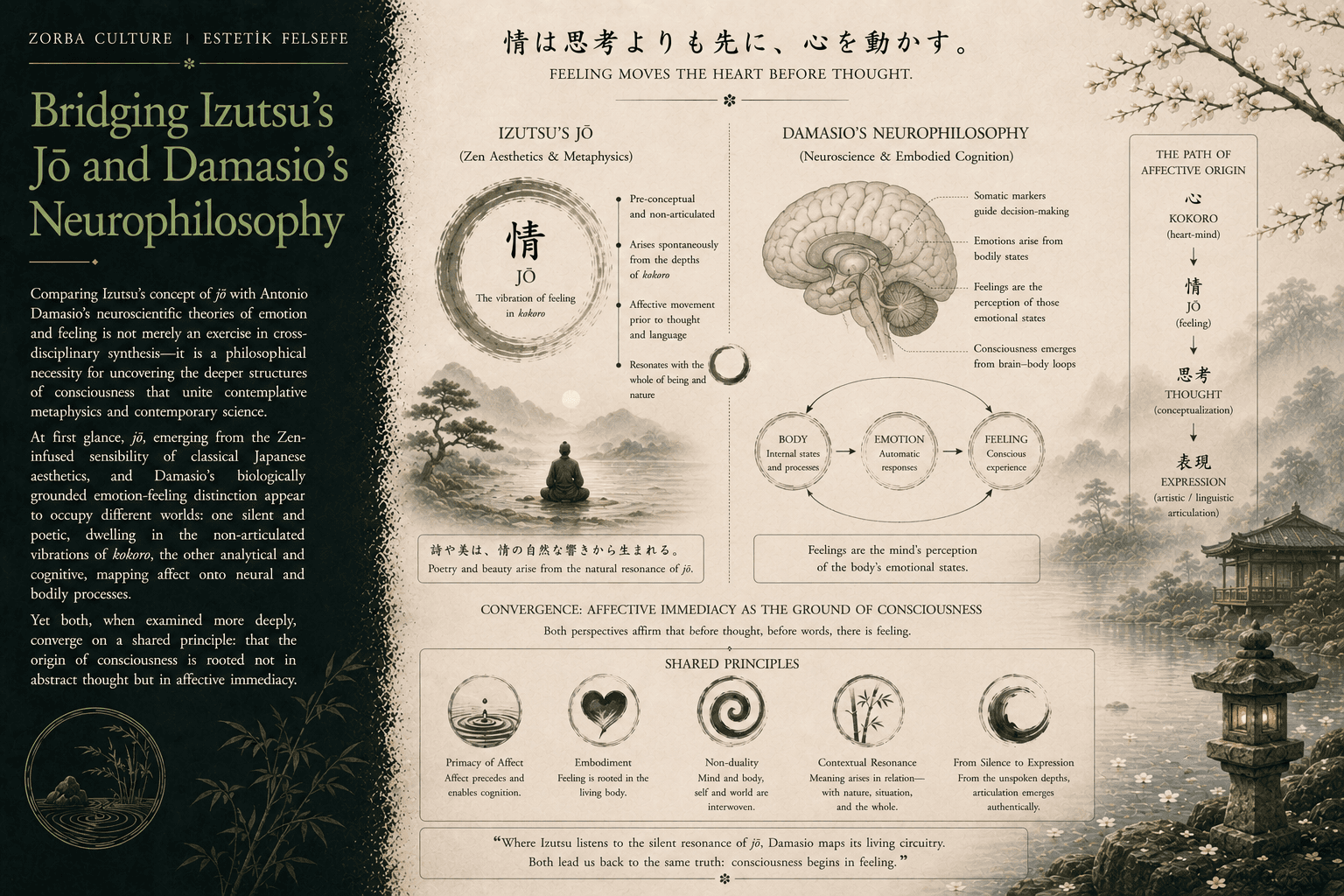
Comparing Izutsu’s concept of jō with Antonio Damasio’s neuroscientific theories of emotion and feeling is not merely an exercise in cross-disciplinary synthesis -it is a philosophical necessity for uncovering the deeper structures of consciousness that unite contemplative metaphysics and contemporary science. At first glance, jō, emerging from the Zen-infused sensibility of classical Japanese aesthetics, and Damasio’s biologically grounded emotion-feeling distinction appear to occupy different worlds: one silent and poetic, dwelling in the non-articulated vibrations of kokoro, the other analytical and cognitive, mapping affect onto neural and bodily processes. Yet both, when examined more deeply, converge on a shared principle: that the origin of consciousness is rooted not in abstract thought but in affective immediacy. Jō expresses a non-conceptual, pre-reflective awareness of the world as it is -an ontological openness where emotion is not a response to an external object, but a co-arising with it, much like Damasio’s description of feeling as the brain’s registration of the body’s emotive state. This alignment suggests that Zen’s intuition of consciousness as a field of dynamic resonance is not a mystical abstraction but an early formulation of what neuroscience increasingly confirms -that feeling precedes cognition, and that the self is born not through detached thinking, but through embodied affective presence. To compare jō and Damasio’s model is to bridge centuries and paradigms, revealing that the heart of Zen -a silent awareness inseparable from the world- is not so far from the neurological insights into how the brain feels the body into being. This dialogue discloses not only the compatibility between Eastern and Western approaches, but a more universal structure of consciousness in which feeling is both origin and expression of the self’s becoming.
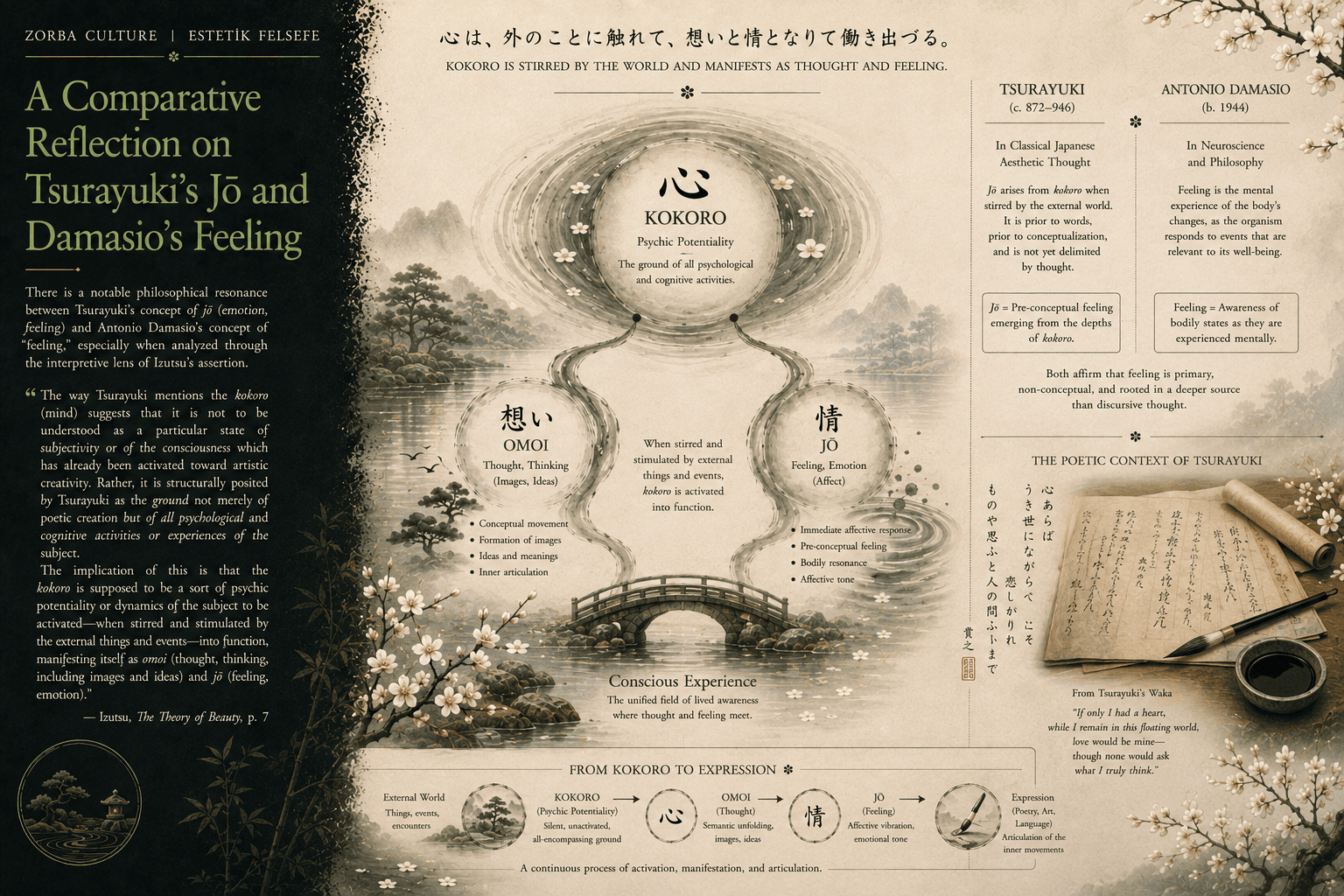
In the metaphysical aesthetics of classical Japan, as interpreted by Izutsu, jō signifies an immediate and affective manifestation of kokoro -the total interiority of consciousness. It emerges not as a discrete psychological function but as a pure vibration of being, resonant with the natural world and expressive of the non-articulated dimension of experience. In contrast, Antonio Damasio, a contemporary neuroscientist and philosopher of mind, proposes a biologically grounded model of emotion and feeling, distinguishing the former as automatic bodily responses and the latter as conscious perceptions of those bodily states. While these systems emerge from distinct philosophical and cultural contexts -classical Japanese metaphysics and contemporary neurobiology- they both probe the subtleties of affective life and the interdependence of body, mind, and consciousness.
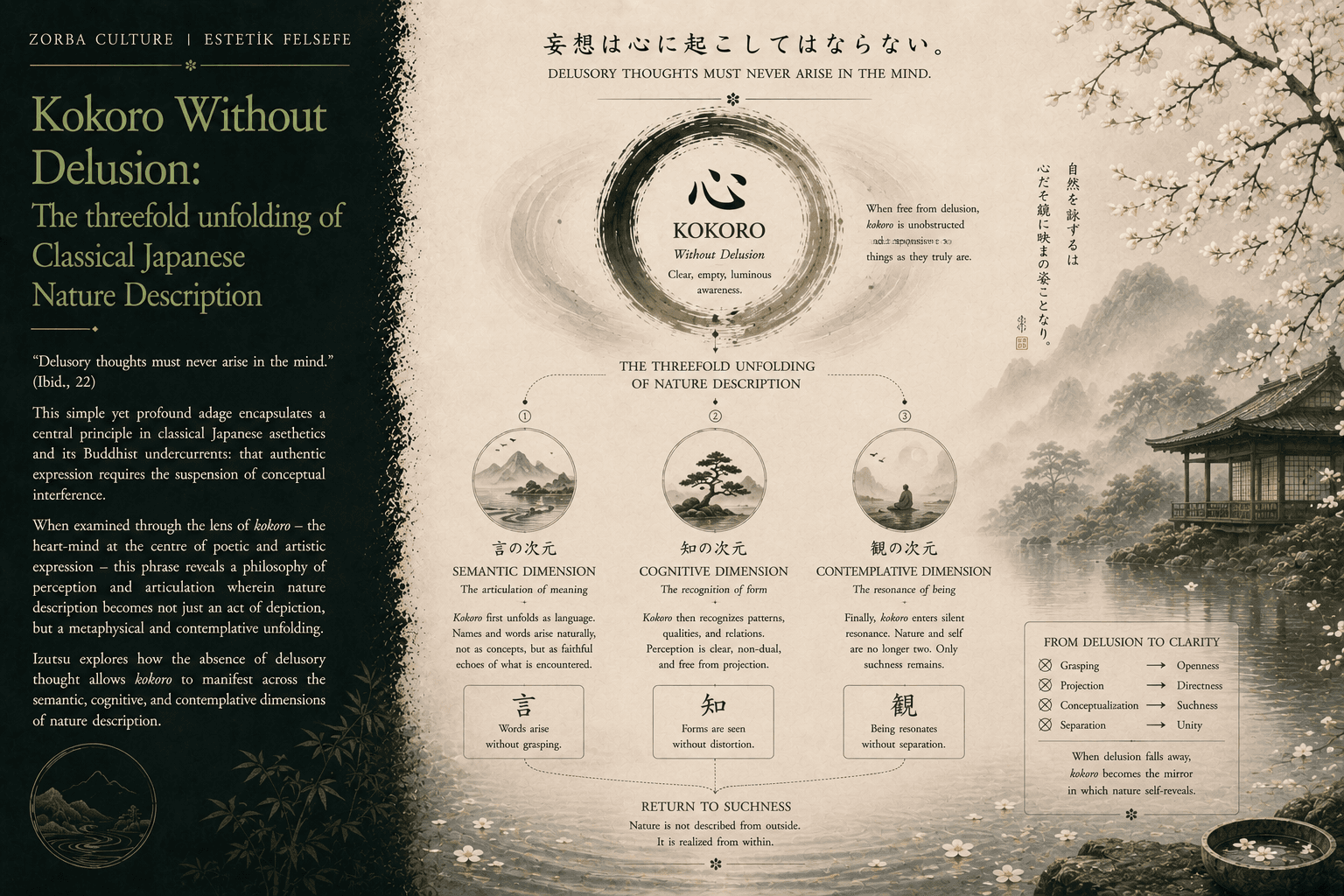
In Izutsu’s reading of classical Japanese texts, jō is not a psychological category but a metaphysical phenomenon. It arises spontaneously and immediately from kokoro, often in response to the subtle rhythms of nature or the fleeting conditions of existence. Jō is thus not something generated by discursive cognition but something felt in the core of being -a quiet trembling of consciousness (ishiki) before it is semantically or linguistically articulated.
This pre-conceptual dimension of jō places it within what Izutsu calls the “non-articulated whole”, a field of metaphysical immediacy where the subject is not yet separated from the world. Jō is, therefore, not a signal of psychological selfhood, but an expression of resonance, of being-tuned-to the pathos of the world -aware. It is deeply aesthetic, ethical, and ontological at once.
In contrast, Damasio begins from a biological foundation. He distinguishes emotion as a set of unconscious, automatic responses of the organism to external or internal stimuli, expressed through bodily changes such as heart rate, facial expressions, or hormone release. These responses occur largely below the threshold of awareness.
Feelings, in Damasio’s framework, are the mental representations of those emotional states, arising when the brain becomes aware of the body’s emotional responses. In other words, feelings are emotions that have entered consciousness. They are “read-outs” of the body by the mind and thus form the substrate of conscious experience and, ultimately, of rational thought and self-awareness. Damasio traces a development arc: beginning with raw bodily emotion, unfolding into conscious feeling, and culmination in higher cognitive functions such as decision-making and reflective selfhood.
One of the most crucial differences lies in the locus of affectivity. For Damasio, emotion originates in the body and is later represented in the mind as feeling. It is a neurochemical, homeostatic reaction. For Izutsu, and the Japanese tradition he interprets, jō originates in the kokoro, which is neither brain nor body, but a metaphysical centre that unites the subjective and the cosmic. In this view, jō is not a reaction to the world but a resonance with it -it is ontologically relational, not mechanistically responsive.
Furthermore, Damasio treats emotion as largely pre-conscious and utilitarian, aimed at survival, whereas jō is aesthetic and contemplative, aimed at existential attunement. The falling of cherry blossoms does not trigger jō as an adaptive emotional response but evokes it as a participation in impermanence. Jō, then, is not affective response but affective presence.
Yet, there are affinities between jō and Damasio’s notion of feeling -especially his later view that feelings form the basis of primordial consciousness. In The Feeling of What Happens, Damasio argues that the sense of self arises from the brain's ability to map emotional responses and form a first-person perspective. Feelings are not just signals of the body but the very fabric of consciousness, the condition for knowing that one exists.
This metaphysical function of feeling draws closer to jō in Izutsu’s vision: both are non-discursive, pre-linguistic forms of knowing. When Izutsu describes jō as a trembling of kokoro in response to the impermanent beauty of the world, he is not far from Damasio’s idea that feeling is a form of proto-cognition, a way in which the organism begins to be aware of itself as part of a world. Both views emphasize non-reflective self-manifestation—Damasio from a neurobiological angle, Izutsu from a contemplative one.
However, where Damasio moves from feeling to rational cognition and narrative selfhood, Izutsu insists on returning to the pre-conceptual, where the truth of beauty and being lies in the unspoken. Thus, while Damasio's feelings are developmental stages toward complex thought, jō is an end in itself, not a precursor to reason but a completion of awareness in aesthetic immediacy.
From the Izutsian perspective, jō lacks inner semantic articulation. It is felt, not thought; present, not conceptualized. In contrast, Damasio’s feelings are articulated, insofar as they are structured representations of bodily states. This difference underlines a profound metaphysical divergence: Damasio sees consciousness as a representational construct, layered and evolving. Izutsu sees consciousness (and by extension, jō) as a direct emanation of being, prior to all representation.
In this sense, Izutsu’s jō is aligned with yūgen -the mysterious, ineffable essence that is beautiful precisely because it resists articulation. It is not to be named, defined, or expressed fully, because its truth lies in its silence. Damasio’s feeling, conversely, gains meaning through articulation -by becoming part of the narrative structure of the mind.
The difference between jō and Damasio’s emotion/feeling reflects two different understandings of human subjectivity. In Damasio, we see an emergent, evolutionary model of mind, grounded in the physiology of the body and ascending toward conscious thought. In Izutsu’s reading of Japanese aesthetics, jō is a metaphysical pulse, an immediate affective knowing that unites the subject with the world in silent resonance. Where Damasio explains the becoming of the mind, Izutsu reveals the being of the heart.
Both thinkers illuminate aspects of affective life -Damasio through the biological structuring of feeling, Izutsu through the aesthetic resonance of feeling. And yet, perhaps they are not opposites but complements: Damasio shows how we come to feel, while Izutsu shows how feeling becomes beauty.