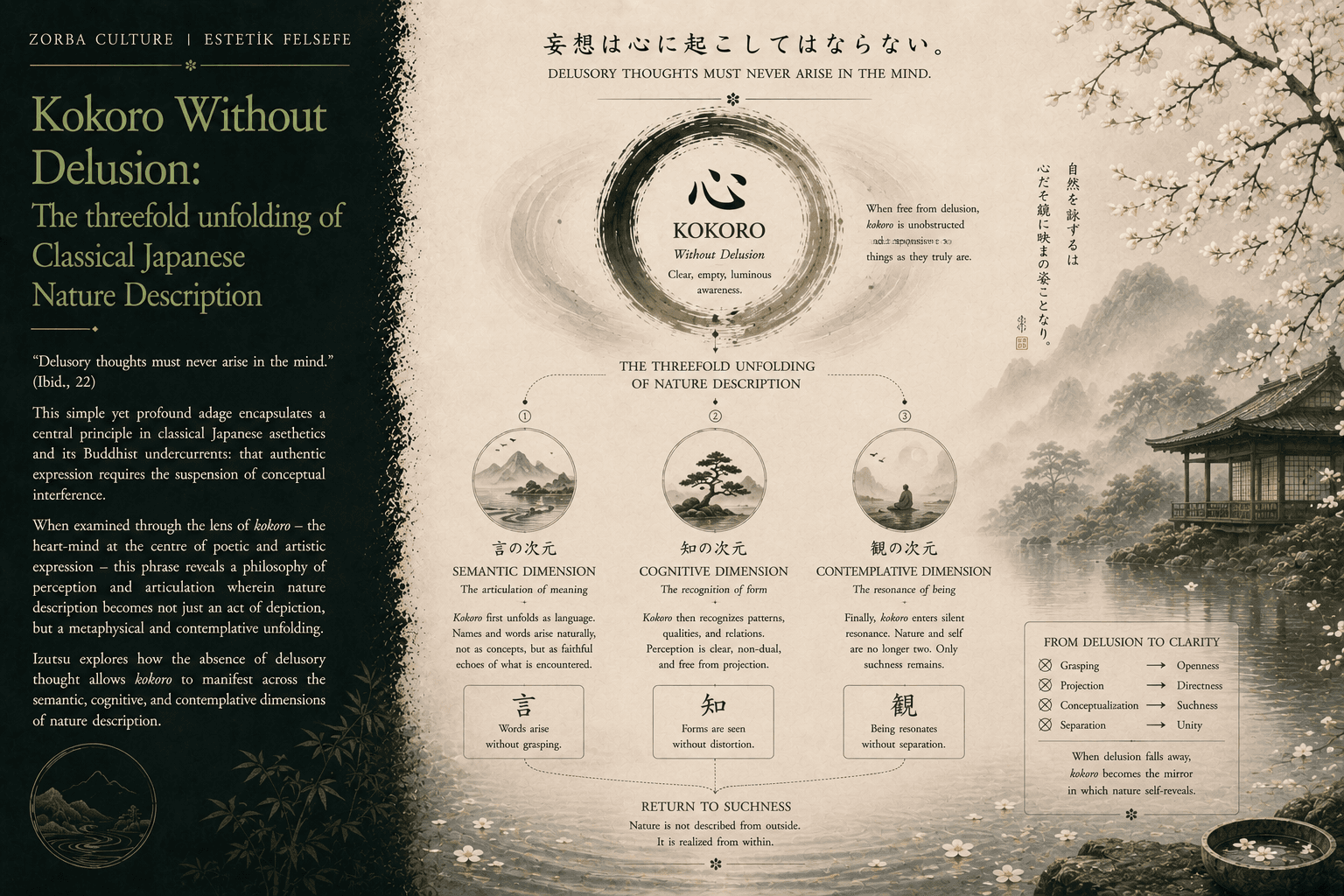
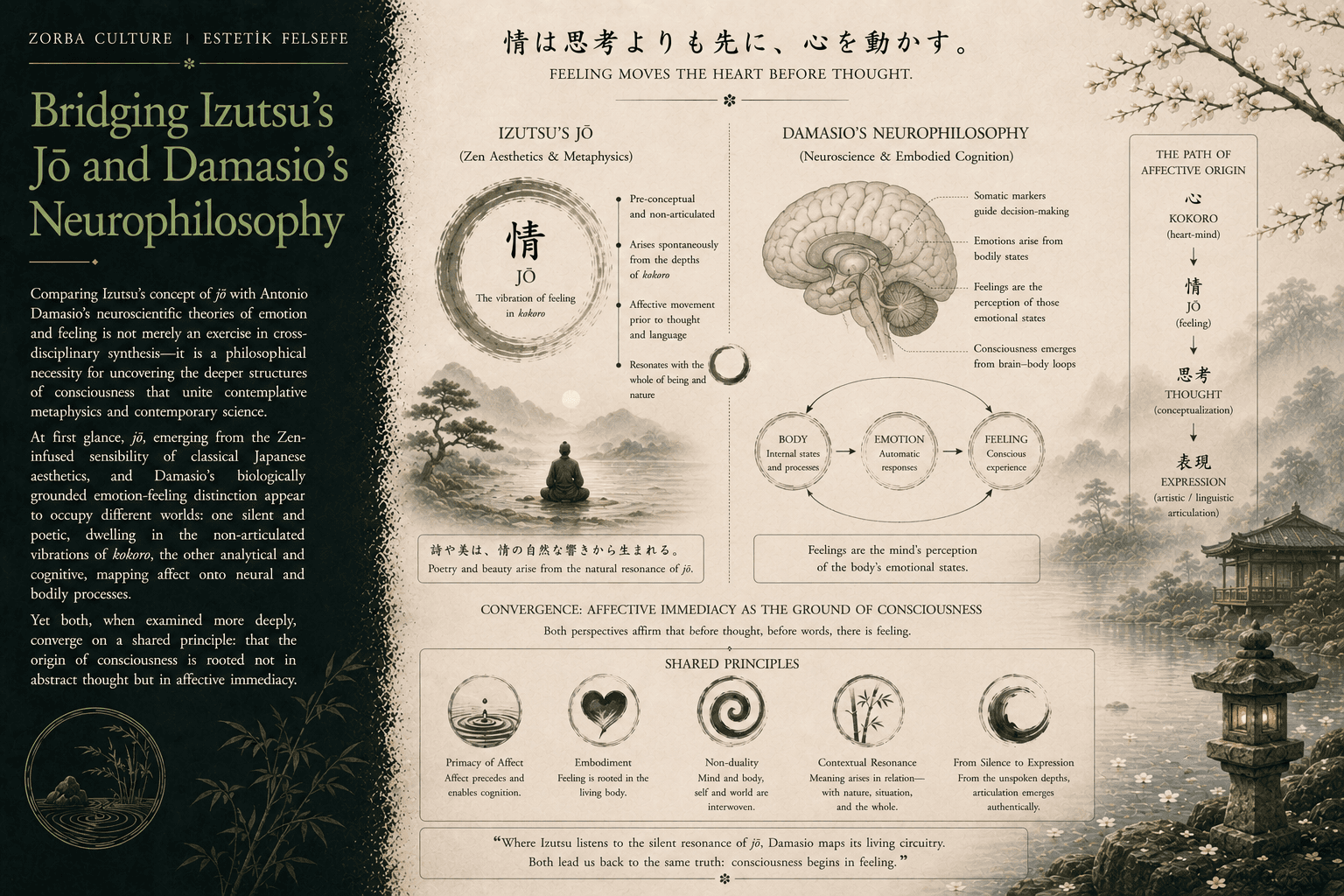
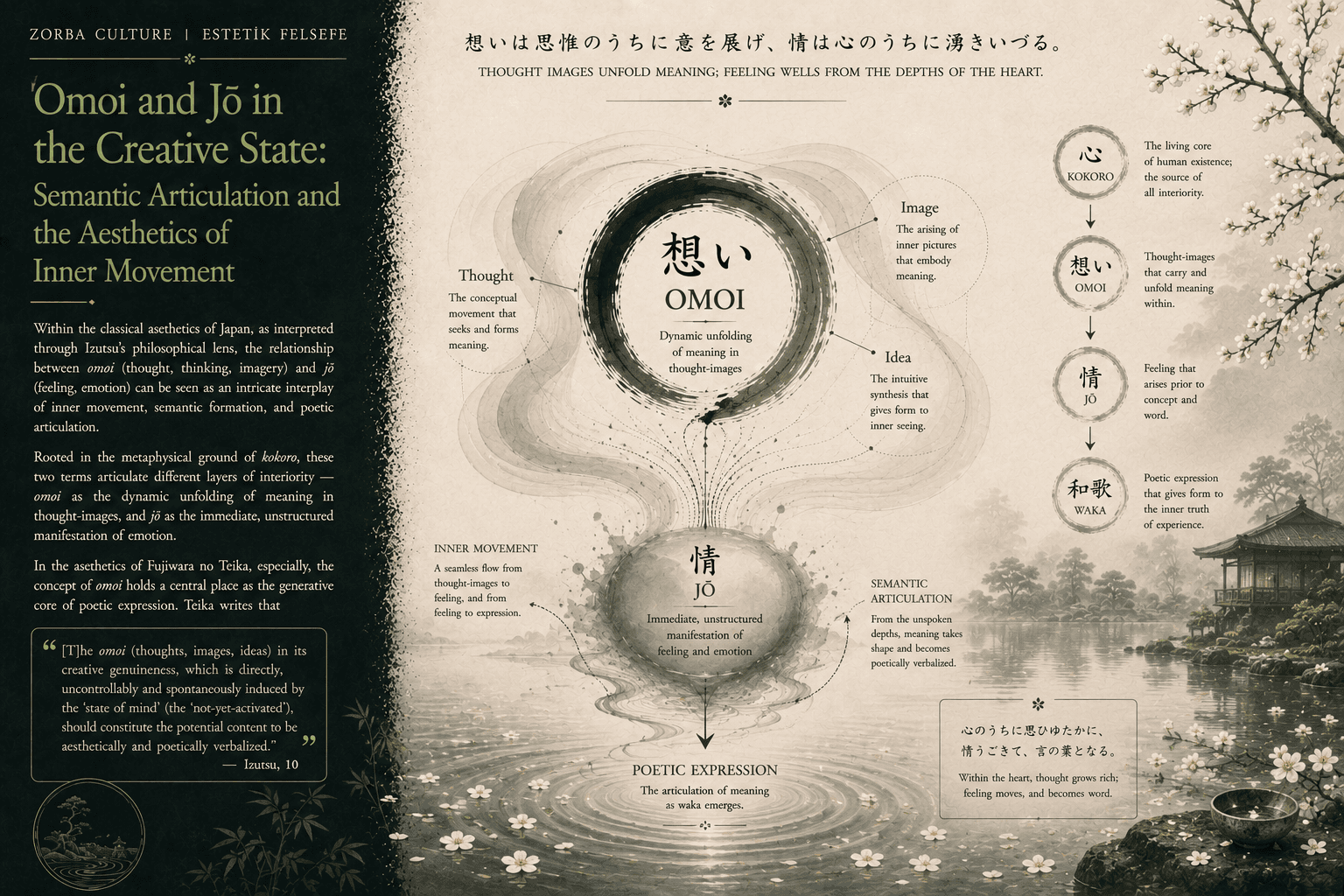
“Delusory thoughts must never arise in the mind.” (Ibid., 22)
This simple yet profound adage encapsulates a central principle in classical Japanese aesthetics and its Buddhist undercurrents: that authentic expression requires the suspension of conceptual interference. When examined through the lens of kokoro -the heart-mind at the centre of poetic and artistic expression - this phrase reveals a philosophy of perception and articulation wherein nature description becomes not just an act of depiction, but a metaphysical and contemplative unfolding. Izutsu explores how the absence of delusory thought allows kokoro to manifest across the semantic, cognitive, and contemplative dimensions of nature description.
In the classical Japanese worldview, particularly as expressed in waka, haiku, and Zen-influenced arts, the description of nature (shizen) is never merely objective or representational. It is a mode of expressing kokoro -the creative subjectivity that resonates with the rhythms of the external world. This resonance is not metaphorical but ontological: kokoro and nature are understood to co-arise, to echo each other in a seamless field of mutual expression.
However, the transmission of kokoro into form requires a particular quality of mind: one that is unclouded by ego, conceptualization, or aesthetic will. This is the ethical-aesthetic imperative implied by the statement “Delusory thoughts must never arise in the mind.” Delusory thoughts are not simply incorrect ideas; they are projections, impositions, or internal commentaries that distort the immediacy of experience. Their absence becomes the necessary condition for authentic poetic and artistic expression.
From a semantic perspective, the principle of non-delusory awareness manifests in the economy and precision of classical Japanese poetic language. Unlike philosophical or analytical discourse, Japanese poetic language does not aim to define or explain. It gestures, evokes, and dissolves into the resonance it creates.
Words such as yūgure (evening dusk), kawa (river), or hana (flower) are never purely denotative; they carry a latent emotional and spiritual density that is only unlocked in the context of a mind attuned to kokoro. When delusory thought is absent, language ceases to be a means of assertion and becomes a vehicle of transparency. Izutsu, reflecting on Zen and Shinto aesthetics, emphasizes this linguistic subtlety as a form of “semantic emptiness” -where meaning emerges not through imposed structure, but through an open field of association grounded in lived immediacy.
In this way, nature description is not an act of naming but of participation. The mountain is not “described” as much as it is allowed to appear through the poet’s purified language. Semantic unfolding thus becomes a spiritual discipline in itself: the restraint of language becomes the gateway for truth to shine through.
The cognitive implications of “delusory thoughts” are even more radical. In both Buddhist and Zen frameworks, delusion arises through the mind’s habit of dualistic structuring -subject versus object, self versus other, mind versus world. The phrase under consideration implies a shift in cognition from analytic grasping to intuitive union.
In the Japanese tradition, especially under Zen influence, cognition is ideally transformed into chokkan, or direct intuition. Here, the observer does not “stand before” the object of description but is dissolved into it. This cognitive mode does not negate perception or understanding but purifies them of conceptual residue. The poet does not think about the plum blossom but experiences the world as the plum blossom. This is a knowing beyond the dichotomy of knower and known.
Nature description in this light is not the record of an observation; it is a cognitive event where the boundary between the world and kokoro becomes porous. The mountain, the wind, and the poet are no longer discrete. Their unity is not metaphorical -it is real, enacted in and through the suspension of delusory cognition.
Finally, the contemplative unfolding of nature description occurs when the mind enters a state of profound stillness -mushin, or “no-mind”- a term used in both Zen and aesthetics to describe the condition of awareness that is free from grasping or interference. In this state, nature is not only observed but encountered as sacred presence.
The falling of a leaf, the sound of rain, the quiet of snow on moss -these become epiphanic events, revealing the suchness of the world. Contemplative awareness does not seek beauty; it finds itself inside beauty when delusion falls away. This is the aesthetic equivalent of satori, a sudden seeing-into the real. Nature description, at its highest expression, becomes a form of contemplative practice in which kokoro is not expressed through nature but as nature.
This, Izutsu would argue, is the metaphysical ground of Japanese aesthetics: the spontaneous manifestation of the Real through a mind that has ceased to project, name, or differentiate. Delusory thoughts are not merely distractions -they are obstacles to truth. Their absence opens the field in which being can be intuited, beauty can be revealed, and kokoro can resonate without obstruction.
To say that “Delusory thoughts must never arise in the mind” is not to call for a suppression of thought, but for its refinement. The phrase outlines a path—semantic, cognitive, and contemplative—by which language, perception, and awareness are emptied of falsity and made transparent to the Real.
In the tradition of Japanese nature description, this transparency is the condition for beauty. The world reveals itself when the mind no longer grasps at it. The poet, the painter, the contemplative—each becomes a silent conduit through which kokoro flows into the world and the world flows into kokoro. What results is not a representation of nature, but its living expression.
In this mutual unfolding, beauty is not created; it is discovered. And in that discovery, the self disappears.
In waka, the world breathes through words; in Noh, those words take on flesh. The poetic mind does not end with the written line -it continues, transformed, in gesture and stillness. In Noh theatre, language becomes movement, and presence is shaped by absence. Here, the aesthetic becomes incarnate: not to display, but to disappear in rhythm. What was evoked in the poem now steps into the space of sacred time, where silence is no longer the background—but the very form.