Contemplation in Western and Japanese Thought
Contemplation is a central practice in both Western and Eastern traditions, yet its nature and function vary profoundly across cultures.
Contemplation is a central practice in both Western and Eastern traditions, yet its nature and function vary profoundly across cultures.

Contemplation is a central practice in both Western and Eastern traditions, yet its nature and function vary profoundly across cultures. In Western thought, contemplation often implies a subject contemplating an object -a dualistic structure that assumes a separation between the thinker and the thing being thought about. In contrast, Japanese thought, particularly as expressed through Zen and classical aesthetics, approaches contemplation as an immersive, non-dual act of presence. Through the lens of Izutsu’s The Theory of Beauty in the Classical Aesthetics of Japan, we can more deeply understand how these differing philosophical foundations shape distinct conceptions of beauty, presence, and the contemplative experience.
At the heart of the difference lies the issue of subject-object dualism. In much of Western philosophy, from Plato to Descartes, the contemplative act is one of intellectual engagement -where the mind seeks to understand, categorize, or master its object. The subject stands apart from the object, creating a space of reflection in which thought operates. This mode of contemplation is linear and goal-oriented, often aiming to reach clarity, insight, or truth.
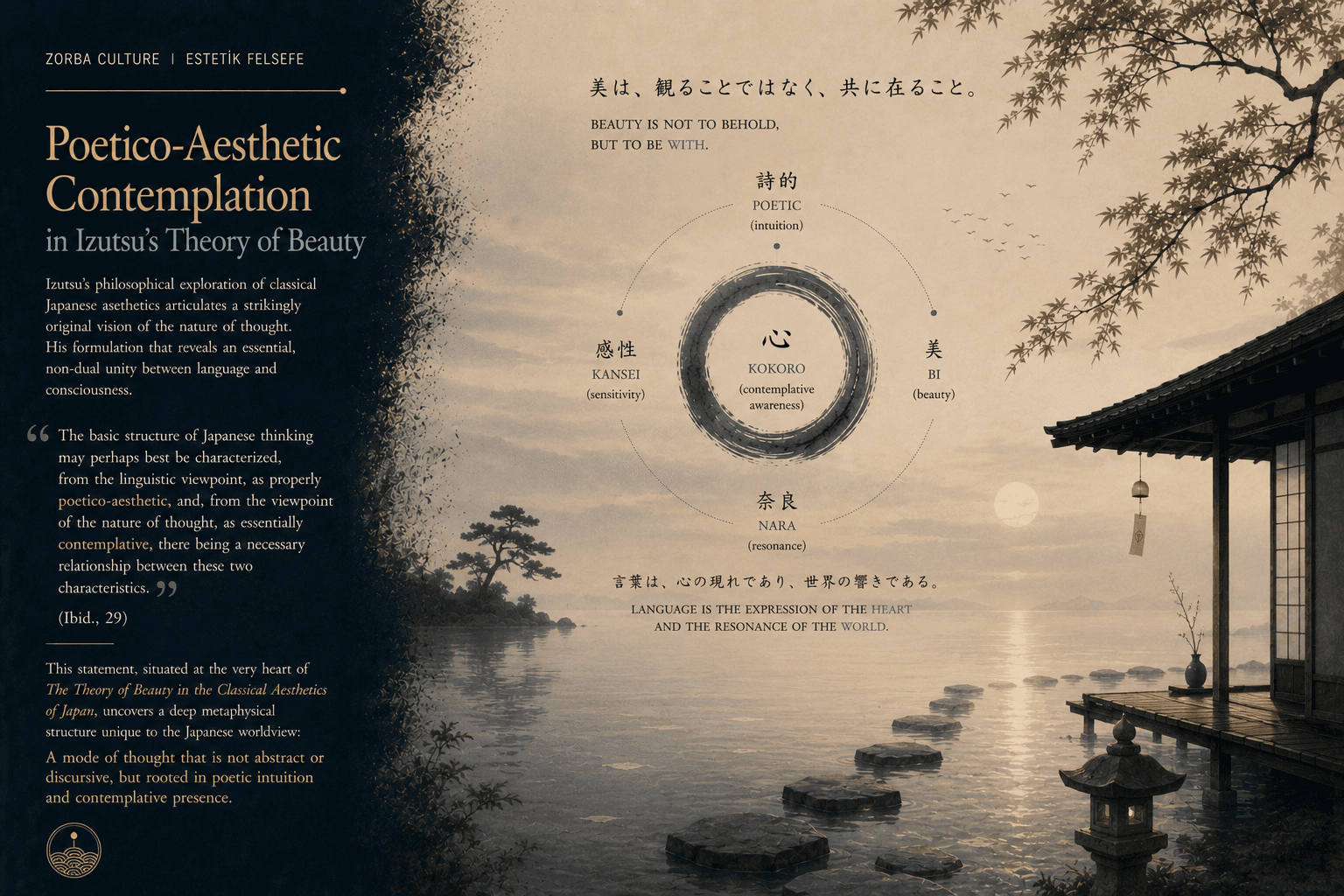
By contrast, Japanese aesthetics, as Izutsu argues, arise from a fundamentally non-dualistic worldview. Rooted in Zen, the act of contemplation dissolves the boundary between observer and observed. The flower is not something to be examined from a distance, but something to be with. Contemplation is not about thinking about the flower, but being present with it. This experiential immediacy reflects the Zen principle of direct, unmediated awareness, where self and world co-arise in the moment of perception. Beauty, in this framework, is not a quality of the object, but an event that occurs in the shared field of presence between the contemplator and the contemplated.
This non-dual mode of perception finds its aesthetic expression in the Japanese concept of ma—the pause, the interval, or the empty space that is charged with meaning. In Western art and philosophy, space and time are often conceived as empty containers for action and form. Absence is generally understood as a lack or deficiency. In Japanese thought, however, ma is a presence in itself. It is not merely the absence of sound or movement but a potent stillness in which meaning can emerge. Izutsu emphasizes that ma is central to Japanese beauty: it is within these intervals, these silences, that the most profound aesthetic experiences arise. The contemplative act, then, is not linear or analytical, but receptive and open-ended—allowing space to speak in its own quiet language.
Izutsu’s theory also highlights the difference between representation and suggestion in aesthetic traditions. Western aesthetics has long emphasized clarity, form, and completeness. Beauty is something that can be represented, grasped, and appreciated through intellectual discernment. In Japanese classical aesthetics, however, beauty often resides in the suggestive and the incomplete. Concepts such as yūgen (mysterious depth), wabi (simple, austere beauty), and sabi (the beauty of age and imperfection) all point toward a preference for ambiguity, subtlety, and evanescence. The beauty lies not in what is fully revealed, but in what is hinted at and left unsaid. This aesthetic sensibility aligns with a contemplative mode that is less about understanding and more about resonating—less about grasping, and more about being moved.
In this light, time itself is experienced differently. Western contemplation tends to unfold through sequential reasoning or emotional progression. In the Japanese context, time is not linear but momentary and cyclical -something to dwell in, rather than to move through. As Izutsu notes, the temporality of beauty in Japanese aesthetics is bound to the moment of encounter, where stillness and motion, presence and absence, come together in a single aesthetic flash. Contemplation becomes an art of attunement to the moment, where even the pause in a Noh performance or the blank space in a scroll painting holds more weight than the action or form itself.
Ultimately, what emerges from Izutsu’s interpretation is a vision of contemplation not as a form of intellectual mastery, but as a mode of being -non-dual, receptive, and in harmony with the world. Beauty is not something one finds, but something one enters into. The contrast with Western thought, where contemplation often seeks knowledge or transcendence through the power of thought, could not be more pronounced.
Thus, to contemplate in the Western sense is often to reflect from a distance; to contemplate in the Japanese sense, particularly through Zen aesthetics as described by Izutsu, is to dissolve that distance and become the moment. The flower, the space, the pause -each becomes a portal into presence. In that presence, beauty unfolds—not as a thing to be known, but as a moment to be lived.
To think, in this tradition, is already to begin to speak -but not in the voice of argument or definition. Rather, it is the voice of suggestion, of echo, of rhythmic emergence. The Japanese way of thinking finds its natural articulation not in discursive clarity, but in poetic form. In waka, thought takes on the texture of feeling, the temporality of nature, and the silence of the unspoken. Language does not represent the world—it moves with it.