Waka-Chapter III
Waka
Waka

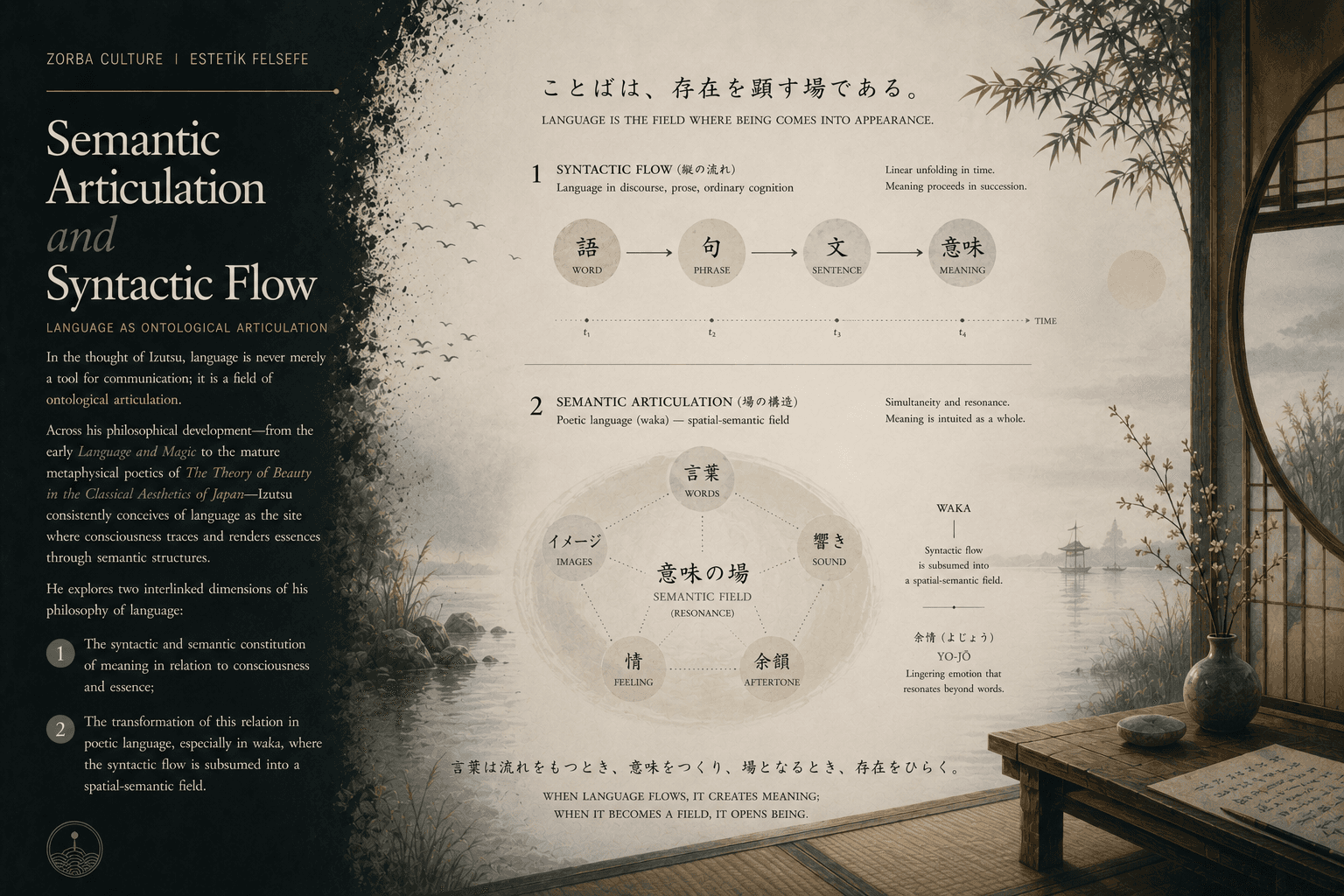
Synopsys: With the metaphysical and cognitive foundations firmly laid, this chapter turns to their first major instantiation: the classical poetic form of waka. The analysis moves beyond literary criticism into the realm of the philosophy of language, positing waka as a deliberate metaphysical operation on language itself. Izutsu’s revolutionary insight is that waka subverts the ordinary, linear function of language. Where prose and discourse unfold syntactically in time, waka seeks to collapse this temporal succession into a synchronic “semantic field.” In this field, all words and images resonate simultaneously, creating a dense lattice of meaning that is absorbed all at once, much like a visual painting.
This poetic achievement is governed by a precise internal mechanism, which this chapter elucidates through the triadic structure of Kokoro-Omoi-Kotoba. The process begins in the Kokoro—the silent, not-yet-activated ground of the heart-mind. From this ground stirs Omoi, the pre-verbal movement of thought-imagery, the inner semantic substance before it is cast into form. This Omoi is then actualized as Kotoba, the external, articulated word. The supreme aesthetic value of ushin (“with-heart”) is achieved only when the Kotoba remains perfectly transparent to the depth of the Omoi and the silence of the Kokoro. The result is yo-jō, a “lingering emotion” that continues to reverberate in the reader’s mind long after the words have been read. This chapter, therefore, presents waka not as a vehicle for expressing pre-formed emotions, but as a linguistic technology for creating a ontological event—a momentary opening where the Non-Articulated Whole shimmers through the delicate fabric of articulated language.