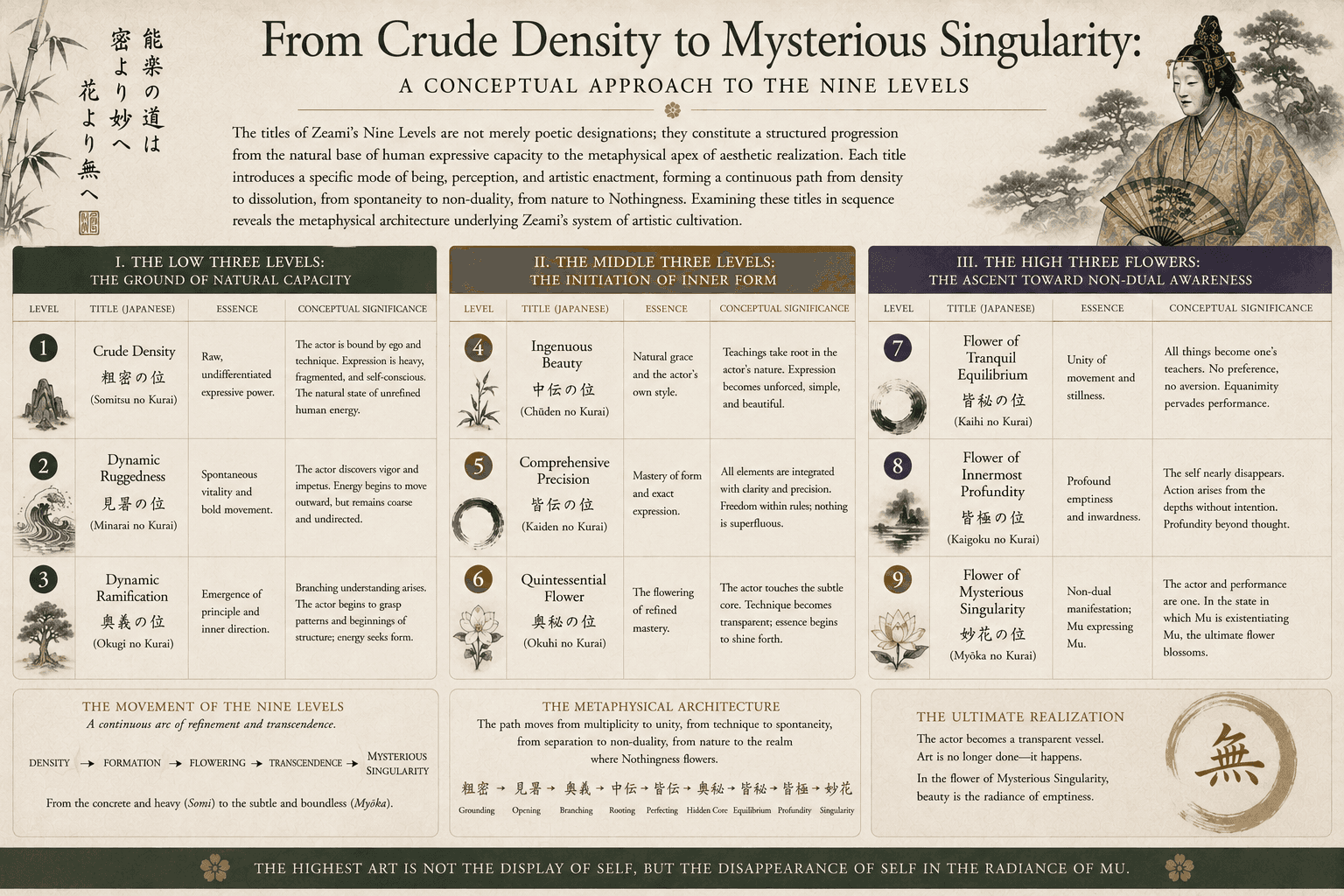
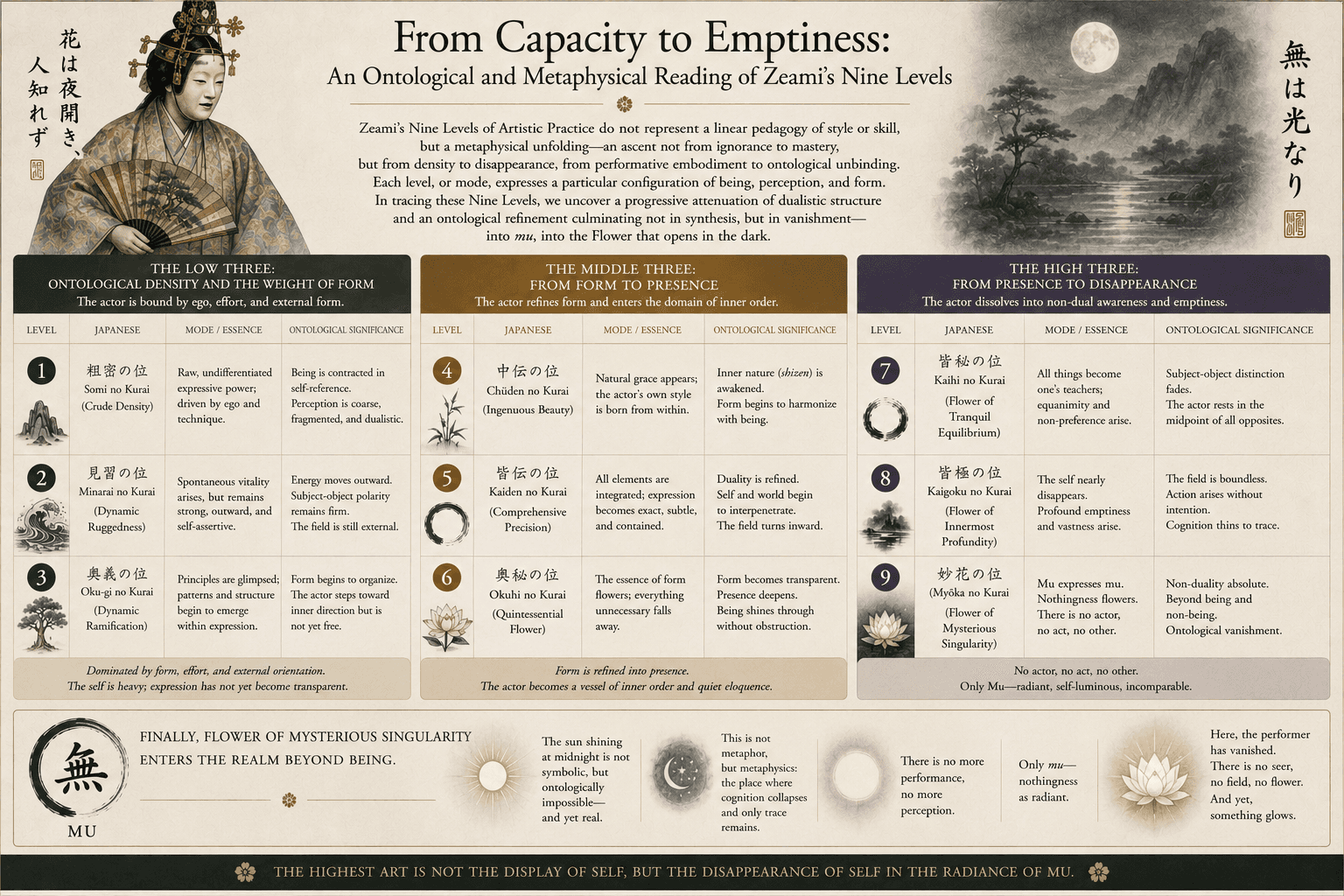
The titles of Zeami’s Nine Levels are not merely poetic designations; they constitute a structured progression from the natural base of human expressive capacity to the metaphysical apex of aesthetic realization. Each title introduces a specific mode of being, perception, and artistic enactment, forming a continuous path from density to dissolution, from spontaneity to non-duality, from nature to Nothingness. Examining these titles in sequence reveals the metaphysical architecture underlying Zeami’s system of artistic cultivation.
I. The Low Three Levels: The Ground of Natural Capacity
1. Crude Density
The first level begins with “density,” which implies not just coarseness, but a lack of differentiation. The term suggests the presence of something substantial, yet unrefined and undirected. “Crude” reinforces this understanding as an undisciplined and pre-formal state of potential. It is the most elementary level of expressive capacity, prior to intentional form or technique.
2. Dynamic Ruggedness
The second title introduces “dynamic,” indicating movement and activity. What was previously inert now becomes animated. “Ruggedness” retains the quality of being untamed and structurally unresolved. Together, the title points to energetic expression that remains unshaped by any organizing principle. It is movement without integration.
3. Dynamic Ramification
Here, “dynamic” is retained, but “ruggedness” is replaced with “ramification.” Ramification implies branching, structuring, and the articulation of parts. While still rooted in motion, this level introduces technical elaboration and complexity. The focus shifts from pure energy to the patterned deployment of energy. However, the structure remains external, not yet linked to interior consciousness.
II. The Middle Three Levels: The Initiation of Inner Form
4. Ingenuous Beauty
This title marks a shift. “Ingenuous” refers to uncalculated naturalness—without guile or constructed form. The term points toward a kind of internal openness or purity, distinct from the instinctive spontaneity of the lower levels. “Beauty” appears here for the first time in the system, indicating the emergence of aesthetic value grounded not in form but in unselfconscious presence. The level is transitional: it retains a lack of self-awareness but now serves as the beginning of a discipline directed toward refinement. It is here that yūgen, though not yet named, first stirs—an incipient, translucent radiance that will fully unfold in the later levels..
5. Comprehensive Precision
At this level, “precision” denotes technical mastery; “comprehensive” adds the dimension of totality or completeness. Together, they suggest the performer has attained full command of technique across all aspects of the art. However, the emphasis remains on an exhaustive formal mastery rather than on inner transformation. It represents the culmination of conscious technical development and an expansion of awareness across the performative field.
6. Quintessential Flower
The term “flower” –hana- appears for the first time in the Nine Levels system here. “Quintessential” implies that the flower being referred to is not transient or superficial, but essential and foundational. This title marks a shift from external form to something metaphysically grounded. The flower, in Zeami’s usage, denotes the emanation of a presence that exceeds technique, yet arises from within it. It is not just aesthetic surface, but the beginning of symbolic and contemplative realization.
III. The High Three Flowers: The Ascent toward Non-Dual Awareness
7. Flower of Tranquil Equilibrium
The title introduces “tranquillity” and “equilibrium.” These terms imply a cessation of oppositional activity and a balancing of internal and external conditions. The “flower” here emerges within stillness—not through motion or expression. The title denotes a state in which dualities (subject-object, self-other) are no longer dominant, and the aesthetic presence is characterized by harmonious stasis. It suggests the convergence of the contemplative field and the contemplative awareness into an integrated reflective condition.
8. Flower of Innermost Profundity
This level centers around “profundity,” specifically that which is innermost or concealed. The term yūgen appears explicitly here for the first time, though its subtle presence has been gestating since the middle triad. Here it reaches ontological depth—yūgen not as suggestion, but as the hidden core of reality. In Zeami’s writings, yūgen denotes a depth that is not accessible to ordinary consciousness —an aesthetic quality linked to hiddenness, ambiguity, and metaphysical resonance. The flower here is not radiant or balanced, but opaque, withdrawing. The title suggests an inner descent, where opposites such as being and non-being begin to lose their distinctness.
9. Flower of Mysterious Singularity
The final title refers to “mystery” and “singularity.” “Mysterious” implies that which is beyond conceptual grasp; “singular” implies the eradication of multiplicity. The “flower” here no longer blooms in relation to form, emotion, or even stillness, but in a non-dual register that abolishes distinctions entirely. The title indicates the point where differentiation collapses and the aesthetic presence is no longer derived from technique, form, emotion, or even contemplation. What remains is neither “being” nor “non-being,” but the indivisible field in which both are transcended -corresponding to the notion of mu.
The sequence of titles maps a coherent transformation. The initial three levels remain within the domain of expressive energy and external skill, describing degrees of movement and elaboration. The middle three introduce inwardness, first as naïve purity, then as mastery, and finally as symbolic presence. The last three enact a progressive reduction of differentiation -first through balance, then through ambiguity, and ultimately through the dissolution of opposites.
The titles themselves do not describe actions, techniques, or emotions; rather, they designate states of being -ontological positions within the performer’s relationship to form, presence, and consciousness. From the initial density of bodily instinct to the mysterious singularity of unmediated manifestation, the titles trace a path not merely of artistic development, but of metaphysical transformation. The path from nature to Nothingness is thus inscribed in the very naming of the Nine Levels.
Where Noh elevates the moment into symbolic gesture, the Way of Tea brings gesture down to earth -into the hushed simplicity of boiling water, arranging flowers, offering a bowl. Yet both arise from the same aesthetic soil: a reverence for stillness, for the unseen, and for the fleeting beauty of form shaped by emptiness. In chadō, performance becomes hospitality, and art becomes life.