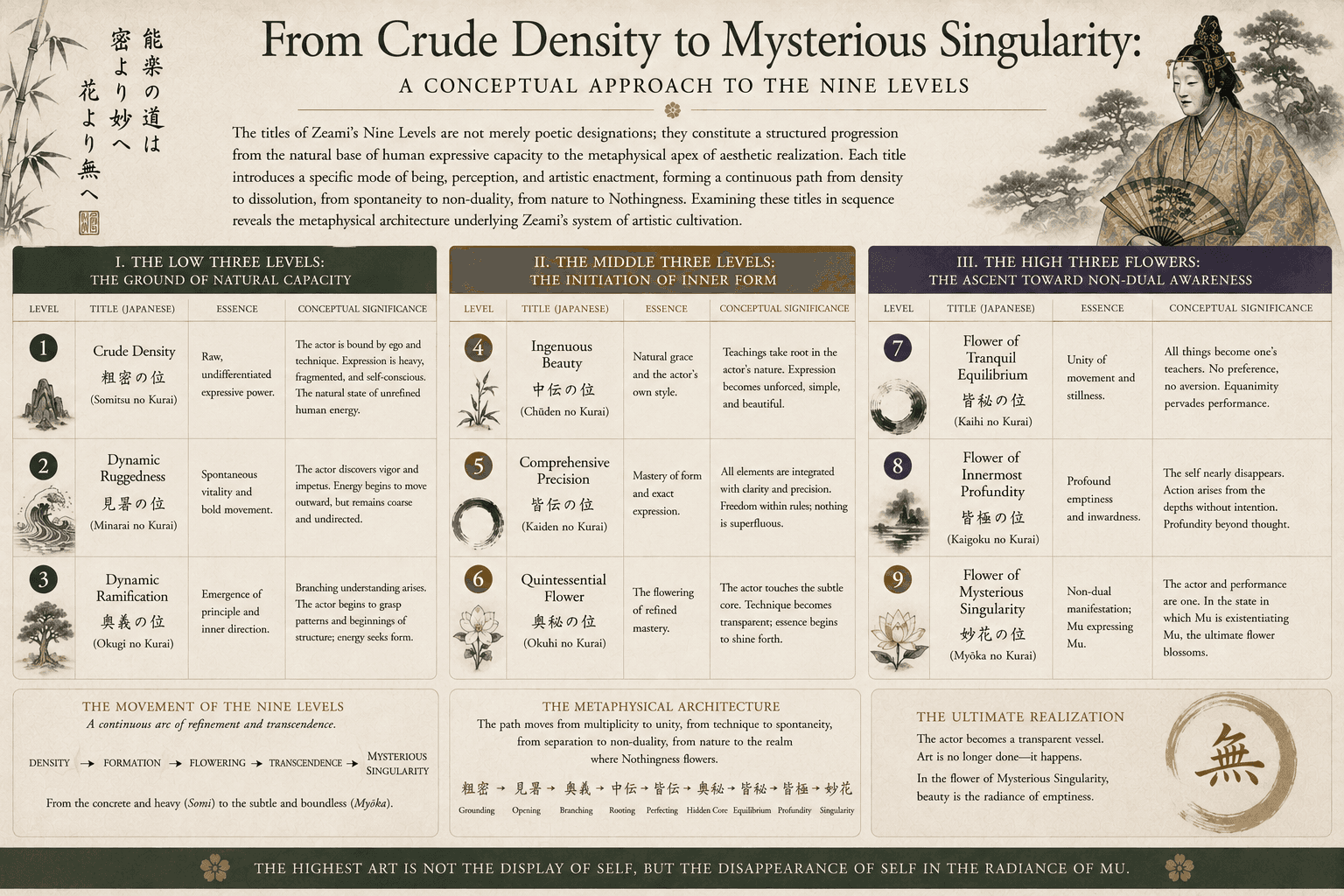
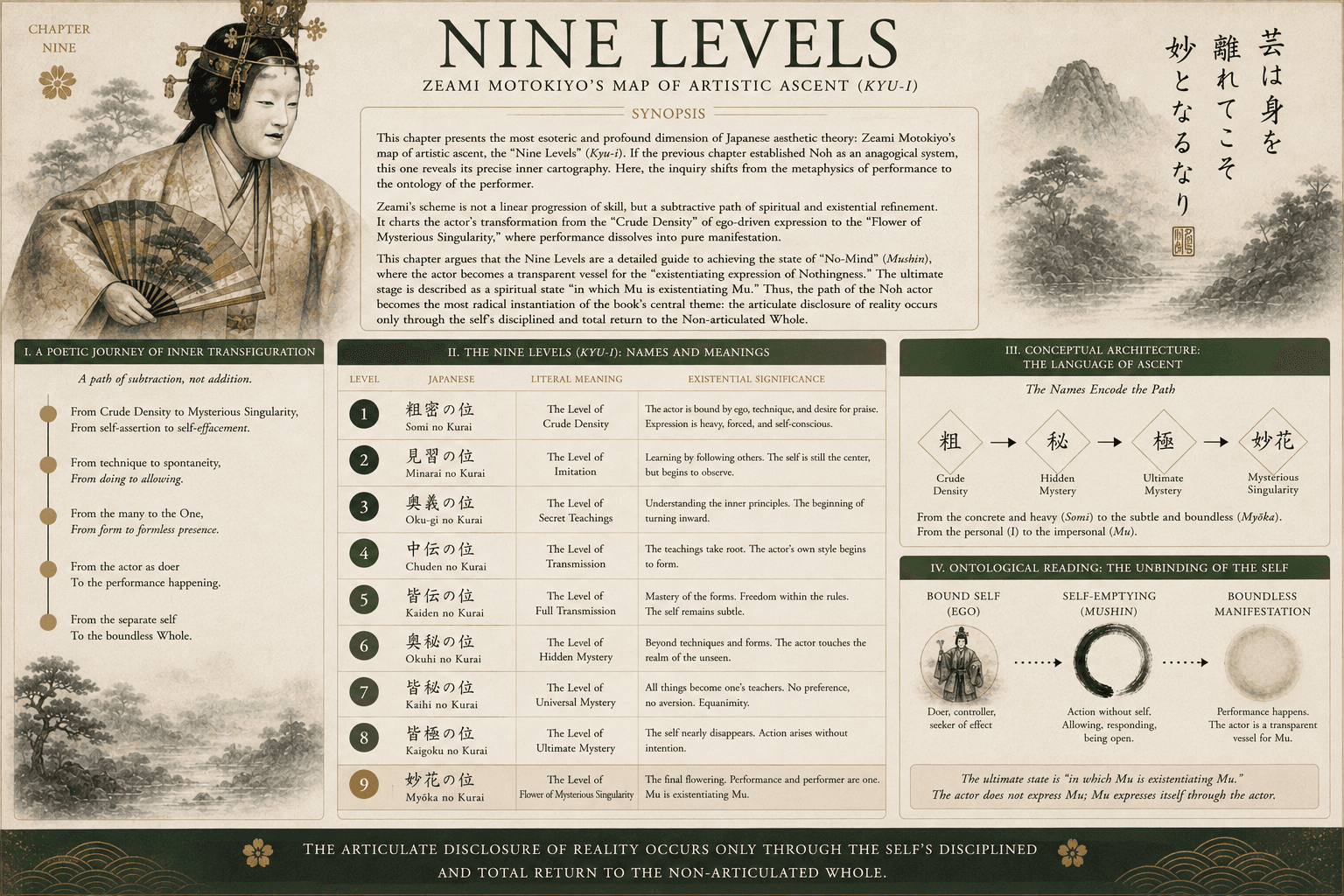
To fully illuminate this esoteric path, the following analysis proceeds through three interlocking perspectives. First, we trace the poetic and spiritual journey of the Levels as an inner transfiguration. Second, we examine their conceptual architecture, revealed through the philosophical precision of their very names. Finally, we undertake an ontological reading, contemplating the performer's gradual unbinding from self. Together, these three visions approach the same silent center: the flower that blooms in the dark of Mu.
In the austere clarity of Zeami’s aesthetic vision, art unfolds not as a sequence of technical achievements, but as a profound path of inner transformation. Each of the Nine Levels[1] he outlines represents a threshold in the journey from instinct to transcendence, from external gesture to metaphysical radiance. The development of artistic expression, in this vision, is neither linear nor merely progressive; it is an anagogical ascent not an upward accumulation, but a subtractive movement—where form is gradually relinquished, spirit becomes still, and finally all distinction dissolves into the silence of Nothingness. This text traces the Nine Levels of Zeami’s thought in terms of their essence, meaning, and significance, illuminating how the art of Noh becomes a spiritual path.
The Low Three Levels: From Instinct to Technique
The journey begins in the earthbound domains of the Low Three Levels, where expression is marked by immediacy and instinct. These levels precede true artistry, existing at the border between the natural and the aesthetic.
The first of these, Crude Density, is characterized by raw, unrefined energy. Its essence lies in the mere fact of inherent ability—action arises from biological instinct rather than cultivated form. It lacks both internal refinement and external elaboration. The meaning of this level is pre-artistic: an impulse of expression not yet shaped by discipline or intention. In its significance, it occupies the zero point of the aesthetic path—a ground of undifferentiated possibility.
The second level, Dynamic Ruggedness, retains the animalistic basis of the first, but introduces spirited vigour, or ki, as psychic intensity. The essence of this mode lies in this forceful energy, no longer merely biological but tinged with interiority. However, it remains rough and unformed, with no clear articulation of technique or spirit. Meaning arises through intensity, not through direction. Its significance lies in its suggestion of potential—it gestures toward artistic force, but has not yet acquired the means to shape it.
In the third level, Dynamic Ramification, we witness the emergence of form. Technical elaboration appears in its full brilliance, and the movements of the artist gain accuracy and precision. The essence here is external refinement. Yet, critically, this technical clarity is disconnected from inward depth. The meaning of the performance is hollowed out—it shines, but it does not resonate. The significance of this level lies in its ambiguity: though it represents a peak of technical skill within the lower triad, it still remains outside the spiritual structure of gei-dō. It is the beauty of separation, of virtuosity that has not yet found its soul.
The Middle Three Levels: The Awakening of Spirit
With the fourth level, the path of gei-dō begins in earnest. Here, the transition occurs from external form to internal resonance, and from unrefined energy to spiritual emergence.
Ingenuous Beauty, the first of the Middle Three Levels, is defined by spiritual innocence. The essence of this mode lies not in technical maturity, but in a natural purity of expression—the radiance of naiveté. The performer may still lack formal polish, yet something shines through: an uncalculated clarity that reflects the original purity of the mind. Its meaning is metaphysical rather than aesthetic: the beauty here is not constructed but revealed. This level is significant as the true beginning of the way. Here, for the first time, the value of yūgen—that elusive, profound beauty—emerges. Zeami calls it a “transient flower,” and yet, in its ephemeral bloom, it already points toward the eternal.
The next mode, Comprehensive Precision, brings with it the full command of technical artistry. The essence here is completeness: the performer has achieved mastery over all forms and styles. The meaning, however, is still bound to external cognition. The artist now sees the entirety of their art, but from without—through cognitive presence, not attunement to presence. This level stands at a crossroads. Its significance lies in its role as a fulcrum: from here, the performer may ascend toward inward synthesis, or descend once again into the outer modes. It is a turning point, not yet a culmination.
In the sixth level, Quintessential Flower, the phenomenal world undergoes transfiguration. The essence of this level is contemplative synthesis: the multiplicity of the world appears as a unified symbolic field. The mind, now stilled, no longer looks at forms but through them. Meaning arises from non-temporal presence, in which the seer and the seen begin to dissolve into each other, and the significance of this level is profound—it marks the emergence of the flower in its essential sense. Beauty now blossoms not from form, but from the seamless union of form and emptiness.
The High Three Flowers: Transcendence and Dissolution
The final triad of levels, the High Three Flowers, transcends technique, expression, and even contemplation. What unfolds here is not merely performance, but metaphysical realization.
Flower of Tranquil Equilibrium, the seventh mode, is defined by a lucid balance. The essence of this level is harmony between all oppositions: inner and outer, subject and object, perception and field. Meaning is no longer created or conveyed—it simply is. The significance of this level lies in its perfect stillness. No longer is beauty derived from vitality or movement; it is present as pure presence, untouched and unshaken.
The eighth mode, Flower of Innermost Profundity, deepens this equilibrium into paradox. Its essence is ambivalence—yū and mu, being and not-being, enter into a mutual resonance. Meaning becomes spacious and indeterminate, arising in the senuhima, the interval of non-action, where interior movement emerges only through exterior stillness. Its significance is metaphysical: here, awareness retains form even as it negates itself. The field of art becomes an echo of that which cannot be said.
Finally, the highest mode: Flower of Mysterious Singularity. This is the dissolution of all structure, the erasure of all oppositions. Its essence is absolute non-duality. Meaning transcends cognition; significance lies beyond expression. Here, the final articulation of Zeami’s path comes into view. Nothing remains—not the artist, not the technique, not even the contemplative mind. And yet, in that abyss, a light shines. Mu—Nothingness—is no longer void but radiance. Yū is mu, and mu is yū. The flower opens in the dark.
“A contemporary critic of Japanese thought makes the following remark: 'This is a spiritual state in which mu is existentiating mu.' And Zeami himself: 'With this the "anagogical" way of Noh reaches its arcanum'.” (Ibid, 44)
Zeami’s Nine Levels do not merely chart the growth of a performer. They trace the unfolding of a soul. From the animal immediacy of instinct to the absolute silence of metaphysical unity, this path is a journey of deconstruction and ontological attenuation. Technical mastery is not the summit, but a necessary threshold. The true art of Noh lies in the gradual relinquishment of the self.
In the end, what remains is not the artist, nor the art, but the “flower” (hana) -not as metaphor, but as manifestation. It is the silent trace of Nothingness, made visible through performance. And so, Zeami’s art is not an art of mastery alone, but of return: to stillness, to purity, to the luminous emptiness from which all true beauty springs.
[1] In this work, we use “mode” to refer to the aesthetic and metaphysical configuration of presence associated with each phase of artistic development in Zeami’s Ninefold Path. The term emphasizes the internal quality or state of being that characterizes a given moment of performance. To describe the broader sequential structure of this path -its hierarchical unfolding- we adopt the term “level” rather than “stage,” to avoid confusion with the physical stage or dramatic divisions in Noh theatre. Thus, while the Nine Levels of gei-dō represent a path of cultivation, each corresponds to a distinct mode of expression or awareness that may recur or manifest non-linearly, particularly in advanced practice.