From Substance to the Self-Forming Field
The Topological Turn
The Topological Turn
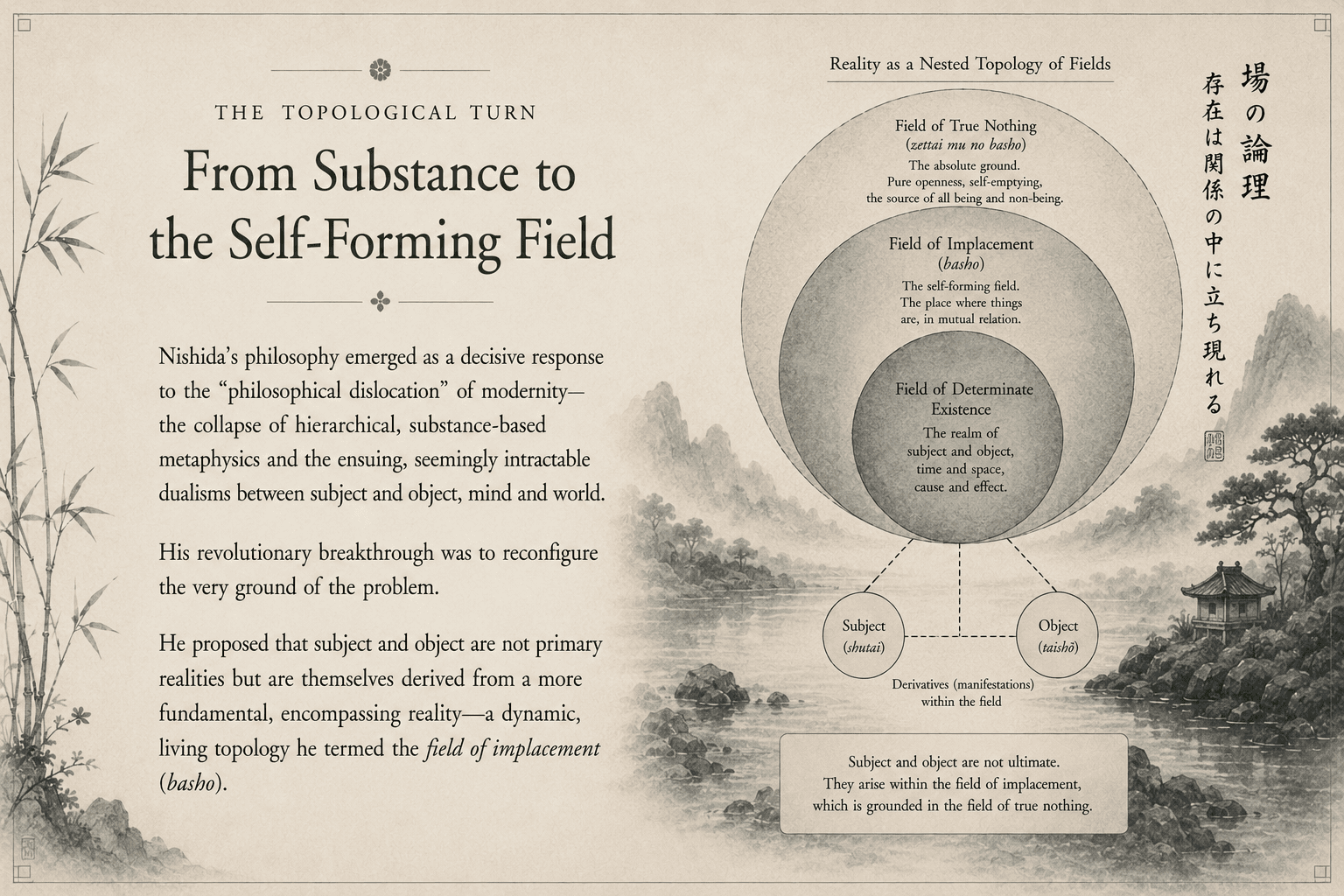
Nishida’s philosophy emerged as a decisive response to the “philosophical dislocation” of modernity—the collapse of hierarchical, substance-based metaphysics and the ensuing, seemingly intractable dualisms between subject and object, mind and world. His revolutionary breakthrough was to reconfigure the very ground of the problem. He proposed that subject and object are not primary realities but are themselves derived from a more fundamental, encompassing reality—a dynamic, living topology he termed the field of implacement (basho).
The core of his system is a radical inversion of the philosophical gaze, derived from the structure of judgment. Traditional, substance-oriented logic focuses on the grammatical subject—the “what” of a statement. Nishida performed a decisive turn towards the predicate. In the judgment “The rose is red,” the particular subject “the rose” finds its determinate being by being implaced within the universal predicate “redness.” The predicate is not a mere property attached to a pre-existing subject; it is the encompassing context that gives the subject its meaning. This “predicate logic” reveals a universe structured not by independent substances but by fields of determination, where particulars are nested within and defined by their contextual universals.
This logical ascent points beyond any determinate field. If we consistently turn from objectified beings (grammatical subjects) toward the determining context (the predicate), we are led to a final, ultimate field—a “predicate that can never become a grammatical subject.” Because it is utterly unobjectifiable and undetermined, it is, in relation to all beings, a form of nothingness. This is the “field of true nothing” (zettai mu no basho). Crucially, this “nothing” is not a nihilistic void. It is the fecund and dynamic ground of all reality: a “self-forming formlessness.” It does not merely receive forms but actively differentiates itself, determining itself into the myriad beings of the world. Its negativity is its positive, creative power. By being no particular thing, it can be the potentiality for all things.
This concept completes the inversion at the heart of Nishida’s system. Traditional metaphysics, in its object-centred quest, sought the ultimate foundation in a primary substance. Nishida’s new metaphysics, founded on the logic of the field, locates the ultimate foundation in the final predicate—a field that can never be a subject. The world does not consist of substances with attributes, but of dynamic expressions within a self-intuiting field. This topological vision is not an abstract speculation; it finds its genesis and validation in the realm of aesthetic experience, to which we now turn.