Muga, Intuition, and the Genesis of Topology
The Aesthetic Ground
The Aesthetic Ground

It is crucial to note that Nishida’s entire metaphysical edifice has its genesis in his earliest philosophical concern: the nature of beauty. In his 1900 essay, Bi no Setsumei (“An Explanation of Beauty”), he first identified the core of aesthetic experience as muga (無我), or “no-self”—a state where one “forgets one’s own interest such as advantage and disadvantage, gain and loss.” This concept of muga, forged in his intensive Zen practice, is the primordial expression of what would later become his mature concepts of “pure experience” and the self-negating basho.
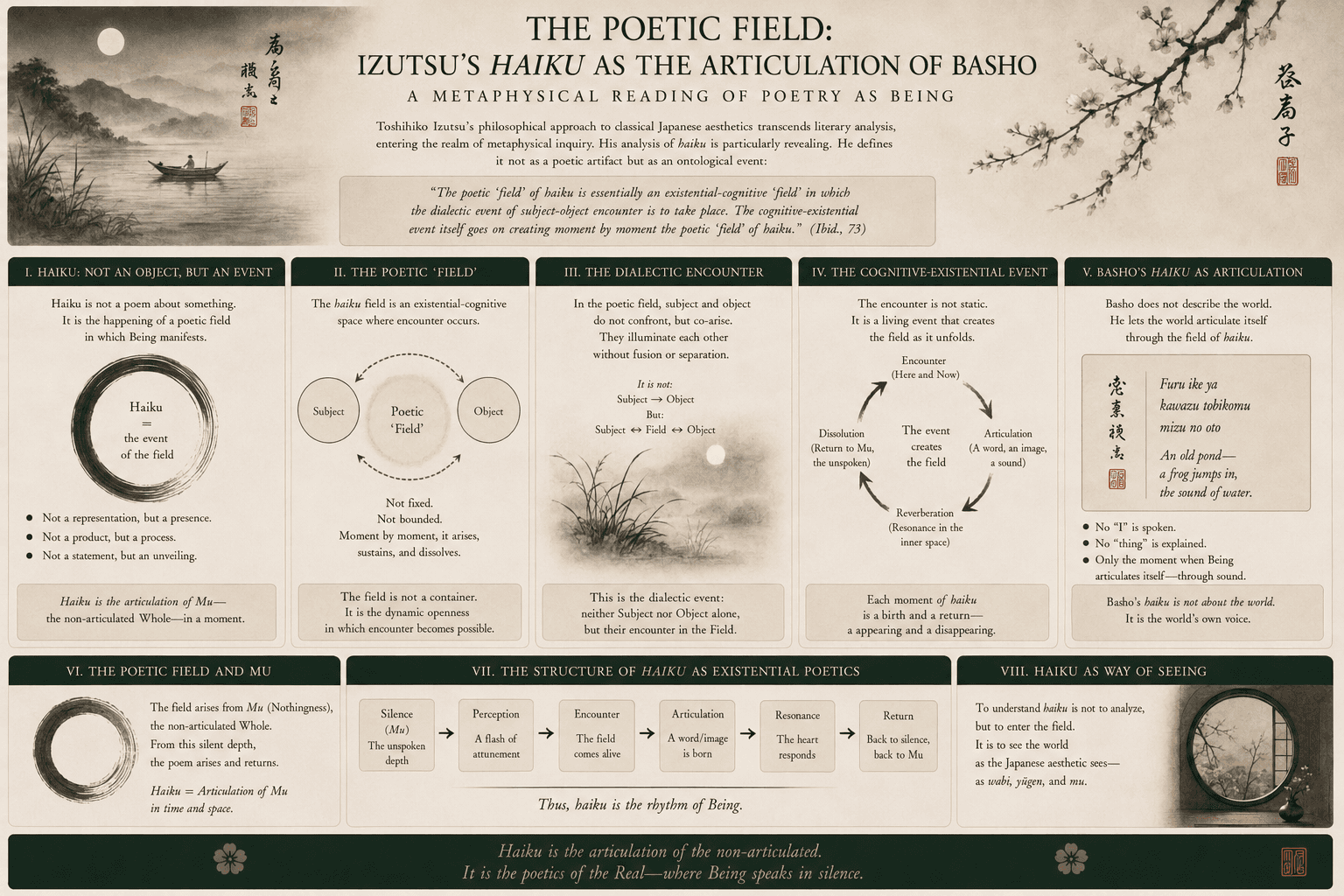
From this ground, Nishida described the artistic mode of knowledge not as discursive reasoning but as an “intuitive glance.” This is a moment of “pure experience” in which the subject-object dichotomy collapses. When a poet like Bashō perceives a weathered rock or a frog breaking the silence of an ancient pond, he does not see an instance of a geological or biological class. He sees the suchness of the thing, a reality so immediate and full that it includes his own presence within the scene. In this intuitive grasp, the unifying activity of nature and the unifying activity of the artist’s consciousness are revealed as one and the same. The poet’s consciousness becomes the locus where the objective world achieves self-expression. As Nishida argued, deep knowledge is not accumulation but union: “The poet… knows the tree itself, because in that moment, the poet’s consciousness has become the tree’s own expression of itself.”
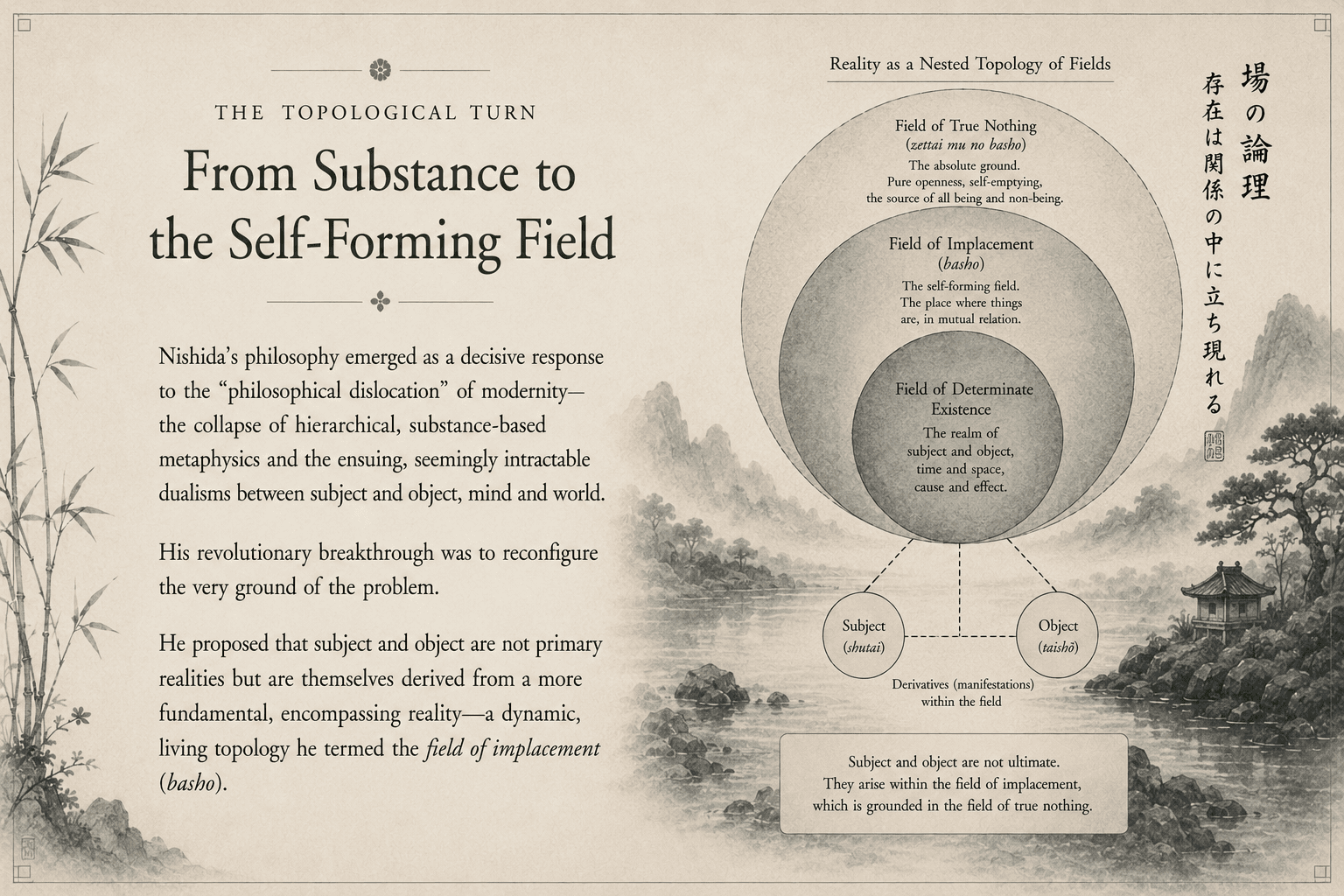
This epistemological claim, born from aesthetics, is the experiential kernel of his predicate logic. The judgment ‘the rose is red’ is, in the state of muga, not an attribution by a subject but the self-expression of the holistic field ‘redness’ seeing itself in the particular ‘rose.’ The intuitive glance of the artist is thus the basho’s own capacity to intuit itself, a “seeing without a seer.” With this framework in place, we can now perceive how Izutsu’s phenomenological descriptions provide the precise, lived counterpart to Nishida’s metaphysical structure.