From Waka to Haiku: Continuity Through Inversion
The transformation from waka to haiku marks one of the most subtle yet radical developments in the history of Japanese poetics.
The transformation from waka to haiku marks one of the most subtle yet radical developments in the history of Japanese poetics.

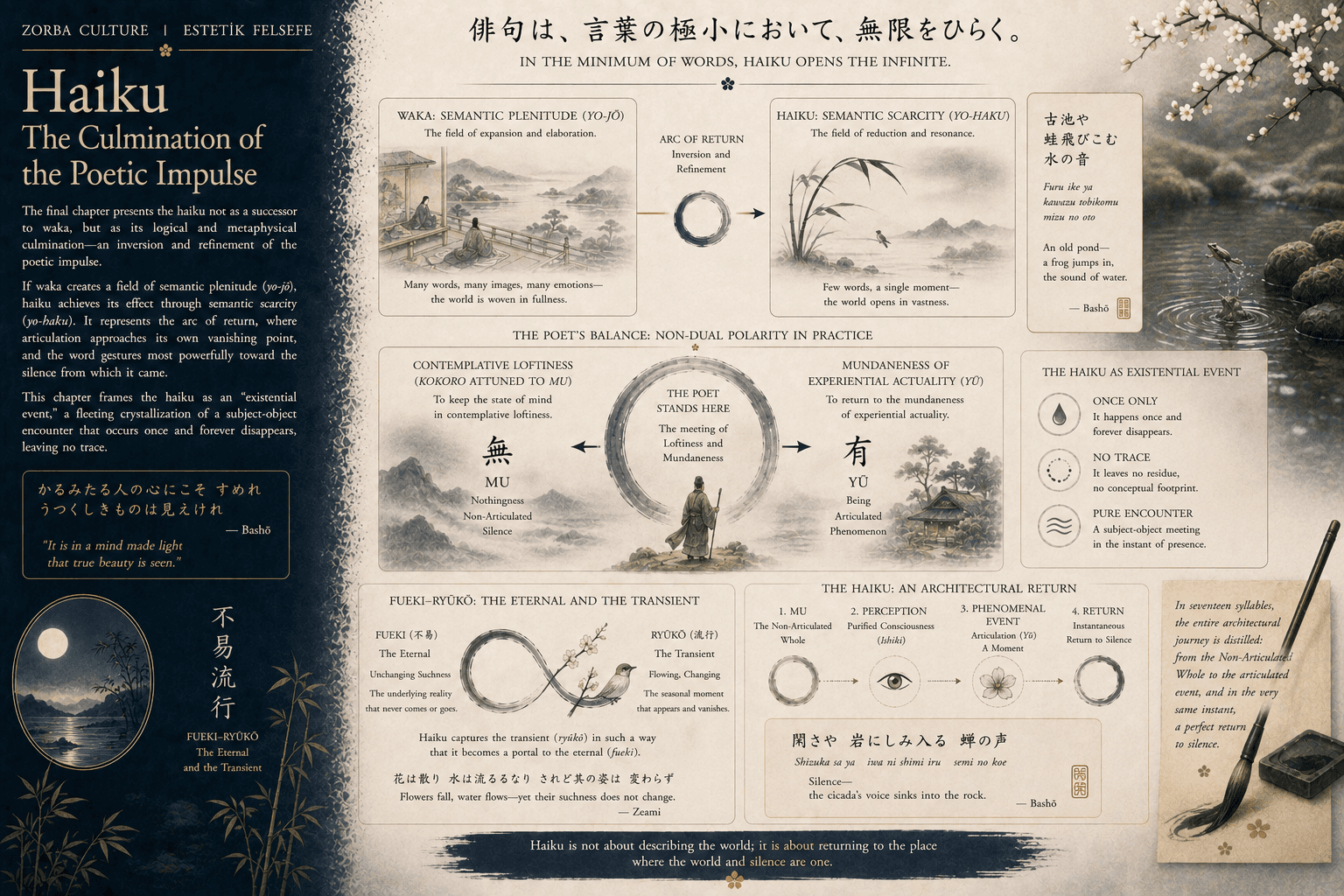
The transformation from waka to haiku marks one of the most subtle yet radical developments in the history of Japanese poetics. At the surface level, haiku retains many of the “essential formal similarities” of its predecessor -chiefly its brevity, syllabic precision, and seasonal references. Yet beneath this formal continuity lies a profound shift: not a rupture or replacement, but an inversion of the inner poetic logic that had governed classical waka for centuries.
This transformation, as Izutsu notes, occurred not abruptly but with “a slow and moderate development... of the external linguistic constitution which has been going on through ages.” (Ibid., 62) That is, the outward form changed little. The 5-7-5 rhythm of haiku echoes the cadence of waka’s longer 5-7-5-7-7 structure. Both forms rely on suggestion, seasonal imagery, and a highly refined sense of emotional nuance. Yet while the form persisted, “its inner disposition and configuration... underwent a drastic evolvement.” This inner evolvement -what might be called an aesthetic reversal- did not abandon the poetic system of waka, but transformed it from within.
At the heart of this system lies the dynamic between kokoro and kotoba -between creative subjectivity and the expressive word. This relationship, established and elaborated by Fujiwara Teika, structured how poetry mediated feeling and form. In waka, kotoba served kokoro; the word was the vehicle through which inner emotion found refined, courtly expression. The poetic act began with interiority and moved outward into language.
Over time, however, this scheme reached what Izutsu calls “the extreme limit of elaboration.” Expression could go no further without folding in on itself. The tradition, rather than collapsing, enfolded itself –a transformation not of abandonment, but of inward renewal. Haiku emerges as the poetic realization of this turn -not a new invention, but a reorientation: “the whole scheme was, as it were, reversed in its organic entirety.” What had been a poetry of inner emotion expressed through words became, in haiku, a poetry in which language presented the external world with such immediacy and restraint that interiority was no longer stated, but implied.
This inversion did not disrupt the structure -it preserved it. As Izutsu puts it, the transformation “has been taking place orderly and with precision along the line and within the boundaries of the original structural setting.” The formal skeleton remained intact; the flow of aesthetic energy simply ran in the opposite direction. Rather than manifesting feeling through image, haiku let the image carry feeling, without ever stating it. It invited the reader to enter the space between words and find kokoro there -silent, deferred, and potent.
Such a reversal is not a negation but a culmination. In the same way that emptiness in Zen is not absence but presence in another form, this poetic reversal allowed the tradition to continue by turning its face inward. The result is a structure that remains formally consistent, yet internally transformed: “its original structural scheme remained intact only in the negative way” -that is, inverted, mirrored, reversed in function though not in form.
In sum, the movement from waka to haiku is not a narrative of innovation overcoming tradition. It is a deeper and more delicate story of transformation from within -where a poetic system, upon reaching its expressive limits, did not expire, but folded back on itself in a gesture of internal renewal. Haiku, then, is not the successor to waka in a linear sense, but its echo in reverse -a continuation that is also a turning.