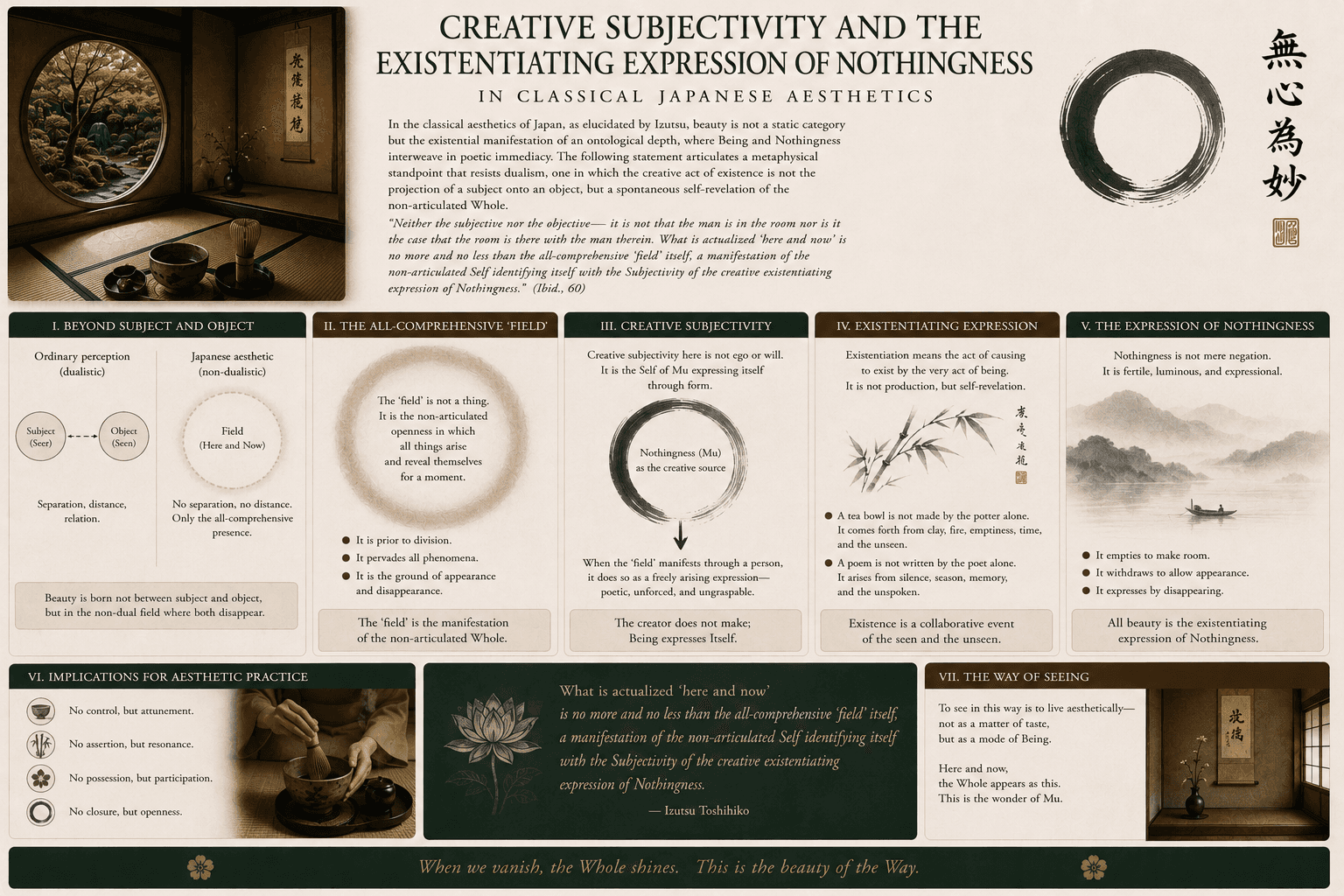
Haiku-Chapter VII
Haiku
Haiku
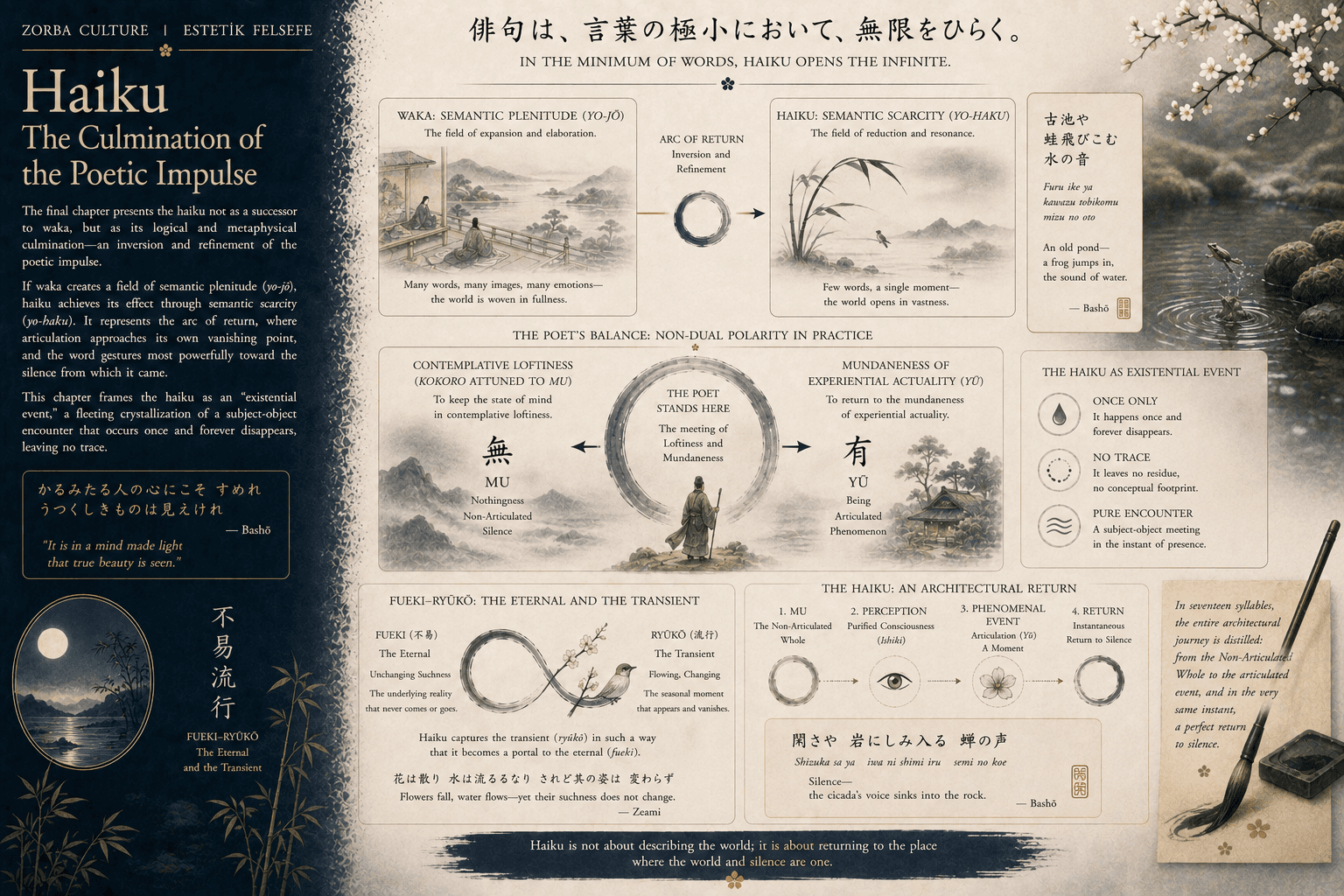
Synopsys: The final chapter presents the haiku not as a successor to waka, but as its logical and metaphysical culmination—an inversion and refinement of the poetic impulse. If waka creates a field of semantic plenitude (yo-jō), haiku achieves its effect through semantic scarcity (yo-haku). It represents the arc of return, where articulation approaches its own vanishing point, and the word gestures most powerfully toward the silence from which it came. This chapter frames the haiku as an “existential event,” a fleeting crystallization of a subject-object encounter that occurs once and forever disappears, leaving no trace.
The analysis centers on the delicate balance Bashō prescribed for the poet: to “keep the state of mind in contemplative loftiness” while returning to the “mundaneness of experiential actuality.” This is the non-dual polarity in practice: the lofty mind (kokoro attuned to mu) must find its validation in the most mundane, transient phenomenon (yū). The chapter also elucidates the pivotal concept of fueki-ryūkō, the eternal (fueki) and the transient (ryūkō). The haiku’s genius lies in its ability to capture a fleeting, seasonal moment (ryūkō) in such a way that it becomes a portal to the eternal, unchanging suchness (fueki) of reality. In seventeen syllables, the entire architectural journey of this book is distilled: the Non-Articulated Whole, perceived by a purified consciousness, articulates itself in a phenomenal event that is, in the very same instant, a perfect and complete return to silence.