Haiku as an Existential Event: The Poetic Field of Subject-Object Encounter
Izutsu’s philosophical approach to classical Japanese aesthetics transcends the boundaries of literary analysis, entering instead into the realm of metaphysical inquiry.
Izutsu’s philosophical approach to classical Japanese aesthetics transcends the boundaries of literary analysis, entering instead into the realm of metaphysical inquiry.

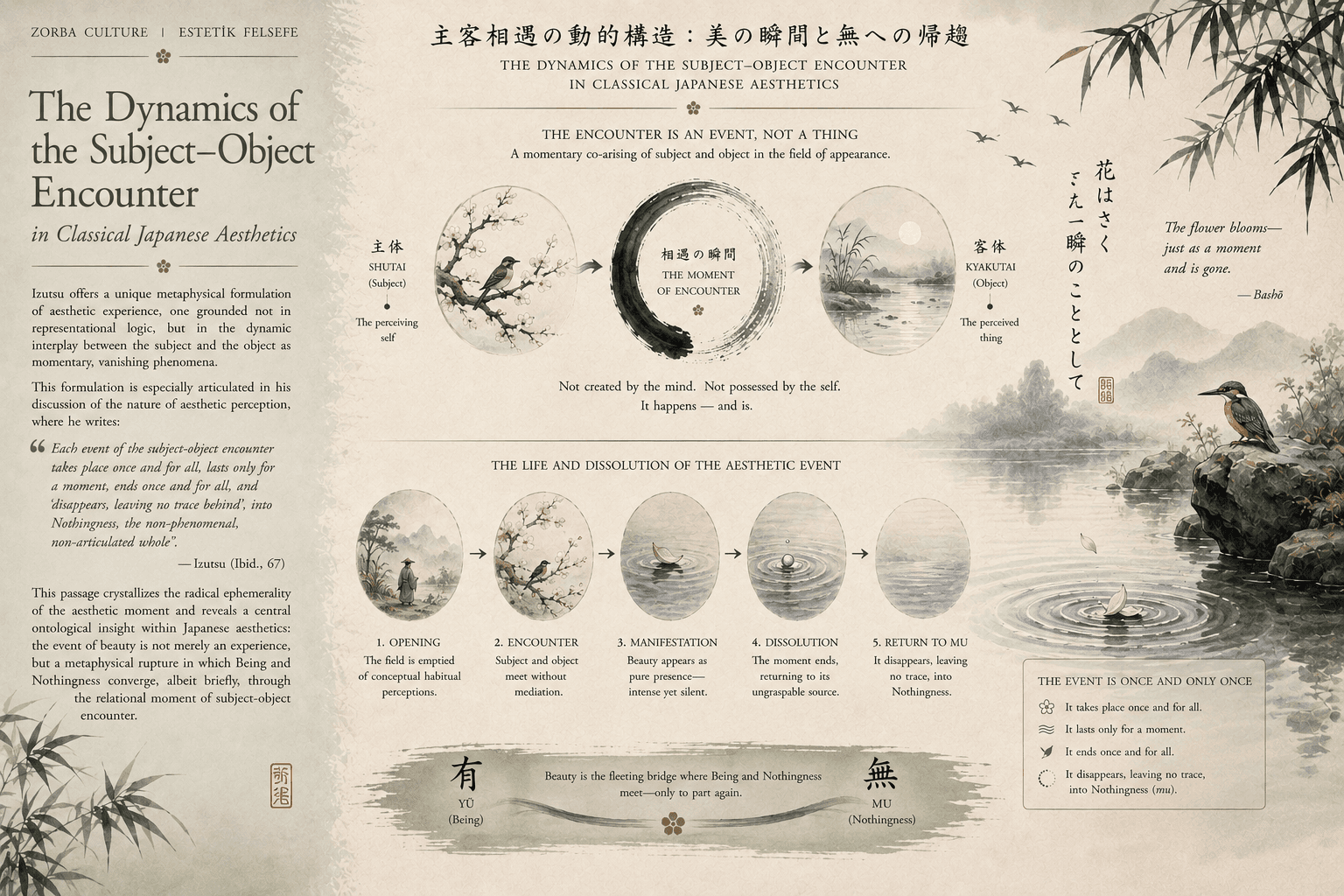
Izutsu’s philosophical approach to classical Japanese aesthetics transcends the boundaries of literary analysis, entering instead into the realm of metaphysical inquiry. His analysis of haiku situates the form not merely as a poetic artifact but as a microcosmic unfolding of existential reality. In his Theory of Beauty in the Classical Aesthetics of Japan, Izutsu states:
“The poetic ‘field’ of haiku is essentially an existential-cognitive ‘field’ in which the dialectic event of subject-object encounter is to take place. The cognitive-existential event itself goes on creating moment by moment the poetic ‘field’ of haiku.” (Ibid., 73)
This formulation reveals haiku as not only a form of poetry but a metaphysical act in which Being, perception, and the world co-arise in a fleeting encounter. The poem is not a fixed object but the very becoming of a poetic space -a field- in which subject and object arise together and dissolve.
The poetic field of haiku is, in Izutsu’s account, more than a spatial or formal structure; it is a field of Being, a dynamic configuration where existential and cognitive dimensions intertwine. It is “existential” because it grounds itself in a lived moment of awareness -the now that is- and it is “cognitive” because it involves a moment of semantic articulation, the arising of meaningful perception out of the formless ground of experience.
Izutsu’s emphasis on the poetic field as a moment-by-moment creation suggests that haiku does not emerge from the imposition of external form but arises spontaneously from the unfolding of awareness. Each haiku becomes a singular event-being, a field in which the distinction between subject and object is neither fully established nor fully dissolved. This field is not pre-existing -it is born with the encounter, and it vanishes with it.
The haiku encapsulates, in its brevity, the dialectic of subject and object -yet this dialectic is not a logical opposition but a movement toward mutual dissolution. In the traditional haiku, a seasonal image often represents the object: a frog leaping into water, a cherry blossom falling, a crow on a withered branch. These are not symbols to be interpreted, but presences to be encountered. The subject, the poet, is not outside of the scene observing, but within the field, dissolving into it.
This is what Izutsu means by the “dialectic event of subject-object encounter.” It is not a Hegelian dialectic of contradiction and synthesis, but a Zen-like simultaneity of appearance and disappearance, where the very act of perception collapses the divide between perceiver and perceived. The haiku becomes the trace of this event, although it is a trace that leaves no fixed residue -only the echo of the moment’s fullness.
In traditional Japanese aesthetics, mujō (impermanence) and mu (nothingness) are central metaphysical principles. Haiku, with its seventeen-syllable form, is structurally attuned to momentariness. But for Izutsu, this momentariness is not only formal; it is ontological. The existential event that the haiku instantiates takes place only once, and then disappears into mu -the non-phenomenal field of Nothingness.
What remains is not the subject who perceived, nor the object that was perceived, but the poetic field that was created in the interval of encounter. In this sense, the haiku is not the description of an experience but the articulation of a field of experience, an existential intensity that has already vanished. This field is a poetic rendering of the non-articulated whole as momentarily articulated into form before it collapses back into formlessness.
The ontological structure of the haiku field corresponds closely with the aesthetic ideal of yūgen, a beauty of depth, obscurity, and subtle suggestion. Haiku operates not by declaring but by pointing. It does not aim to describe beauty, but to allow it to appear -momentarily, faintly, as if through mist. The cognitive-existential field is therefore not a stage for clarity, but a threshold for emergence.
The haiku's power to instantiate a 'cognitive-existential field'—where subject and object co-arise and vanish in a single breath—is rooted in a foundational principle of Japanese philosophy: the primacy of non-dual, pre-reflective experience. This principle, articulated metaphysically by Kitarō Nishida as 'pure experience' (junsui keiken)—the direct, unified ground of awareness before the subject-object split—finds its ultimate aesthetic expression in Izutsu's interpretation of haiku. For Izutsu, the haiku does not describe this unified reality; it enacts it. Where Kitarō provided the abstract structure of non-dual awareness, Izutsu, through Bashō, reveals its lived, poetic form. The haiku is thus not a representation of an experience but the experiential event itself, a momentary crystallization of 'pure experience' in seventeen syllables. This is why the frog's splash is not an observation by the poet but a sound that includes the poet's awareness, vanishing without a trace back into the silent, non-articulated Whole from which it came. It is from this non-dual ground that haiku’s famous restraint naturally emerges. aiku’s silences, its reliance on suggestion, open a space in which yūgen is not a quality added to the poem, but the very condition of its being.
The haiku does not seek to make the hidden visible, but to make the visible hint at the hidden. It is a formal manifestation of the beauty that is always withdrawing, just beyond articulation.
In Izutsu’s metaphysical system, ishiki (consciousness) is not the Cartesian interiority of thought but the field of articulation through which Being is disclosed. In haiku, ishiki is activated not as rational reflection but as a mode of resonance -a contemplative opening. The poet becomes a field of sensitivity, receptive to the world’s subtle utterance. The poem arises not from intention, but from the kokoro’s spontaneous attunement with the world.
This attunement is not a passive reflection but a co-creative act: the poet and the world come into being together, momentarily, within the poetic field. Haiku becomes the crystallization of that ontological resonance, not a product of ego but a manifestation of the field’s dynamic unfolding.
Through Izutsu’s lens, haiku is not a genre but a metaphysical operation. It stages the moment of ishiki’s articulation of the world, the fleeting event of Being coming into form through encounter. It is the poetic field wherein the world and the self, the cherry blossom and the gaze that beholds it, meet only to dissolve.
What haiku offers, then, is not meaning but presence -not understanding but encounter. It is the echo of a moment when Being became visible, only to vanish. The haiku poet, like the Zen practitioner, listens for that echo, not to preserve it but to disappear with it. The poem is thus the form of vanishing itself—poetic, existential, cognitive, and metaphysical.
As Izutsu suggests, “the cognitive-existential event itself goes on creating moment by moment the poetic field of haiku.” Haiku, in this formulation, is not written -it happens. It is the moment when the world appears, just once, and disappears, forever.