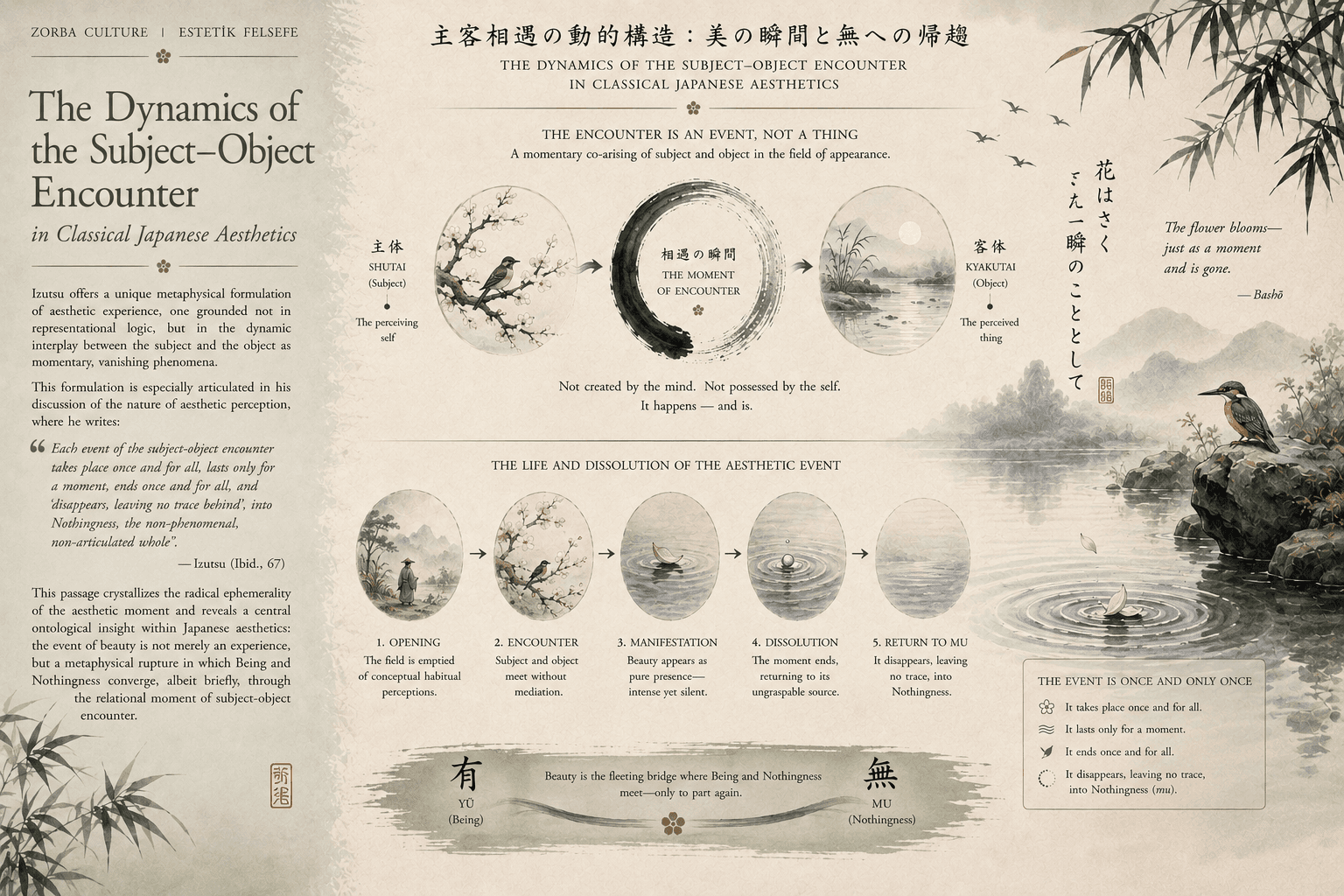
Izutsu offers a unique metaphysical formulation of aesthetic experience, one grounded not in representational logic, but in the dynamic interplay between the subject and the object as momentary, vanishing phenomena. This formulation is especially articulated in his discussion of the nature of aesthetic perception, where he writes:
“Each event of the subject-object encounter takes place once and for all, lasts only for a moment, ends once and for all, and ‘disappears, leaving no trace behind’, into Nothingness, the non-phenomenal, non-articulated whole”. (Ibid., 67)
This passage crystallizes the radical ephemerality of the aesthetic moment and reveals a central ontological insight within Japanese aesthetics: the event of beauty is not merely an experience, but a metaphysical rupture in which Being and Nothingness converge, albeit briefly, through the relational moment of subject-object encounter.
The structure of the encounter described by Izutsu is inherently non-repeatable. “Each event… takes place once and for all.” This indicates a unique temporal structure: not the linear flow of time as understood in Western metaphysics, but a kairological instant -a time of qualitative presence. The subject and the object meet only once, in an unrepeatable way, meaning that the aesthetic encounter does not fall into the domain of abstract generalization. The flower seen at dawn, the sound of a distant bell, or the sudden flight of a crane over a winter field -all represent moments that, once perceived, are no longer.
This irreversibility is not a mere poetic sentiment, but a metaphysical principle. The Japanese aesthetic experience, as Izutsu explains, resists conceptual fixation. It is the anti-thesis of “articulated knowledge”; instead, it points to an “event-being” that appears and disappears without subsistence. The beauty is not “in” the object nor “in” the subject -it exists only in the event of encounter, and that event collapses the very boundaries that define subject and object.
Izutsu’s distinction between the “phenomenal” and the “non-phenomenal” draws heavily from Zen Buddhist and Daoist metaphysical structures, which emphasize the limitations of articulated forms. Phenomenal reality is the world of forms, names, and discriminations -the articulated whole. However, the beauty that arises in the subject-object encounter is not of this articulated world. It is the fleeting opening into what Izutsu calls the non-articulated -a wholeness not given in parts, not divisible, not nameable.
This is not a negation of the phenomenal, but a transcending of it. The moment of beauty lifts both the subject and the object out of their respective self-enclosures. In this moment, “no trace is left behind” precisely because nothing has been acquired or accumulated. The encounter, by its nature, dissolves both entities into a field of pure suchness -a concept derived from Zen, indicating the world as it is before thought or judgment intervenes.
The aesthetic moment “disappears… into Nothingness,” says Izutsu, situating the entire experience against the backdrop of a metaphysical Nothingness (mu). But this Nothingness is not a void in the nihilistic sense. It is the originary field from which all articulated forms arise and into which they return. In Japanese aesthetics, influenced by Mahāyāna Buddhist thought, mu is not the absence of being but the ever-present, formless potentiality that precedes articulation.
In this sense, the subject-object encounter is an ontological phenomenon: it emerges from mu, actualizes briefly as an aesthetic moment, and then returns to mu. This cycle, this movement from formlessness to form and back, is not tragic or melancholic -it is the very rhythm of beauty in the Japanese tradition. That nothing is left behind is precisely what grants the experience its profundity.
The disappearance of the aesthetic event into Nothingness finds its aesthetic counterpart in the notion of yūgen, which Izutsu describes as a beauty of hiddenness, mystery, and subtlety. Yūgen is not the beauty that stands in the light, but the one that withdraws just as one begins to grasp it. In this regard, the subject-object encounter is imbued with yūgen precisely because it evades fixation. It recedes into the dark hollows of Nothingness, suggesting that beauty is most profound where it evanesces.
The implication here is that true beauty is not present in the prolongation of form, but in its vanishing trace -or more accurately, its vanishing without trace. The subject does not possess the object, nor does the object remain for the subject. Both dissolve into the metaphysical field of non-differentiation.
This dynamic carries important consequences for the structure of consciousness (ishiki) in Japanese aesthetics. The encounter entails a form of consciousness that does not centre the ego or its cognitive functions, but one that dissolves the self into the very movement of perception. This is not the Cartesian subject who beholds an object, but a fluid field of awareness in which self and other momentarily interpenetrate and vanish.
The subject is, in this moment, not even aware of “experiencing beauty” as a conceptual object. Instead, kokoro -the heart-mind- resonates with the form and then empties itself. The silence that follows the moment is not absence, but fullness: a fullness of ungrasped presence.
Izutsu’s formulation of the subject-object encounter opens a radical path in metaphysical aesthetics: it proposes a view of beauty not as property, object, or even emotion, but as the momentary self-erasure of the dualistic frame. The encounter is not about permanence, but about presence. It is not about knowledge, but about disappearance. It is a poetic metaphysics wherein the rhythm of being is marked not by what endures, but by what vanishes -the trace that leaves no trace, the form that returns to formlessness.
In this light, the Japanese aesthetic experience, as formulated by Izutsu, is fundamentally contemplative and metaphysical. It is not an attempt to represent the world, but to be touched by it in a way that transcends representation. And in that moment of encounter -brief, unrepeatable, and vanishing- one is given access to the deepest rhythm of existence: the rhythm of emergence and disappearance, of form and Nothingness, of beauty and its dissolution.