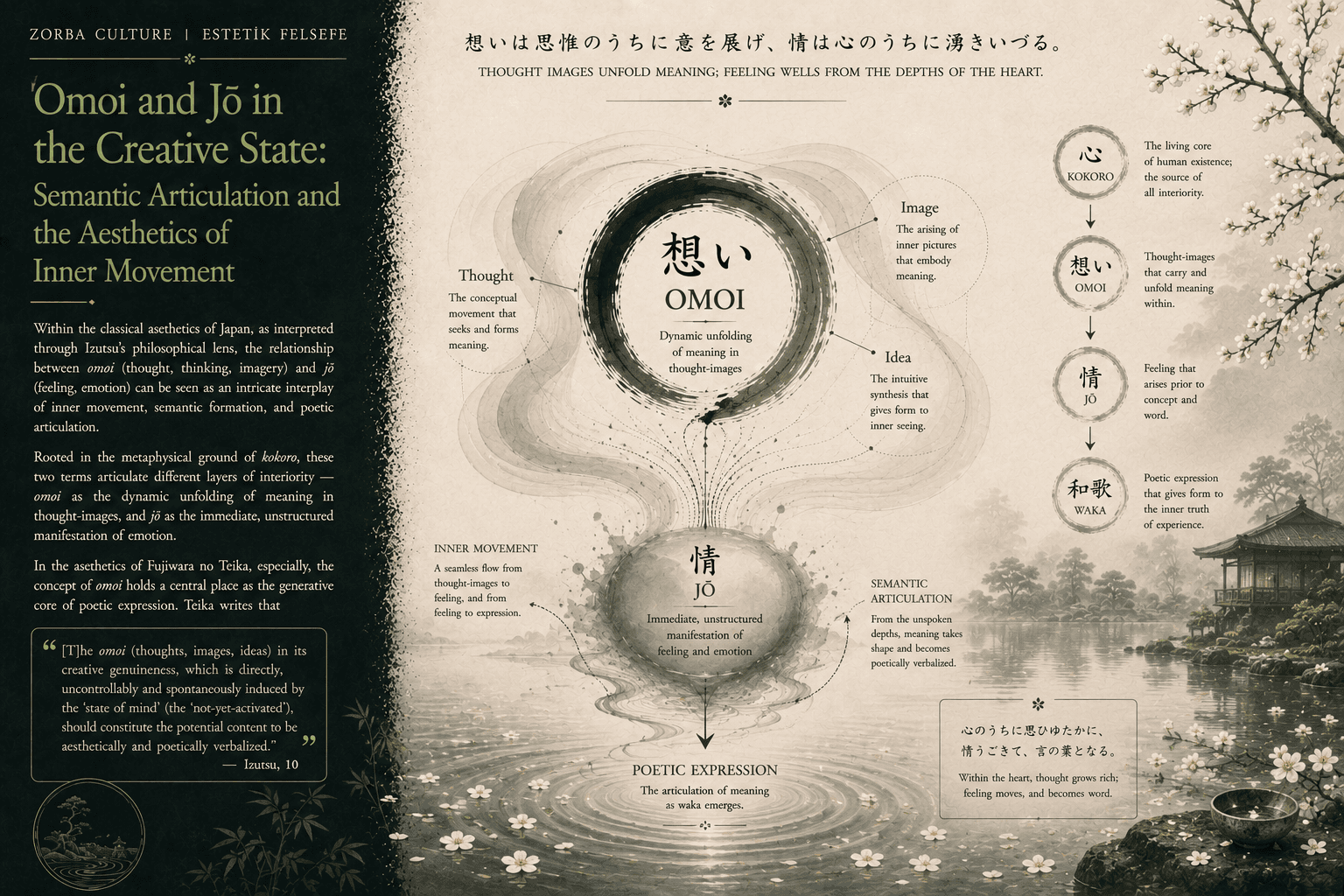
Within the classical aesthetics of Japan, as interpreted through Izutsu’s philosophical lens, the relationship between omoi (thought, thinking, imagery) and jō (feeling, emotion) can be seen as an intricate interplay of inner movement, semantic formation, and poetic articulation. Rooted in the metaphysical ground of kokoro, these two terms articulate different layers of interiority -omoi as the dynamic unfolding of meaning in thought-images, and jō as the immediate, unstructured manifestation of emotion. In the aesthetics of Fujiwara no Teika, especially, the concept of omoi holds a central place as the generative core of poetic expression. Teika writes that
“[T]he omoi (thoughts, images, ideas) in its creative genuineness, which is directly, uncontrollably and spontaneously induced by the 'state of mind' (the 'not-yet-activated'), should constitute the potential content to be aesthetically and poetically verbalized.”(Ibid., 10)
Izutsu situates the origin of Japanese aesthetics in the ontological dynamics of kokoro -the heart-mind-as a metaphysical substratum that precedes both thought and feeling, and which gives rise to the poetical expression of reality. Kokoro is neither pure cognition nor affect; it is a totalized field of inner movement, whose differentiations yield both omoi and jō as modalities of aesthetic consciousness. In Teika’s formulation, the “state of mind” from which omoi arises refers to this pre-activated kokoro, still undivided and whole, yet possessing a latent potentiality for expression. It is within this metaphysical quietude that omoi stirs -an unformed movement of semantic force, which, through poetic form, takes shape in verse. In contrast, jō arises more immediately as an affective tremor, a pulse or sigh within kokoro that remains non-articulated by words, yet carries an aesthetic resonance.
According to Izutsu, the Japanese aesthetic consciousness does not posit a subject-object dichotomy as in the Cartesian model. Rather, it dwells in a field of immediate participation, wherein the inner and the outer are perceived in terms of resonance rather than opposition. Omoi, in this sense, is not abstract rationality, but a dynamic movement of inner images, impressions, and half-formed meanings that emerge within kokoro. It is a semantic articulation in the sense that it carries with it the potential for being formulated—poetically condensed—into verse. In waka, for example, the omoi is not yet the completed word (kotoba), but the silent, forming image behind it. It is, as Izutsu would say, the “semantic movement in its pre-verbal phase.”
This inner articulation does not signify logical formulation, but rather a movement of thought that seeks poetic form. As Teika emphasizes, omoi should be genuine -spontaneous and uncalculated. The poet does not create the omoi, but receives it as a stirring from within, one that is semantically potent though not yet syntactically expressed. Its truth lies in its ability to be verbalized, not through deliberate construction, but through a contemplative openness to the internal image's natural rhythm.
In contrast to omoi, jō represents a different mode of aesthetic innerness. It is feeling in its purest, most immediate form -emotion that arises in kokoro not as a semantic movement but as a direct expression. Izutsu describes such aesthetic feeling as “non-articulated” in that it resists the formality of words. While omoi may be shaped into kotoba, jō exists as the emotional ground beneath expression, often surpassing it. In Noh, for instance, the actor’s stillness, his subtle trembling (yūgen), and his silence often express more than words ever could. This is jō -a silent aesthetic emotion that is deeply internal, inaccessible to semantic articulation, yet profoundly communicative in its non-verbal expression.
From this perspective, jō may be seen as pre- or extra-semantic -it is a mood, a tremor, a color of feeling that pervades the poem or performance. It is not articulated in linguistic form, but it inhabits the space of poetic expression, often through suggestion, absence, or atmosphere. Izutsu would locate jō in the non-articulated whole -the unspoken interiority- which constitutes the metaphysical horizon of Japanese aesthetic experience.
The key distinction between omoi and jō, then, lies in the degree and nature of inner articulation. Omoi is already on the path toward expression -it is the semantic potential, the inner shaping of imagery, which awaits poetic condensation. It can be refined, ordered, and condensed, even while remaining true to its spontaneity. Jō, on the other hand, is not ordered. It is felt in a flash, without inner semantic formation. It is more elemental, less formed. If omoi moves toward the word, jō retreats from it.
Yet both exist in the field of kokoro, and both are aesthetic realities. Izutsu's aesthetics is not dualistic: the two modes are not opposed but complementary. Omoi is a vertical deepening into meaning; jō is a horizontal spreading of feeling. Together, they generate the full poetic moment: omoi gives the poem its image, and jō gives it its soul.
In Teika’s vision, as refracted through Izutsu’s metaphysical interpretation, omoi is the pure thought-image that springs from the heart-mind, moved not by reason but by the spontaneous stirrings of kokoro. It carries with it the impulse to form, to articulate. It is, in essence, an internal semantic articulation -an ishiki of poetic movement. Jō, by contrast, resists semantic ordering. It is immediate, mute, yet affectively overwhelming. It is feeling as such -vivid, present, and profoundly aesthetic.
Through Izutsu’s lens, the beauty of Japanese classical aesthetics lies not in the dominance of one mode over the other, but in the delicate balancing of both. The poem is the meeting point where omoi’s image crystallizes, and jō’s feeling hovers behind the verse—an unseen depth. One is the inner articulation of beauty; the other, its silent echo. Together, they form the living breath of poetic expression in the Japanese tradition.