Loftiness and Mundaneness in Bashō: Ontological Movement and Aesthetic Realization
The poetic world of Matsuo Bashō is not merely a realm of form and meter, but a space wherein ontological depth is manifested in the simplest of phenomena.
The poetic world of Matsuo Bashō is not merely a realm of form and meter, but a space wherein ontological depth is manifested in the simplest of phenomena.

The poetic world of Matsuo Bashō is not merely a realm of form and meter, but a space wherein ontological depth is manifested in the simplest of phenomena. His poetry is governed not by stylistic convention, but by a metaphysical movement—a dynamic interplay between loftiness of the mind and mundaneness of experiential actuality. In one of his pivotal aesthetic formulations, Bashō asserts:
“Keeping the state of mind in contemplative loftiness, the poet should return to the mundaneness of his experiential actuality.” (Ibid., 70)
This statement captures a central tenet of classical Japanese aesthetics: that beauty is not found in detachment from the world, but in the world’s direct encounter, transfigured through contemplative awareness.
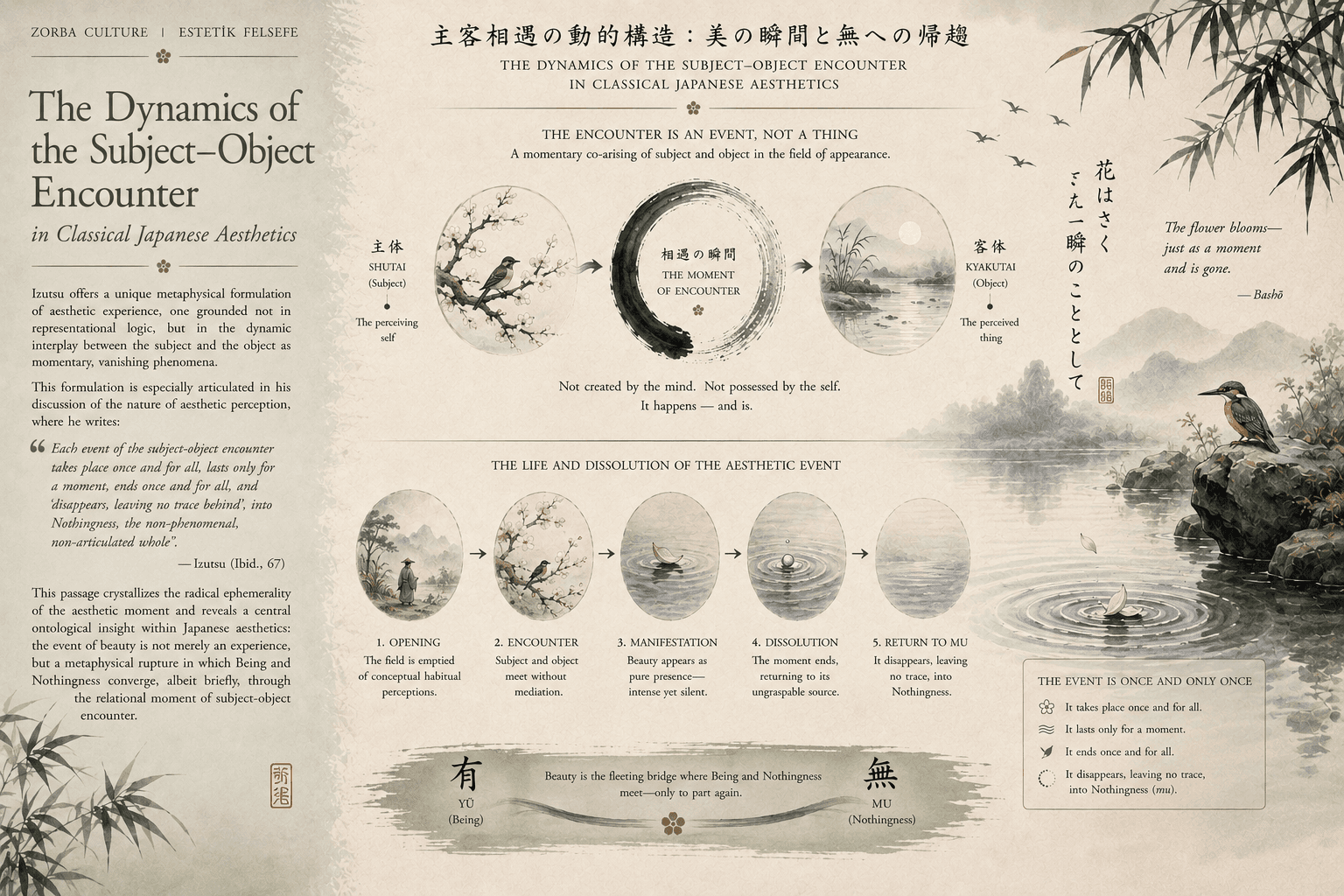
In The Theory of Beauty in the Classical Aesthetics of Japan, Izutsu provides a framework for understanding such formulations, not as poetic guidelines, but as articulations of a metaphysical logic governing the very structure of being and appearance in the Japanese aesthetic tradition. For Izutsu, the axis of Japanese beauty is defined by an ontological polarity: the vertical movement of spiritual detachment and inner stillness, and the horizontal unfolding of those conditions into concrete phenomena. Bashō’s dictum is not metaphorical. It is a structural mandate: the poet must internalize the vertical stillness of loftiness of the mind, but must not remain there. He must re-enter the world.
The "loftiness" of the state of mind, in this reading, is not merely a noble disposition. It is a condition of inward openness—what Izutsu repeatedly aligns with mu, emptiness—not as absence, but as a pre-formal potentiality. It is within this loftiness that the poet perceives the world unmediated, ungrasped by conceptual distortion. But this loftiness is not self-justifying. It must descend—or more precisely, radiate—into the domain of the mundane. Hence Bashō’s further assertion:
“The ‘loftiness’ of the state of mind is structurally validated only by its phenomenal manifestation, i.e., in this particular context the ‘mundaneness’ of the experiential actuality which, in its turn, is actuated by the state of mind, positively and vitally into a true phenomenal reality.” (Ibid)
This second statement reveals the ontological mechanism beneath Bashō’s poetic method. The vertical axis -the contemplative state- is not complete until it realizes itself in the horizontal axis -the phenomenological moment. This is not dualism; it is non-dual differentiation. The "lofty mind" and the "mundane actuality" are not two substances. They are two modes of a single continuum of being. Izutsu would insist that it is precisely through this polarity that Japanese aesthetic experience becomes structurally coherent. The mind in its loftiness is not simply contemplative; it is generative. The mundane world is not passively observed; it is vitalized, shaped, and rendered meaningful through the echo of the contemplative.
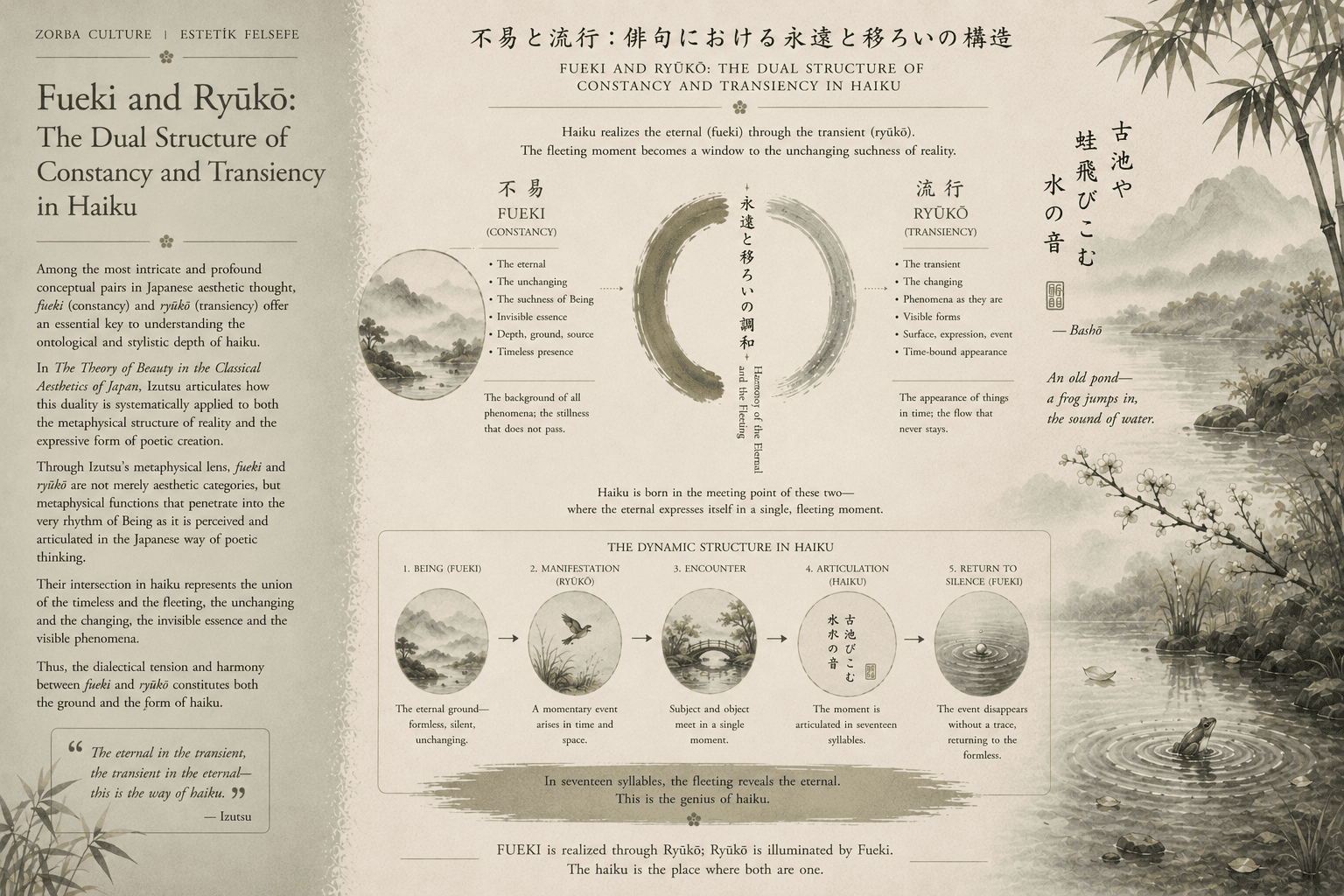
Thus, Bashō’s poetry is never an expression of inner mood, nor a record of external phenomena. It is the exact point at which inner loftiness and outer mundaneness converge to form a moment of irreducible suchness. The frog jumps into the pond -not as metaphor, not as image, but as event, born of a mind stilled in emptiness and returned to the world. This event is not illustrative of beauty -it is beauty, as it arises when the invisible axis of loftiness of the mind reveals itself in the fully lived immediacy of mundaneness of experiential actuality.
Izutsu’s analysis supports this non-representational view. The poet does not speak about the world; he lets the world speak itself, through him, once he has been emptied of all that would obstruct it. The mundane becomes the carrier of loftiness, and loftiness finds no other form than in the mundane. The structure is reciprocal, but not symmetrical: the world becomes actual in its relation to the purified gaze of the poet, and the poet becomes real through the world he re-inhabits.
In this light, Bashō’s insistence on the return to experiential actuality is not a retreat from contemplation but the very culmination of it. The vertical finds its truth not in separation from the horizontal, but in its full entry into it. As such, Bashō does not seek to escape the world, nor to elevate it artificially. He returns to it, precisely so it may be seen as it truly is: transient, subtle, ungraspable, and yet sufficient. Poetry, then, becomes the ontological enactment of this return—a moment when the Absolute manifests in a rusted gate, a chill wind, or a single falling leaf.
Thus, in the terms given by both Bashō and Izutsu, true poetic being is realized when contemplative loftiness actualizes itself into mundane particularity, and that particularity, in turn, becomes the luminous site wherein the mind of emptiness recognizes its own reflection. The loftiness and mundaneness are not stages, but poles whose tension produces the very condition of aesthetic revelation. The poet stands between them—not as a mediator, but as their meeting point.