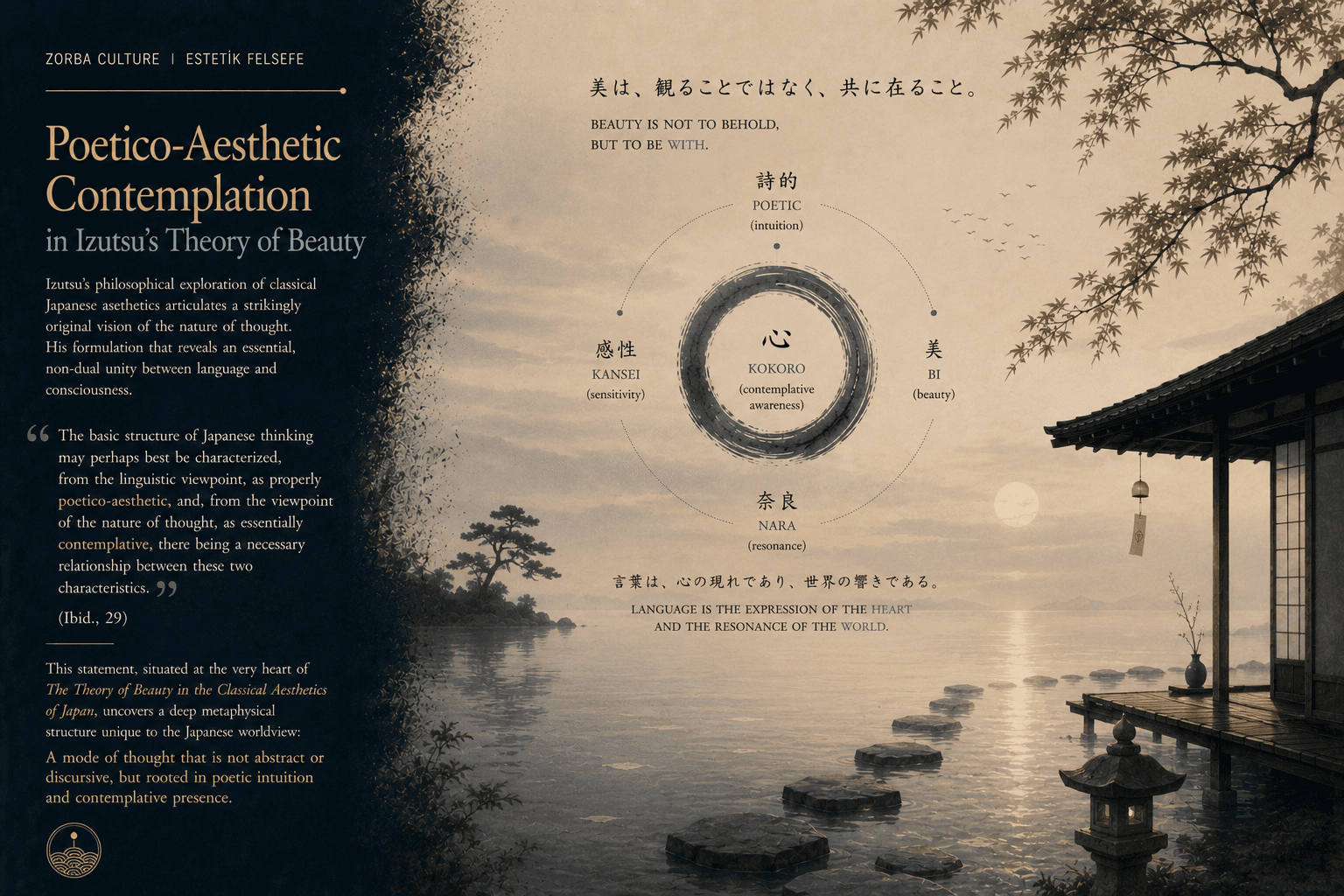
Izutsu’s philosophical exploration of classical Japanese aesthetics articulates a strikingly original vision of the nature of thought. His formulation that reveals an essential, non-dual unity between language and consciousness.
“The basic structure of Japanese thinking may perhaps best be characterized, from the linguistic viewpoint, as properly poetico-aesthetic, and, from the viewpoint of the nature of thought, as essentially contemplative, there being a necessary relationship between these two characteristics.” (Ibid., 29)
This statement, situated at the very heart of The Theory of Beauty in the Classical Aesthetics of Japan, uncovers a deep metaphysical structure unique to the Japanese worldview: A mode of thought that is not abstract or discursive, but rooted in poetic intuition and contemplative presence.
By examining the relation between poetic language and contemplative consciousness, we will see that Japanese thinking, as Izutsu describes it, emerges not from conceptual articulation, but from a silent, intuitive participation in the totality of being. This unique form of thought, where beauty and awareness co-emerge, will be clarified through Izutsu’s key metaphysical notions, such as the non-articulated whole, semantic restraint, kokoro, ma, and shizen. These concepts will help illuminate how the Japanese mind does not perceive the world as a set of discrete, objectifiable entities, but rather as a continuous unfolding of being -articulated not through analysis but through poetic evocation.
Izutsu begins with language not as a neutral communicative tool, but as the very medium through which a culture perceives and structures reality. In this sense, the poetico-aesthetic nature of Japanese thinking is fundamentally a linguistic phenomenon. But what does it mean for language to be “poetico-aesthetic”? It does not simply imply that Japanese speech is poetic in tone or rhythm; rather, it signifies that the act of articulation in Japanese language is guided by the principles of suggestion, subtle evocation, and resonance. Japanese words rarely define or delimit an object in logical clarity. Instead, they point toward a broader semantic horizon, a field of unspoken meaning whose richness lies precisely in its refusal to be closed off.
This aesthetic of evocation is rooted in what Izutsu calls the semantic style of restraint. Japanese language tends to withhold rather than expose, to suggest rather than define. The phenomenon of kakekotoba (pivot words) and enjambment in waka, for instance, reveals a consciousness of meaning that is layered, plural, and open to contemplation. The poetic word in Japanese functions as a resonance, not as a concept. Thus, the structure of thought that emerges from this language is not analytical, but contemplative. It does not seek to dissect reality into discrete categories, but to become one with the rhythm and movement of being itself.
Izutsu contrasts the Japanese mode of thought with the Western, especially Greek, philosophical tradition. Western thought often begins with logos -reason, definition, and categorization. But Japanese thinking, in Izutsu’s formulation, emerges from kan -a word that connotes deep seeing, intuitive insight, and silent contemplation. This contemplative mode of thought is not passive, but receptive: it allows the world to reveal itself in its suchness, without the interference of subjective projections or conceptual impositions.
This brings us to Izutsu’s crucial concept of the non-articulated whole -the metaphysical ground of all aesthetic and cognitive phenomena. The non-articulated whole is not a totality composed of parts; it is a pre-reflective unity, an original wholeness that precedes all division into subject and object, form and content, inner and outer. It is from this ground that beauty arises -not as an added attribute, but as the very form in which the whole momentarily appears.
Contemplative thinking, therefore, is the act of dwelling within this non-articulated whole without attempting to abstract from it. It is a mode of awareness that perceives the world as continuous, relational, and dynamic. In this state, the Japanese mind does not assert, interpret, or represent; it contemplates, listens, and allows. This contemplative stillness is not an absence of thought, but a deep alignment of thought with being.
Central to Izutsu’s theory is the concept of kokoro, often translated as “heart” or “mind,” but more accurately understood as the living ground of consciousness in its dynamic openness. Kokoro is the seat of both omoi (thought, image) and jō (feeling, emotion), yet it transcends the dichotomy of cognition and affect. It is the pure field in which perception, emotion, and meaning arise simultaneously as one integrated movement.
In this sense, kokoro is a contemplative function: it does not operate by objectifying reality but by resonating with it, much like a mirror that reflects things as they are, without distortion. The Japanese aesthetic ideal is not to impose form upon nature, but to allow form to emerge naturally from within. Hence, the concept of shizen (nature) in Izutsu’s framework is not the external “natural world” of objects, but the spontaneous becoming of things, the Tao-like unfolding of reality in its own rhythm.
The Japanese mind, Izutsu argues, does not stand apart from shizen as a detached observer. Instead, it participates in shizen contemplatively, letting beauty manifest from within the natural process itself. The poetic word, the brushstroke, the gesture -all arise from this ground of spontaneous order. There is no separation between thought and being, word and world. Beauty is not made; it is revealed.
What emerges from Izutsu’s work is not merely a theory of aesthetics, but a radical redefinition of what thinking is. Japanese thinking is not representational or abstract, but ontological -it is the movement by which the world is allowed to be, to come forth in its own voice. This is why Izutsu describes it as necessarily poetico-aesthetic and contemplative. The poetic element is not decorative -it is structural. It marks the very mode in which the world speaks through language, not as concept but as presence.
This contemplative-poetic thinking is not about arriving at truths, but about dwelling in the openness of things. In such a world, beauty is not the adornment of truth; it is truth in its self-showing. Thus, for the Japanese mind, to think is to let-be, to create the conditions for appearance without reducing that appearance to fixed identity.
Izutsu’s insight resonates with Zen and Daoist notions, but it remains uniquely tied to the Japanese linguistic and cultural sensibility. The Japanese language, with its capacity for ambiguity, semantic layering, and rhythmic silence, is not a mere medium for thought -it is the place (basho) in which thought happens. And in this basho, the poetico-aesthetic and the contemplative are not separate domains, but two inseparable aspects of a single metaphysical act: the emergence of beauty as thought, and the emergence of thought as beauty.