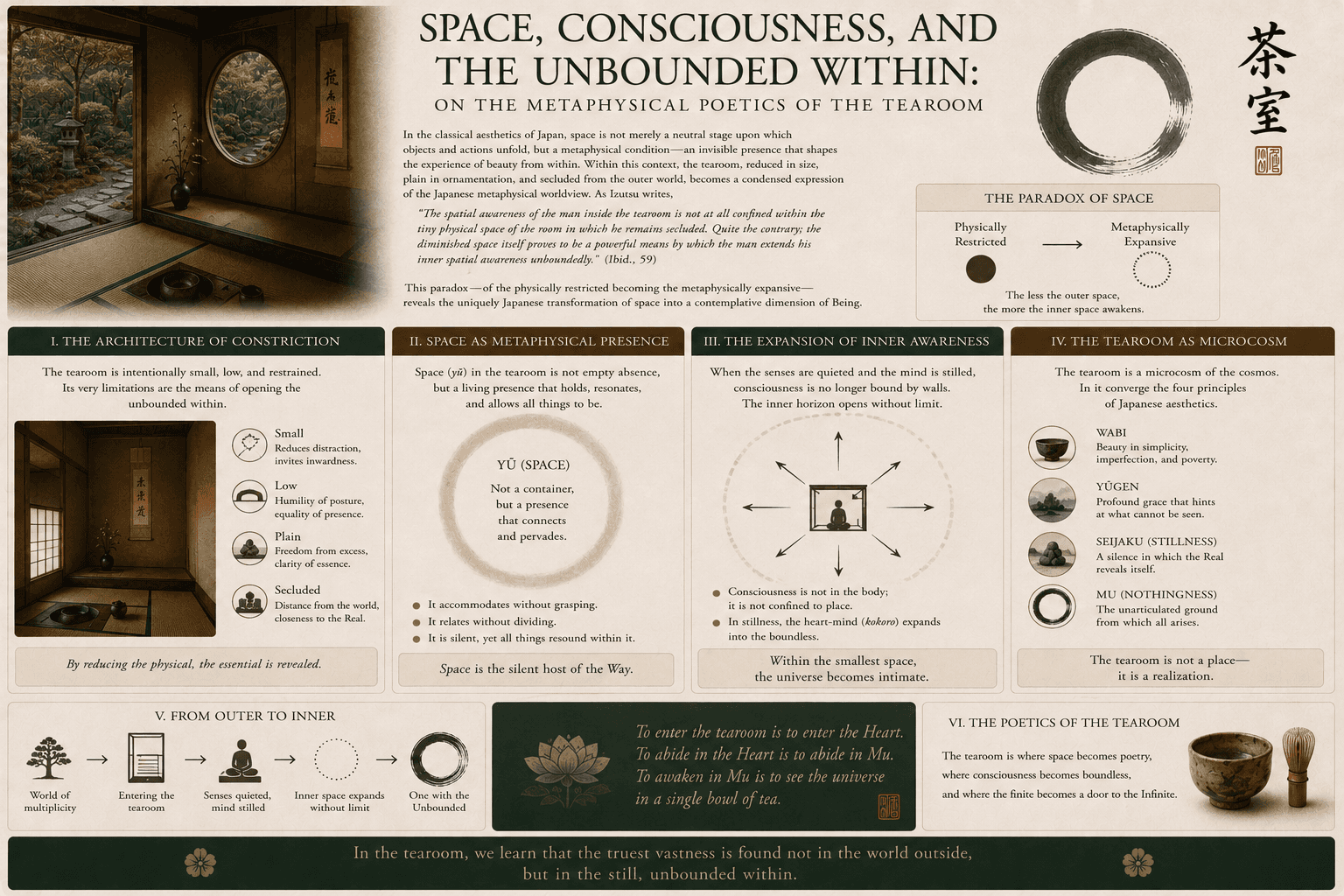
In the classical aesthetics of Japan, space is not merely a neutral stage upon which objects and actions unfold, but a metaphysical condition -an invisible presence that shapes the experience of beauty from within. Within this context, the tearoom, reduced in size, plain in ornamentation, and secluded from the outer world, becomes a condensed expression of the Japanese metaphysical worldview. As Izutsu writes,
“The spatial awareness of the man inside the tearoom is not at all confined within the tiny physical space of the room in which he remains secluded. Quite the contrary; the diminished space itself proves to be a powerful means by which the man extends his inner spatial awareness unboundedly.” (Ibid., 59)
This paradox -of the physically restricted becoming the metaphysically expansive- reveals the uniquely Japanese transformation of space into a contemplative dimension of Being.
In the Western metaphysical tradition, space tends to be conceived in Cartesian or Newtonian terms: a homogenous, extended container that remains indifferent to its contents. By contrast, Japanese aesthetics -as interpreted by Izutsu- treats space as qualitatively structured, intimately responsive to perception, and charged with affective resonance. The tearoom, traditionally no larger than four-and-a-half tatami mats, is not experienced as “small” in the geometrical sense. Rather, its spatial limitation functions as a gateway to a new mode of awareness -a contraction of the external that gives rise to an expansion of the internal.
This transformation reflects what Izutsu calls the movement from the articulated to the non-articulated. The articulated space -the visible structure of the tearoom with its precise dimensions, walls, alcove, and tatami arrangement- is not the final horizon of experience. Rather, these limited elements point beyond themselves, acting as symbols of a metaphysical reduction in which the finite turns inward, toward the infinite. The man seated within this space does not occupy it as a body in physical extension, but dwells in it as a consciousness in poetic receptivity. The spatial awareness that arises is not that of coordinates, but of silence -an unmeasured fullness that arises precisely through physical diminishment.
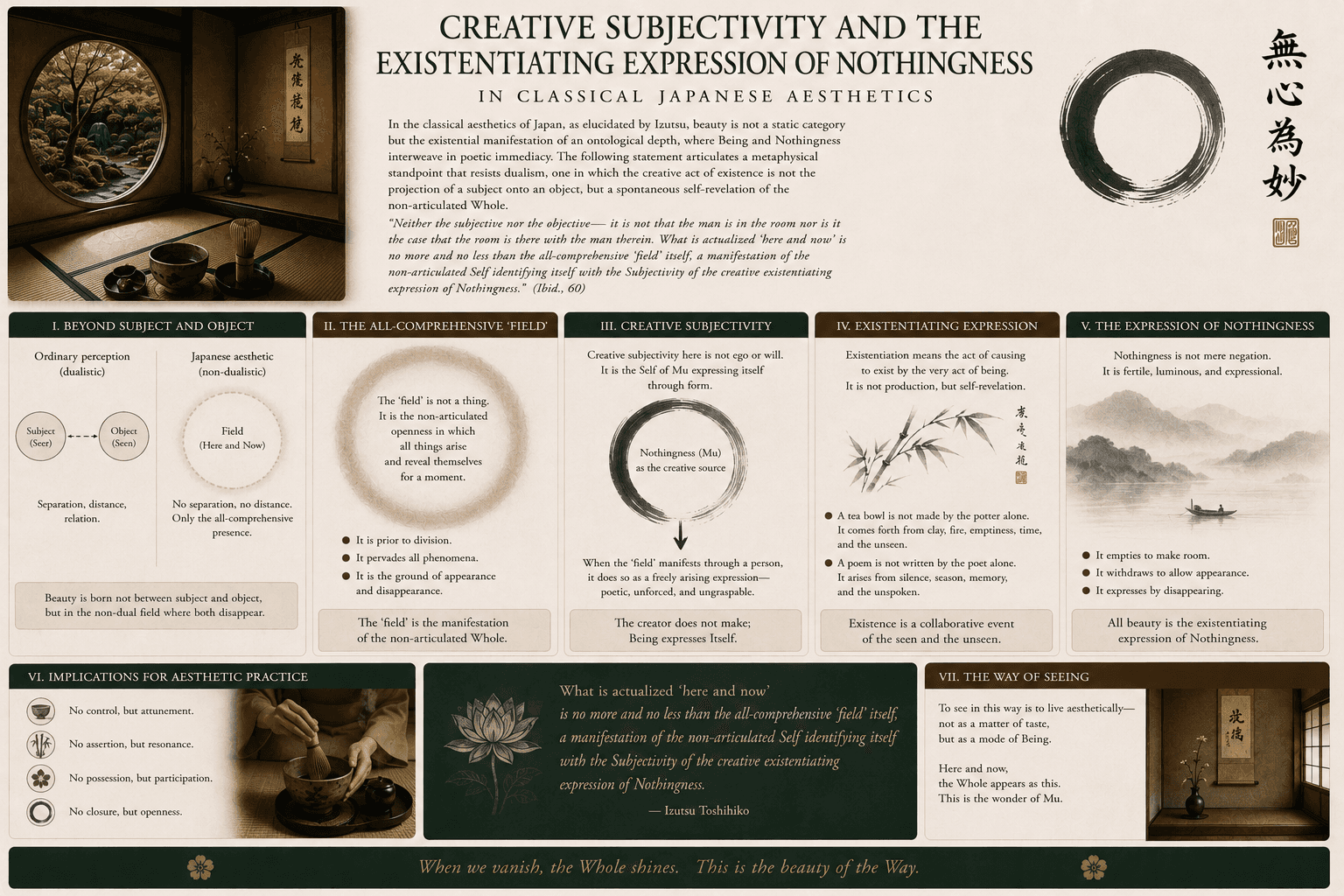
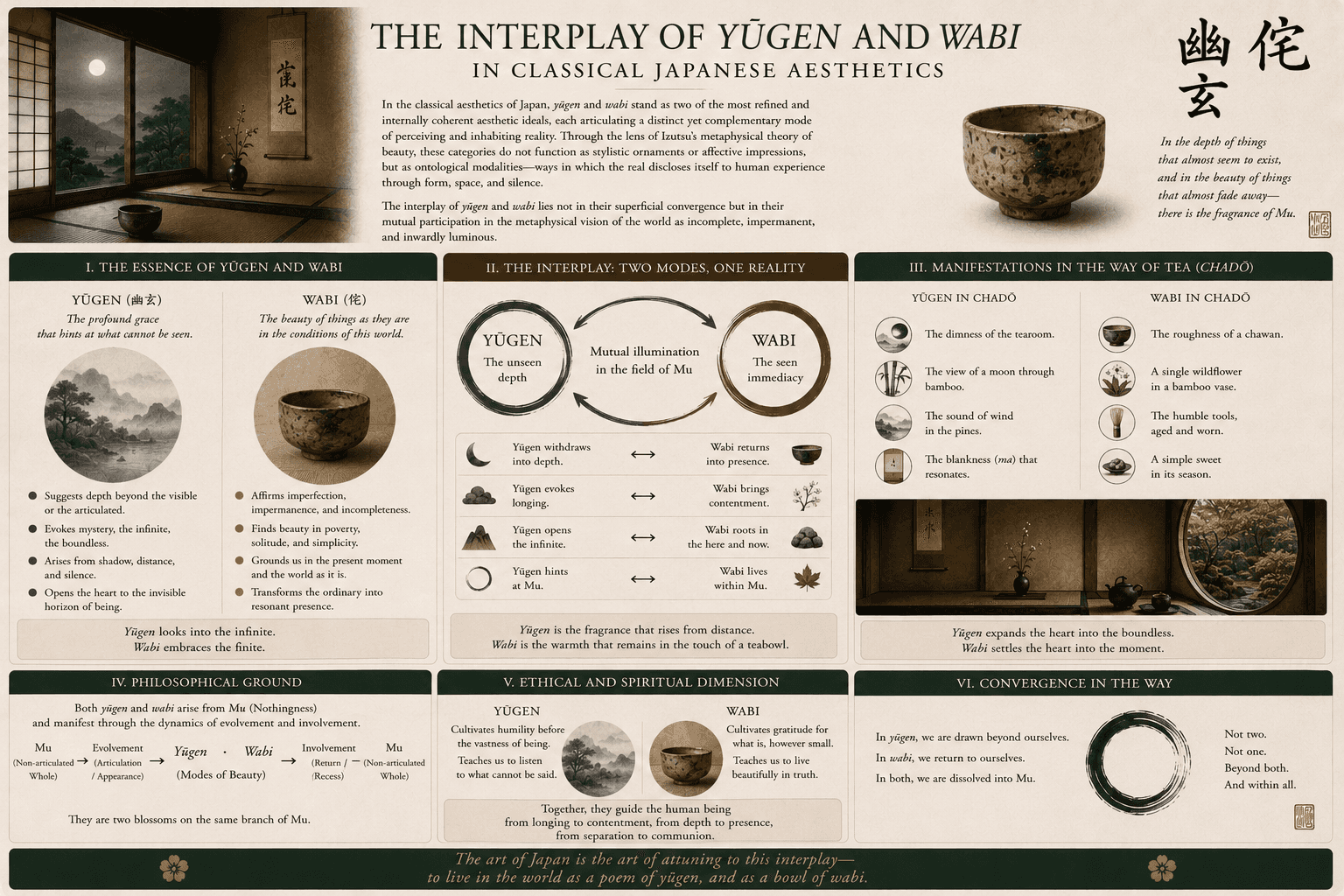
Izutsu places at the centre of Japanese aesthetic thinking the concept of mu, Nothingness -not as a negation of being, but as a metaphysical openness that underlies all concrete appearances. The tearoom is the architectural manifestation of this principle. The space is empty not only in terms of minimal furnishing but in the deeper sense that it has been cleared of all distraction, utility, and ego-assertion. This emptiness (kū) is not void, but the condition for receptivity, for the unobstructed movement of kokoro, the heart-mind. The man in the tearoom does not encounter space as an object; he becomes space as a mode of spiritual participation.
This emptiness is not passive. It is dynamic, resonant, and full of potentiality. Within it, the awareness of space becomes analogous to the awareness of Being itself -not Being as a fixed essence, but Being as yū, the arising of presence within emptiness. In Izutsu’s terms, mu and yū are not opposites, but polarities within a single metaphysical field. The small, quiet room, by diminishing sensory noise, brings into relief the subtle vibration of yū within mu. The tearoom becomes a still point at which Being gently discloses itself through its own absence.
The space of the tearoom is designed to elicit a transformation not in things, but in kokoro, the interior faculty of perception and poetic intuition. Kokoro, for Izutsu, is not simply emotion or cognition -it is the spiritual centre of the self, the point at which the inner world and outer world interpenetrate. In the tearoom, kokoro moves in response to the delicate interplay of shadows, textures, and silences. This movement is not goal-oriented; it is contemplative, intuitive, and non-discursive. Spatial awareness here is not a mental mapping of distances, but a resonance with what is not immediately seen or said. The man seated in the tearoom perceives space not as occupied, but as pregnant with absence -and this absence allows the field of consciousness to dilate beyond the visible.
The awareness that emerges is not one of separation between subject and object, but of co-being -an immersion in the quality of space as poetic presence. The tearoom is thus not experienced from the outside, as an architectural object, but from the inside, as a rhythm of awareness. In Izutsu’s terms, this shift marks the passage from epistemological dualism to ontological immediacy: the man is not confronting a space; he is dwelling in Being.
A crucial dimension of this spatial awareness is the Japanese concept of ma -the interval, the pause, the “between.” Ma is not an empty gap but a meaningful silence, a temporal and spatial breath in which things reveal themselves not by assertion, but by withdrawal. In the tearoom, ma pervades every aspect: the space between objects, the moment between the raising and lowering of a tea ladle, the shadow between the paper shoji and the light. Izutsu interprets ma as a metaphysical operator that allows yū and mu to interweave. It is in ma that the articulated and non-articulated touch each other.
Within ma, spatial awareness becomes a form of listening -an attunement to what lies beneath appearance. The man in the tearoom, in his stillness, listens not with his ears but with his whole being. His perception becomes less about things and more about the relations between things -the invisible threads of tension, the quiet hum of presence. This experience transforms space from a backdrop into an event -a metaphysical happening that unfolds through silence and presence. In this sense, the tearoom becomes a sanctuary of ma, a cradle for the poetic arising of Being.
Ultimately, the tearoom is a spatial metaphor for consciousness itself. It is a world reduced to essentials, stripped of distractions, purified into a metaphysical clarity. The physical contraction of space allows for the dilation of inner depth. In Izutsu’s language, the tearoom enacts a movement from the phenomenal to the noumenal, from the articulated world of appearances to the non-articulated world of being-aware. The walls, the ceiling, the soft light, all serve not as enclosures but as thresholds. What appears as containment is, in truth, opening.
The spatial awareness cultivated in the tearoom is not passive perception but a poetic function of consciousness. It is an awareness that creates the world not by imposing form, but by receiving it in its emptiness. In this way, the man in the tearoom becomes a microcosm of the metaphysical Whole: a centre of stillness in which the infinite speaks through finitude. The tearoom does not reduce the world; it reveals that the vastness of the world lies not in what can be seen, but in what can be silently felt.
To sit in the tearoom is to be present in a space that is no-space -a space that has renounced physical expansion in order to recover metaphysical depth. Through Izutsu’s theory of beauty, we come to understand that such space is not a container, but a condition of awareness. It is not the outer form that matters, but the mode of being it elicits. The man who sits alone in the tearoom is not isolated; he is immersed in the silent unfolding of Being, made possible through emptiness, through ma, and through the poetic vibration of kokoro. In this moment, space is no longer an object to be traversed, but a presence to be dwelt within -and in that dwelling, the entire cosmos breathes.