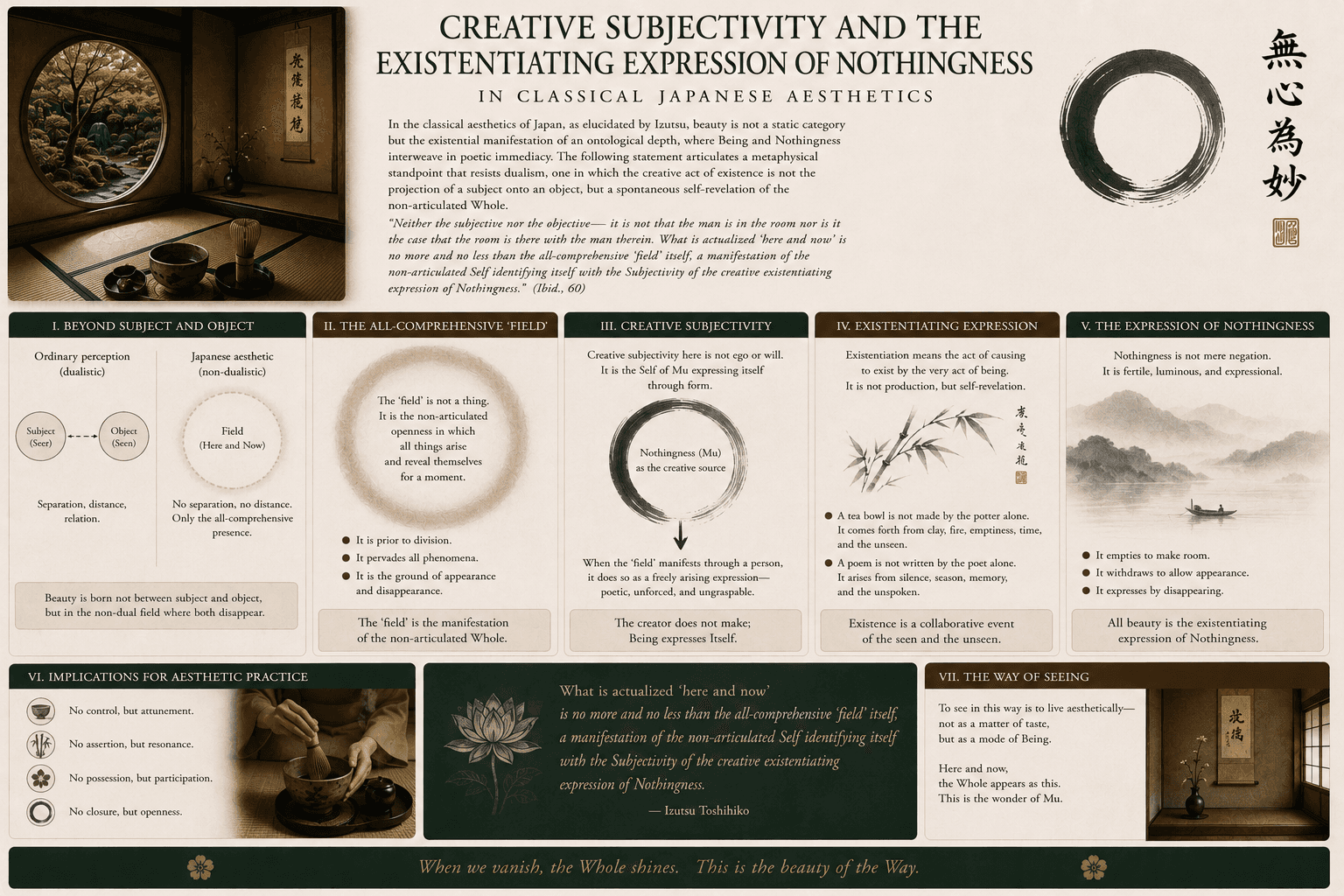
In the classical aesthetics of Japan, as elucidated by Izutsu, beauty is not a static category but the existential manifestation of an ontological depth, where Being and Nothingness interweave in poetic immediacy. The following statement articulates a metaphysical standpoint that resists dualism, one in which the creative act of existence is not the projection of a subject onto an object, but a spontaneous self-revelation of the non-articulated Whole.
“Neither the subjective nor the objective- it is not that the man is in the room nor is it the case that the room is there with the man therein. What is actualized 'here and now' is no more and no less than the all-comprehensive 'field' itself, a manifestation of the non-articulated Self identifying itself with the Subjectivity of the creative existentiating expression of Nothingness.” (Ibid., 60)
Izutsu’s metaphysical vision of beauty draws its force from the Oriental mode of thought, where the bifurcation between subject and object is dissolved into a deeper existential unity. The passage opens with a negation: “Neither the subjective nor the objective.” Here, Izutsu implicitly invokes a critique of Western metaphysics, particularly Cartesian dualism, which posits the thinking subject as distinct from the world it perceives. Instead, the Japanese aesthetic sensibility -especially in traditions like waka, Noh, and haiku-perceives the world not as a set of objects external to the self, but as a field of mutual interpenetration where the self is not a fixed ontological centre but a point of disappearance into the Whole.
This Whole is referred to in Izutsu’s terminology as the “non-articulated Self,” a metaphysical unity that precedes and transcends any conceptual division. The aesthetic act, then, is not the expression of the self, but rather the self-expressing field itself -a field in which both the self and the world simultaneously arise. Creative subjectivity, in this framework, is not egoic self-expression[1] but the “existentiating expression of Nothingness,” where mu becomes manifest as a poetic event.
To understand the nature of creative subjectivity, we must revisit Izutsu’s interpretation of kokoro, the “heart-mind” that lies at the centre of classical Japanese aesthetics. In Izutsu’s account, kokoro is not a psychological entity, but a metaphysical function that binds interiority and exteriority in a non-dual unity. In a waka poem, for instance, kokoro is the locus where the emotion of the poet and the form of the natural world coalesce into a single expressive gesture. Yet this kokoro is not a stable subject; it is ever-shifting, like a mirror reflecting without holding, a transient centre in the flow of phenomena.
The creative subjectivity that arises here is grounded not in the affirmation of a personal identity but in the negation of it. That is, true creativity in the Japanese sense begins only when the ego-self disappears, giving way to mu -Nothingness- not as a void, but as the origin of all form. The “existentiating expression of Nothingness” is the moment when the self effaces itself so completely that beauty can emerge unimpeded. This is the essence of yūgen, that subtle profundity which points toward the invisible behind the visible.
Izutsu describes the aesthetic moment as the actualization of an “all-comprehensive ‘field’.” This notion corresponds to the metaphysical plane of the tōtai, the Whole, as a field of immanence where subject and object no longer stand opposed. In Zeami’s Noh aesthetics, this is realized in the moment of hana (the flower) -a sudden, fleeting emergence of beauty that cannot be willed or possessed. The actor, in a state of mu-shin (no-mind), becomes a vessel for the field to express itself through movement, gesture, and stillness. The field is not somewhere “between” the actor and the stage, but rather the very actuality of their non-dual interrelation.
In this sense, creative subjectivity is not a personal choice but a metaphysical transparency. It is Nothingness actualized as poetic gesture. The man is not “in” the room, nor is the room simply “there” with him; rather, what exists is a self-generating field in which both the man and the room arise as co-expressive elements of the Whole. The aesthetic moment -whether in waka, Noh, or haiku- is the moment when the field blooms, where the non-articulated becomes articulated just enough to suggest, never to assert.
Izutsu distinguishes between the articulated and the non-articulated. The articulated is the world of form, language, and concept. The non-articulated is the formless source, the metaphysical ground. Creative subjectivity, in its highest form, is the moment when the non-articulated Whole expresses itself through a minimal articulation—an image, a sound, a word—without breaking the unity of its origin.
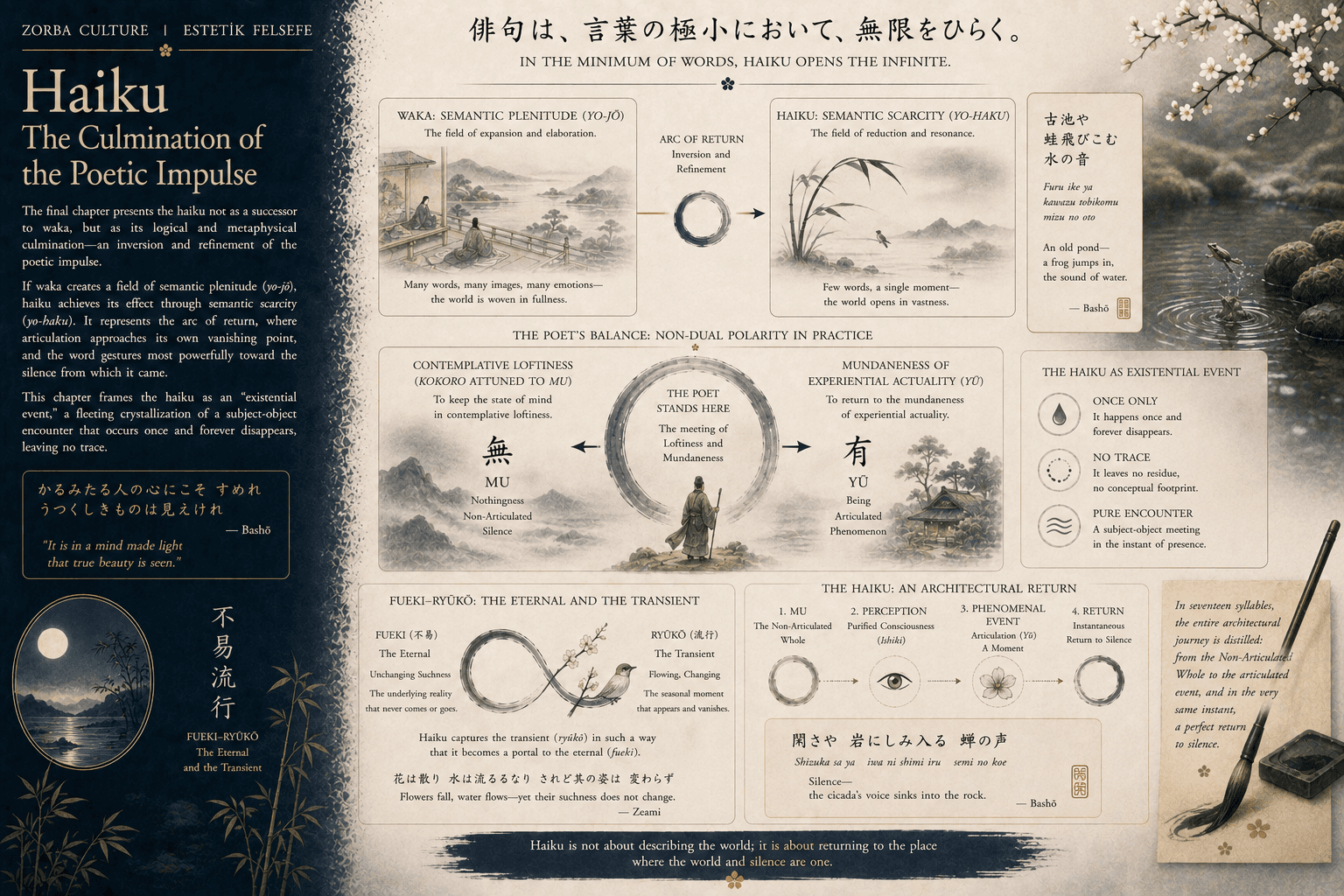
Haiku poetry embodies this structure. The seventeen syllables of a haiku are not mere linguistic forms; they are metaphysical cuts through which mu reveals itself. The poet’s subjectivity is present, but not as an ego. Rather, it is the Subjectivity of the field itself, momentarily assuming form. This is why the beauty of Bashō’s haiku does not lie in personal emotion but in the depth of impersonal presence. The frog’s leap into the old pond is not observed by a subject, but is the poetic field itself actualizing as event.
In Izutsu’s vision, creative subjectivity is not an assertion but a disappearance -the self dissolves into the act, and in that vanishing, beauty arises. The field is neither internal nor external; it is the metaphysical here and now where Being and Nothingness dance as articulation and silence. The aesthetic subject is the non-articulated Self identifying with the expression of the field, not as master or observer, but as the openness through which the Whole momentarily takes form.
Thus, the Japanese aesthetic tradition, seen through Izutsu’s metaphysical eye, redefines the very nature of creativity: not as an expression from a self, but as the spontaneous self-expression of the Whole. In that silence, in that mu, lies the purest form of beauty.
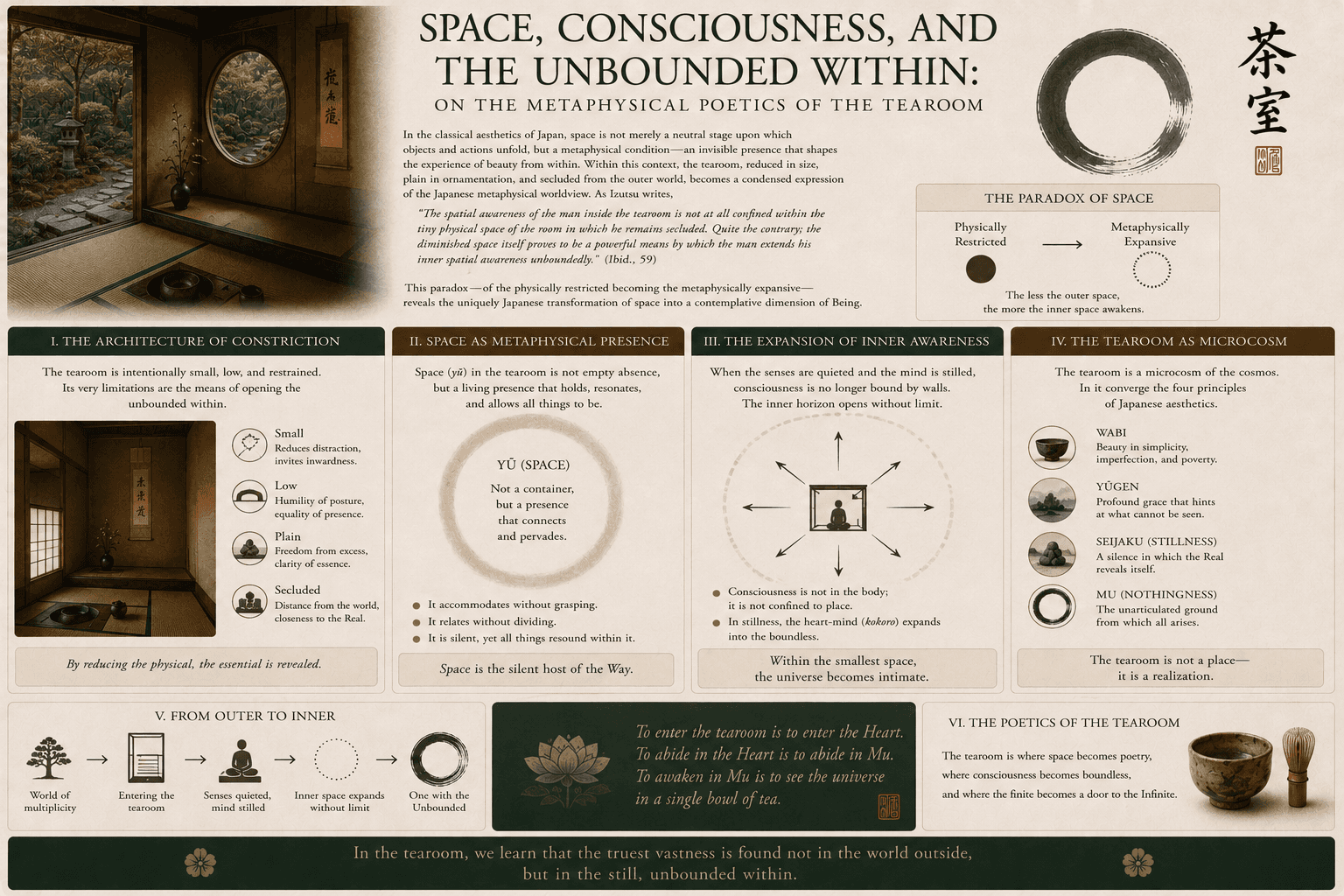
The silence of Tea finds its echo in the stillness of haiku. What the hand performs, the word now captures—not by describing the moment, but by becoming it. In haiku, the world reveals itself in its most fleeting articulation: a season, a sound, a single gesture of nature. But this is not minimalism—it is distillation. After the long passage through form, thought, and ritual, haiku returns us to the origin: the moment before the word, suspended in the syllable.
[1] Description and self-expression are related but distinct modes of articulation. Description typically involves the objective or intersubjective presentation of phenomena, focusing on rendering details, qualities, or states in a manner that can be apprehended or recognized by others. It emphasizes clarity, accuracy, and communicability, often serving as a means to convey what is externally or experientially manifest. In contrast, self-expression is a more subjective and creative act, wherein the individual manifests inner states, emotions, or unique perspectives through an artistic or embodied medium. Self-expression involves an unfolding of the self in relation to the world, not merely reporting on it, but actively disclosing an original presence or insight. While description aims to represent, self-expression seeks to reveal or embody a lived truth, often transcending literal depiction to evoke resonance and participation.