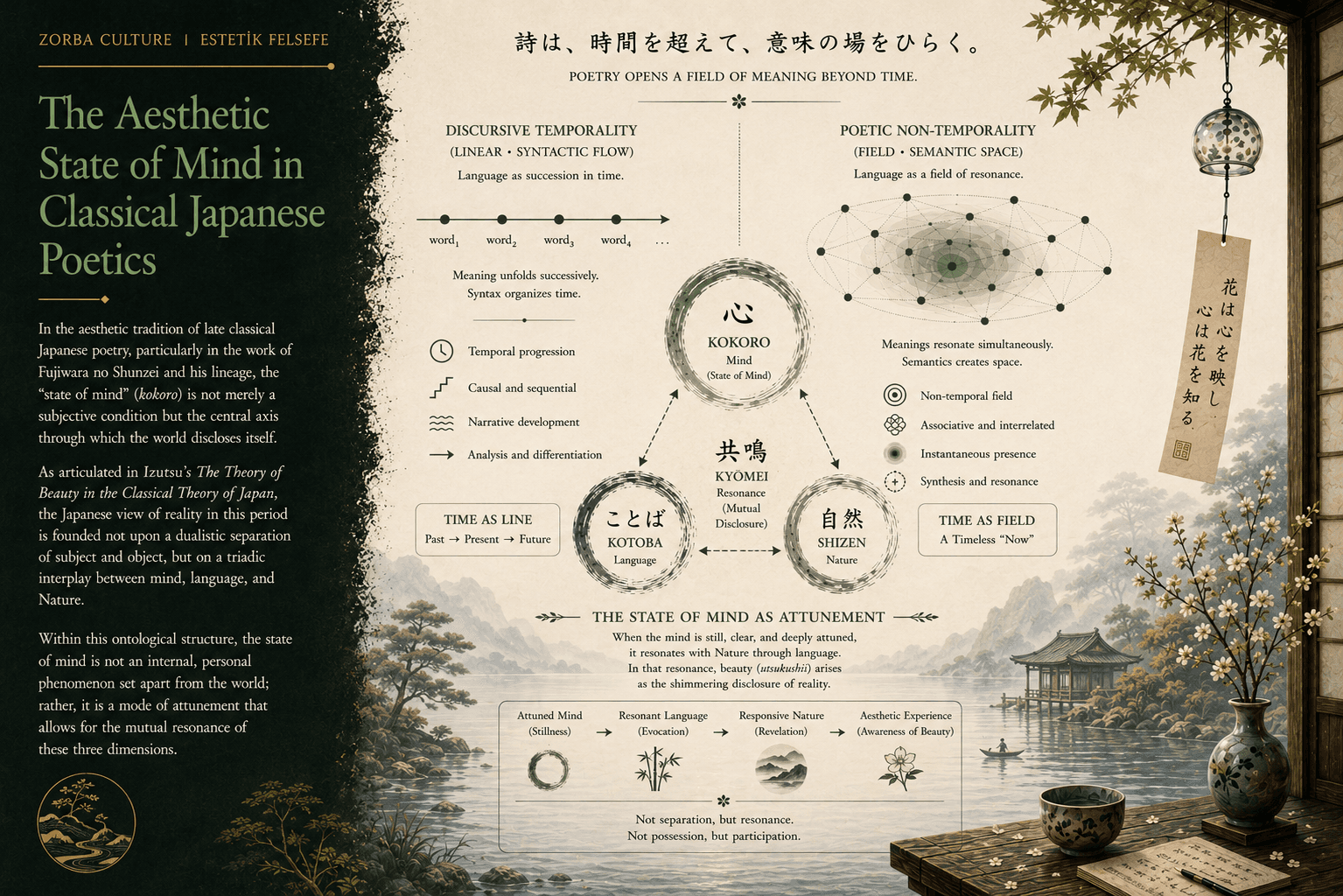
In the aesthetic tradition of late classical Japanese poetry, particularly in the work of Fujiwara no Shunzei and his lineage, the “state of mind” (kokoro) is not merely a subjective condition but the central axis through which the world discloses itself. As articulated in Izutsu’s The Theory of Beauty in the Classical Theory of Japan, the Japanese view of reality in this period is founded not upon a dualistic separation of subject and object, but on a triadic interplay between mind, language, and Nature. Within this ontological structure, the state of mind is not an internal, personal phenomenon set apart from the world; rather, it is a mode of attunement that allows for the mutual resonance of these three dimensions.
The mind (kokoro), in this tradition, is never static or uniform. It exists in varying states, each with the potential to reveal different aspects of reality. It is the quality of the mind, its state at a given moment, that determines what aspect of the world will come into view. The world does not present itself independently of the perceiver’s disposition; instead, reality unfolds relationally, depending on the refinement, stillness, or turbulence of the perceiving mind. Thus, the mind functions not as a container of impressions, but as a field of dynamic resonance.
Within this view, the state of mind becomes an ontological precondition for perception, not a distortion of it. A disturbed or clouded mind will fail to perceive the deeper resonances of Nature, while a clarified and stilled mind -one in harmony with itself- will serve as a transparent medium through which reality’s more delicate qualities emerge. The world is not something that exists outside the perceiving subject; it reveals its form only when mirrored in the purified stillness of the mind. This principle finds poetic articulation in waka and haiku, where the poetic image is not a constructed representation but a momentary revelation: a scene as seen through a particular state of mind.
Importantly, different states of mind correspond to different expressive unfolds. The classical poetic ideal required a deep sensitivity to the subtle emotional and spiritual textures that the heart could occupy. Terms such as aware, sabi, or yūgen do not name external realities, but rather, interior states that allow certain aspects of the world to emerge poetically. These are not moods in the modern psychological sense, but finely cultivated dispositions of perception. Aesthetic value in Japanese poetics lies not in the object itself, but in the particular state of mind, which is capable of seeing into the inner reality of the object.
This explains why, in the traditions influenced by Zen and the dō (the Way), such as the tea ceremony, Noh theatre, or poetry, the emphasis is placed not on formal mastery alone, but on the inner cultivation of the practitioner. Mastery of technique is inseparable from mastery of the mind. The core of the dō lies in the training of the heart to enter the appropriate state from which authentic action can arise. The perfection of the form is but the natural outflow of a perfected state of mind.
The notion of stillness (kyo or sakai) is critical in this context. It is not passivity but a high state of readiness and receptivity -a condition in which the mind ceases to impose and begins to listen. This stillness is dynamic. It permits the spontaneous convergence of Nature, mind, and language in the poetic moment. In haiku, especially, the poet does not compose a poem through conscious manipulation but allows a fleeting perception to pass through a purified state of mind. The mind does not seek, but it receives. The haiku becomes a trace of this moment -a linguistic crystallization of a particular alignment of inner and outer worlds.
What emerges from this is a radically different understanding of the mind’s role in art and perception. In contrast to the Western model -where knowledge is acquired by observing an objective world- the Japanese model posits that the world becomes articulate only through the mediating form of kokoro. Beauty, then, is not out there to be captured; it is within the interplay of one’s state of mind and the form of things. It is relational and transient, not absolute.
In this sense, the state of mind is not merely important to the production of poetry; it is the very site where poetry happens. Without the appropriate state, even the most vivid natural scene remains silent. But when the mind is attuned, the scene speaks -not in concepts, but in resonant images. The poetic moment occurs when the form of the world and the form of the heart enter into a correspondence too subtle for analysis but too real to deny.
Ultimately, the aesthetic tradition shaped by this philosophy regards the cultivation of mind as an ethical and spiritual task. The goal is not only to refine artistic sensitivity but to transform the very way one inhabits the world. In training the states of one’s mind, the poet -or actor- does not merely achieve personal insight; they participate in the ongoing unfolding of reality itself.