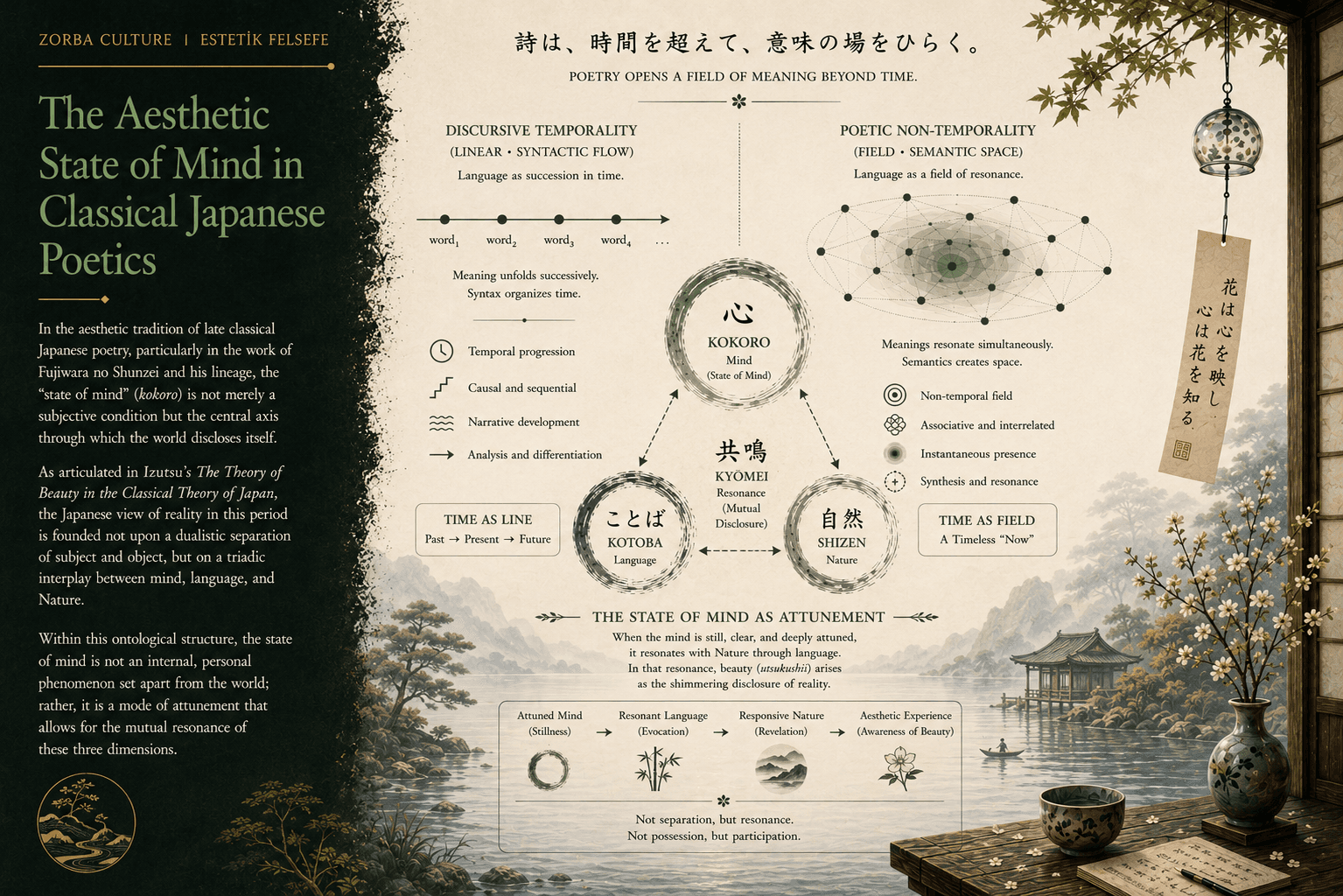
In Izutsu’s analysis, kokoro functions primarily as the inner state of being wherein the subject perceives, resonates with, and articulates the beauty of the world. But this state is not psychological in the modern Western sense—it is closer to a metaphysical attunement to the structure of reality. As such, kokoro is simultaneously contemplative, intuitive, and affective. It is both the seer and the seen, the ground of perception and the field of appearance.
This aesthetic state of mind is particularly evident in the expression of mono no aware—the sensitivity to the transience of things. When the poet or artist is immersed in this state of kokoro, they do not simply observe the world; they feel the world’s inner vibration within themselves. A falling leaf or a passing cloud is not merely an external phenomenon but a revelation that strikes the kokoro, resonating within it and drawing forth a response.
Izutsu stresses that this state of kokoro is not an analytical awareness but an aesthetic cognition—a mode of knowing that fuses perception, feeling, and metaphysical insight. In this sense, kokoro is the medium through which the non-articulated Whole becomes partially articulated in experience, without losing its ineffable core.
In The Theory of Beauty in the Classical Aesthetic of Japan, Izutsu asserts that:
“Taken technically in the narrow sense, kokoro may be said to be a particular domain of inner subjectivity, namely that of the 'not-yet activated', prior to all functional manifestations. The kokoro in its broad sense, however, signifies the whole domain of inner subjectivity covering both the 'not-yet-activated' and 'already-activated', the ground and its manifestation, including images, ideas, thoughts, feelings and emotions.” (Ibid., 7)
The not-yet-activated kokoro is the state of latent potential within the consciousness. It is the pre-aesthetic condition in which the heart-mind has not yet been touched by the world, but is primed for resonance. Izutsu interprets this state metaphysically, as a silent, undisturbed openness—a mirror that has not yet reflected an image.
His idea of the not-yet-activated kokoro bears strong affinity with the Daoist and Zen-influenced notion of emptiness (kū), wherein the mind must be cleared of attachments and conceptual entanglements in order to be truly receptive. It is a stillness pregnant with possibility, a metaphysical readiness to be stirred by the beauty of Being.
In classical poetics, this state often precedes the act of creation. Before the waka poet composes, there is a silent moment in which nothing is yet formed, but everything is implicitly present. It is the twilight before expression, the breath before the utterance. This inchoate kokoro is not inactive—it is silently vigilant, fully alert in its emptiness, echoing Izutsu’s formulation of the non-articulated Whole.
The already-activated kokoro is the state in which the heart-mind has been touched, stirred, and moved. It is the moment when an external phenomenon—a sound, a fleeting glance, a natural occurrence—has penetrated into the field of consciousness and elicited a deep inner reverberation. Here, kokoro becomes dynamic and expressive, transitioning from pure receptivity to poetic or artistic articulation.
This activation, however, is not a violent or dominating act; it is a gentle movement, a motion of the heart that arises from resonance with the world. In Izutsu’s view, this is where ishiki (consciousness) fulfils its aesthetic and metaphysical function: to let Being disclose itself through the subtle inner movements of the self.
Poetic articulation, such as that found in waka or haiku, is the crystallization of the already-activated kokoro. But such articulation must remain delicate and indirect, allowing the unspoken vastness of the original experience to linger. This is why classical Japanese aesthetics values suggestion over exposition, evocation over description. The already-activated kokoro does not seek to conquer the moment through words but to preserve its ineffability within the structure of expression.
The triadic movement of kokoro can be understood as a metaphysical arc: from emptiness (not-yet-activated), to resonance (state of mind), to expression (already-activated). These are not static states but phases of a single unfolding process. The beauty that emerges in classical Japanese aesthetics is the trace of this movement—a trace left by the passage of Being through the medium of kokoro.
Izutsu’s theory allows us to see this not merely as a psychological sequence but as a metaphysical rhythm inherent in consciousness. The not-yet-activated kokoro holds the silence of the Whole. The state of mind is its contemplative clarity. The already-activated kokoro is the reverberation that gives rise to poetic form. At each phase, beauty appears not as a substance but as a modulation—an echo of the infinite within the finite.
This dynamic is preserved in aesthetic principles such as yūgen (mysterious depth) and ma (interval), which reflect the ongoing interplay between presence and absence, articulation and silence. A poem, a Noh gesture, or a brushstroke becomes beautiful precisely because it enacts this movement of kokoro—from void to vibration to visible trace.
In Izutsu’s metaphysical aesthetics, kokoro is not merely the seat of emotion or thought—it is the metaphysical eye, ear, and mirror of beauty. As the not-yet-activated kokoro, it is the silent potential of resonance; as the state of mind, it is the contemplative medium of aesthetic perception; as the already-activated kokoro, it is the expressive trace left by the world’s subtle touch. The interplay between these modalities constitutes the inner rhythm of Japanese aesthetic experience—a rhythm not of production but of participation in the self-disclosure of Being. Beauty, in this view, is neither object nor judgment, but a movement within kokoro that reveals the eternal in the fleeting, the whole in the part, the unspoken in the uttered.