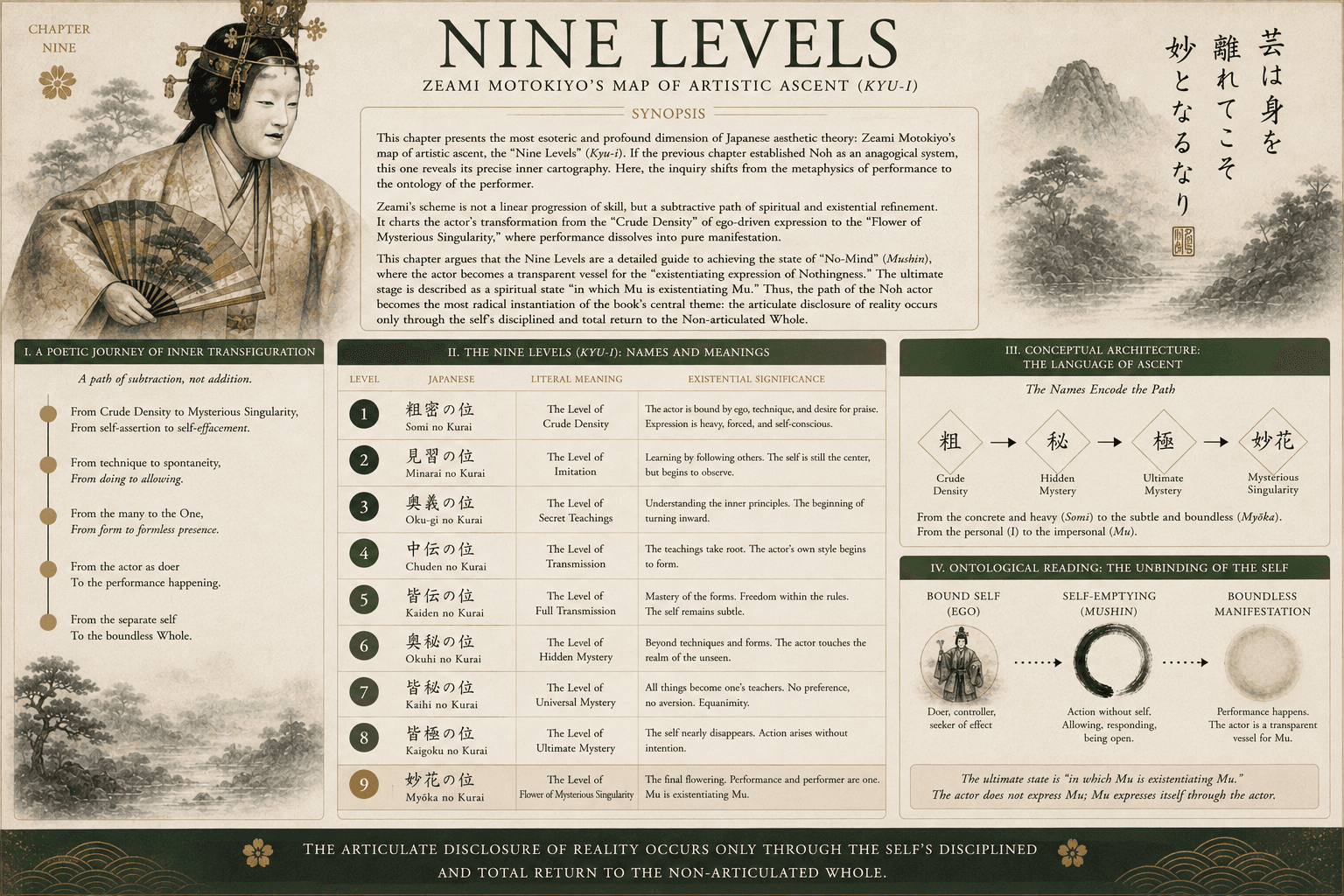
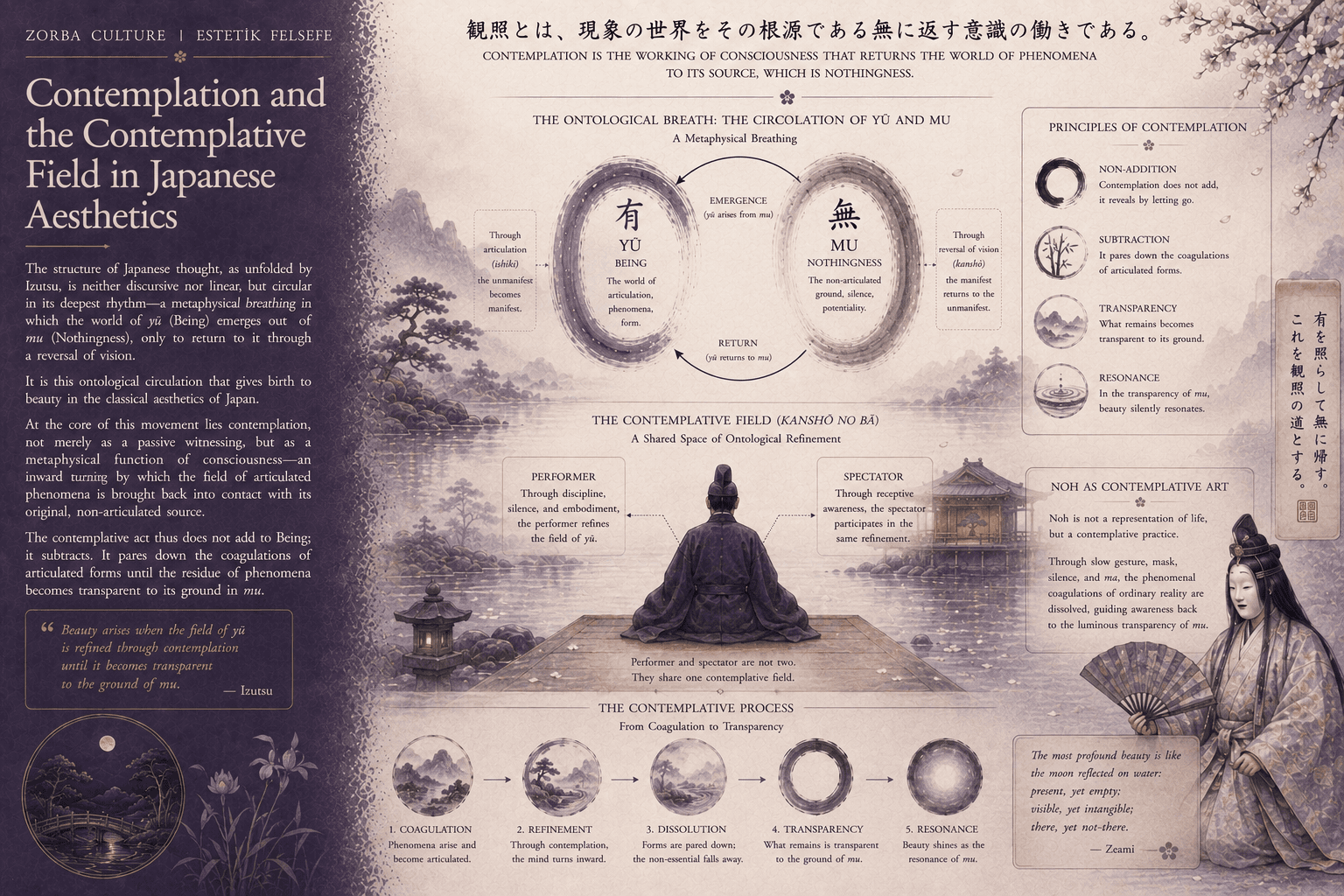
In the framework of classical Japanese aesthetics, as elucidated by Izutsu in The Theory of Beauty in the Classical Aesthetics of Japan, beauty is not merely a sensuous or psychological phenomenon, but a manifestation of a metaphysical depth, disclosing the movement of Being and Nothingness within the aesthetic consciousness. Within this ontological horizon, the theory of Noh developed by Zeami Motokiyo, particularly in his treatise Kyu-i (The Nine Stages), exemplifies a model of contemplative experience which advances through a series of inwardly deepening “fields.” These fields are not psychological states in the Western sense but are metaphysical strata of consciousness -levels of ishiki- where the aesthetic subject (kokoro) gradually dissolves into the non-articulated unity of the Real. Zeami’s fourfold articulation of the contemplative process thus corresponds, in Izutsu’s metaphysical reading, to an anagogical unfolding of beauty as a path toward Nothingness.
We may delineate these four stages as concentric layers of contemplative depth, each corresponding to a transformation in the relation between the self and the aesthetic field -a transformation not merely of perspective, but of ontological quality. In what follows, we analyze each stage in light of Izutsu’s metaphysical categories: the articulated and the non-articulated, yū (Being) and mu (Nothingness), kokoro and ma, leading to the final state of absolute aesthetic transparency.
The First Level (The Formative Field of External Mastery): At the most exterior level, the field of contemplation is still largely defined by technical form and mimetic performance. Zeami speaks of the performer's ability to master external expression -movement, voice, and gesture- in accordance with the formal canons of the tradition. In Izutsu’s terms, this stage corresponds to what he calls the “articulated whole”, in which beauty appears through an orderly, externally structured expression. Here, the contemplative field is governed by conscious control, where the actor's kokoro is still “attached” to the articulated elements of the performance. Although this stage may produce aesthetic pleasure, it is still within the realm of representation; the field is not yet metaphysically transparent.
This stage, as Izutsu would say, is the level where omoi (thought and semantic articulation) predominates over jō (emotion). The self is still cantered, and the world appears as its object. Beauty is perceived, but not yet truly felt as a metaphysical presence. The field remains dualistic.
The Second Level (The Internalization of Technique and the Beginning of Non-Attachment): With prolonged experience, the performer gradually internalizes the forms to the point where expression becomes spontaneous and unselfconscious. Zeami describes this stage as one in which the actor is “not performing,” though he performs. Here, the contemplative field opens toward a deeper horizon: the actor no longer manipulates form but becomes it. The body and kokoro act in unity; the self begins to “forget itself” in performance.
Izutsu interprets this as a crucial metaphysical turn: the dissolution of the articulated into the non-articulated whole. Beauty now emerges not as a consciously projected form but as a spontaneous and natural expression of the inner reality of kokoro. This shift signals a movement from externalization to inwardness, where the aesthetic field becomes a space of resonance rather than projection. The contemplative field begins to reflect the logic of shizen (Nature) not as external background, but as the metaphysical source from which true form arises. This is the beginning of aesthetic emptiness (kū), where the self begins to become transparent.
The Third Level (The Disappearance of Form and the Field of Yūgen): In the third level, form fades into the background entirely, and the aesthetic field becomes suffused with yūgen -a depth of subtle beauty that cannot be expressed directly. Zeami insists that the actor at this stage does not “show” beauty, but allows it to appear through the cracks of stillness and silence. Here, the contemplative field has become a field of reverberation -where beauty is no longer shaped but allowed to manifest. It is, in Izutsu’s language, the field of yū, the subtle presence of Being that hovers on the threshold of disappearance.
The contemplative subject has now become deeply passive in the metaphysical sense; not inactive, but “receiving” the world in the mode of absolute openness. The performative subject has ceased to be the origin of beauty. Instead, beauty flows through him from a deeper source. This is the stage where the field becomes poetic in the highest sense: no longer the site of action, but of vision. The field of ma becomes thick with metaphysical depth -it is no longer just a gap, but the resonant field of Being on the verge of becoming Nothing.
The Fourth Level (The Void of Performance and the Field of Mu): The final stage, according to Zeami, is reached when the actor becomes “invisible” in performance -when he performs from the depths of Nothingness itself. Izutsu interprets this as the ultimate field of contemplative experience: the non-articulated whole realized as mu, pure Nothingness. The aesthetic subject has disappeared entirely; only the event of beauty remains, arising from and returning to the void.
This stage marks the complete dissolution of the subject-object duality. There is no longer a “performer” or a “spectator” -only the self-disclosing field of Being-as-Nothing. Izutsu describes this as a moment of absolute aesthetic unity, where the Real manifests in its ungraspable, non-conceptual essence. The contemplative field is now an empty mirror: clear, still, and infinitely deep. The actor has entered the realm of no-mind (mushin), where action arises without volition, and expression without intent. Beauty is now the radiance of Nothingness.
This, in Izutsu’s metaphysical aesthetics, is the highest point of the contemplative process: a return to the origin beyond Being and thought, where ishiki is no longer directed outward, but dissolved into the ontological transparency of the Real. The aesthetic experience has now become a religious or mystical one, where to “see” beauty is to be annihilated in it.
The four levels described in Zeami’s Kyu-i, when viewed through Izutsu’s theory of beauty, delineate not only a path of aesthetic refinement but a metaphysical ascent toward Nothingness. The contemplative field evolves from the externally articulated into the internally resonant, from the represented form into the ungraspable essence. This movement -an anagogical unfolding- is not linear, but spiral, returning always to the same centre: mu, the silent depth from which all beauty arises.
In this light, Zeami’s Noh theory is not merely performative or pedagogical. It is a metaphysical map of the aesthetic journey, a gradual purification of kokoro, culminating in a state of pure transparency. And in this transparency, as Izutsu would insist, lies the true source of beauty: not as a thing to be seen, but as the trace of Nothingness where Being ceases to articulate itself.