The Metaphysics of Wabi and the Mode of Wabi in Classical Japanese Aesthetics
Within the framework of classical Japanese aesthetics, as interpreted by Izutsu, the concept of wabi occupies a central metaphysical and aesthetic position.
Within the framework of classical Japanese aesthetics, as interpreted by Izutsu, the concept of wabi occupies a central metaphysical and aesthetic position.

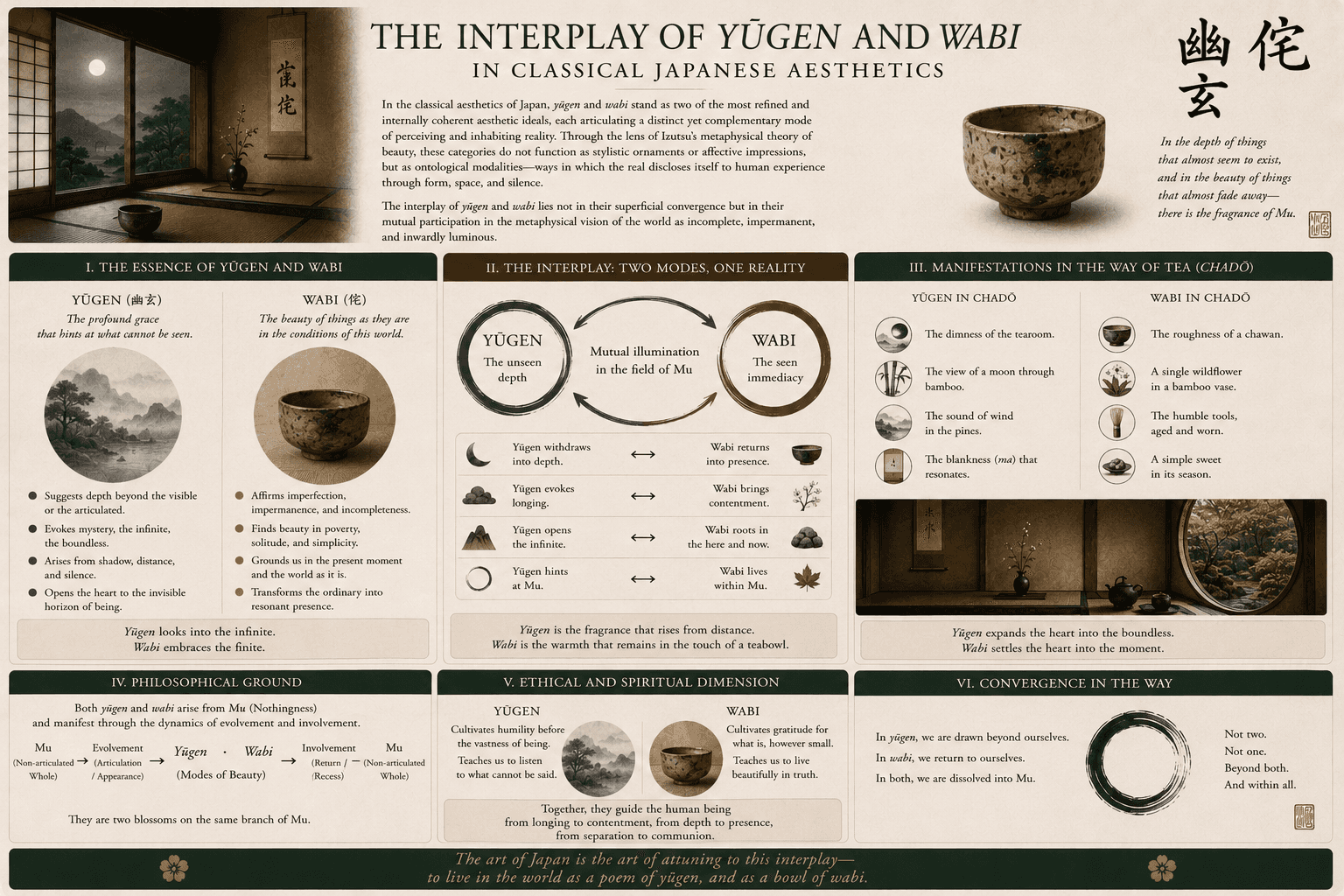
Within the framework of classical Japanese aesthetics, as interpreted by Izutsu, the concept of wabi occupies a central metaphysical and aesthetic position. Far from being merely a socio-cultural sentiment or an atmospheric mood, wabi comes to denote a fundamental mode of human existence and perception -one that not only undergirds a specific aesthetic orientation but also establishes a distinct ontological and ethical ground. Through Izutsu’s theory, which situates beauty not as an autonomous aesthetic phenomenon but as an ontological manifestation, the metaphysics and the mode of wabi acquire a coherent conceptual form within the spiritual-visual synthesis of the Way of tea (chadō).
The initial and ordinary understanding of wabi -destitution, deprivation, desolation, and forlornness- is not discarded but is rather preserved and deepened into an existential mode of being. This transformation is not a symbolic reinterpretation but a recognition of the existential reality of man. In this light, the state of wabi is not a metaphor for emptiness but a direct disclosure of man's essential being-in-the-world. It is a mode wherein human existence is stripped of all artificial adornments and thus becomes transparent to the fundamental truth of impermanence, solitude, and non-substantiality. This mode of wabi reveals itself as a locus of authentic experience, where the ontological bareness of man is accepted not as a lack but as a ground of ethical-aesthetic contentment.
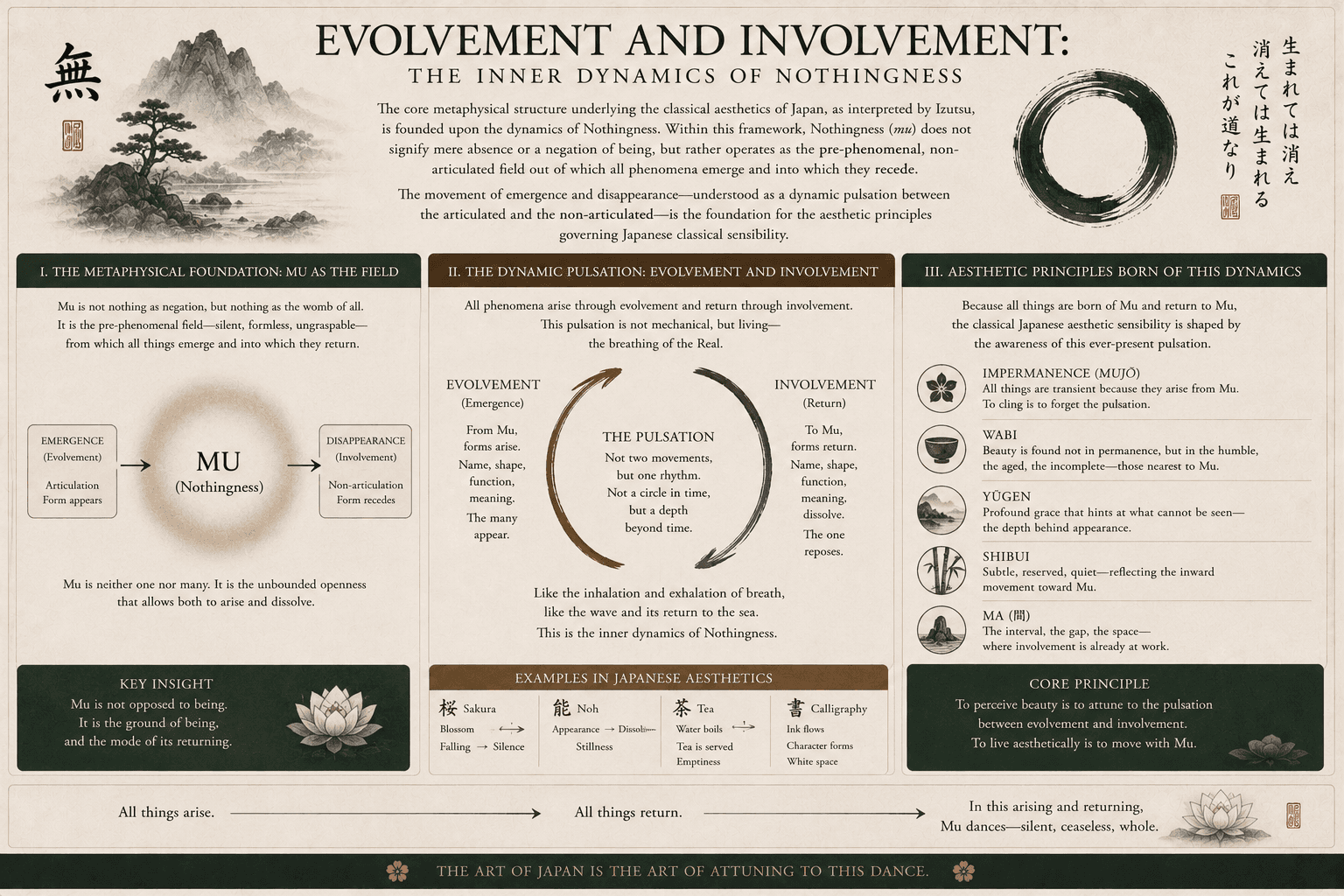
Izutsu’s metaphysical aesthetic framework allows for this transformation by situating the beautiful not in the realm of the pleasing or the decorative, but as the experiential appearance of the real. In this schema, wabi becomes a way in which Being itself appears. The metaphysical dimension of wabi is thus grounded in the mutual penetration of aesthetic and ontological structures: wabi is beautiful because it is real, and it is real because it is stripped of all that is superfluous, transient, and illusory. The existential bareness of wabi is the aesthetic appearance of the real as such.
This metaphysical understanding found concrete expression in poetic and literary forms, where the sentiment of wabi was given voice. However, its full ontological and aesthetic potential was realized only when it was incorporated into the sensory and spiritual structure of the Way of tea. Within chadō, wabi transcends its status as a poetic ideal or a literary theme and becomes the formative principle of an entire way of being. The tearoom, the utensils, the gestures, the atmosphere -all of these elements are orchestrated to give concrete sensory form to the wabi mode of existence. What was previously a contemplative concept becomes an enacted metaphysics.
In this culmination, wabi ceases to be a mere index of aesthetic asceticism. It now constitutes the highest aesthetic-ethical value. The metaphysical background of the Way of tea is not an abstract ontology imposed upon the practice, but an immanent mode of being revealed through it. The real, as experienced in the Way of tea, is disclosed in the subtle, the imperfect, the humble, and the transient. The metaphysical structure of wabi aligns with the ethical structure of self-effacement, non-attachment, and harmony with the flux of existence.
Izutsu’s interpretation thus clarifies how wabi, through its incorporation into the Way of tea, becomes not only an aesthetic category but also a metaphysical orientation and an ethical disposition. The beautiful, the true, and the good are not distinct realms but converge in the experience of wabi. It is precisely in the desolate, the weathered, and the quiet that the profoundest metaphysical truths are revealed and aesthetically affirmed. The sensory structure of the Way of tea becomes the vehicle through which this ontological truth is both experienced and embodied.
Therefore, the metaphysics of wabi is not a theory of aesthetics in the Western sense, but a vision of Being that manifests as a mode of life. The mode of wabi is the actualization of this vision in the lived experience of simplicity, imperfection, and serene emptiness. Through the lenses of Izutsu’s classical Japanese aesthetic theory, wabi is disclosed as the point where metaphysics, ethics, and aesthetics converge in a unified act of spiritual seeing. In the worn surface of a tea bowl, one encounters the most humble and profound expression of the Arche-Texture: the enduring presence of Mu within the transient form of Yū.