Evolvement and Involvement: The Inner Dynamics of Nothingness
The core metaphysical structure underlying the classical aesthetics of Japan, as interpreted by Izutsu, is founded upon the dynamics of Nothingness.
The core metaphysical structure underlying the classical aesthetics of Japan, as interpreted by Izutsu, is founded upon the dynamics of Nothingness.
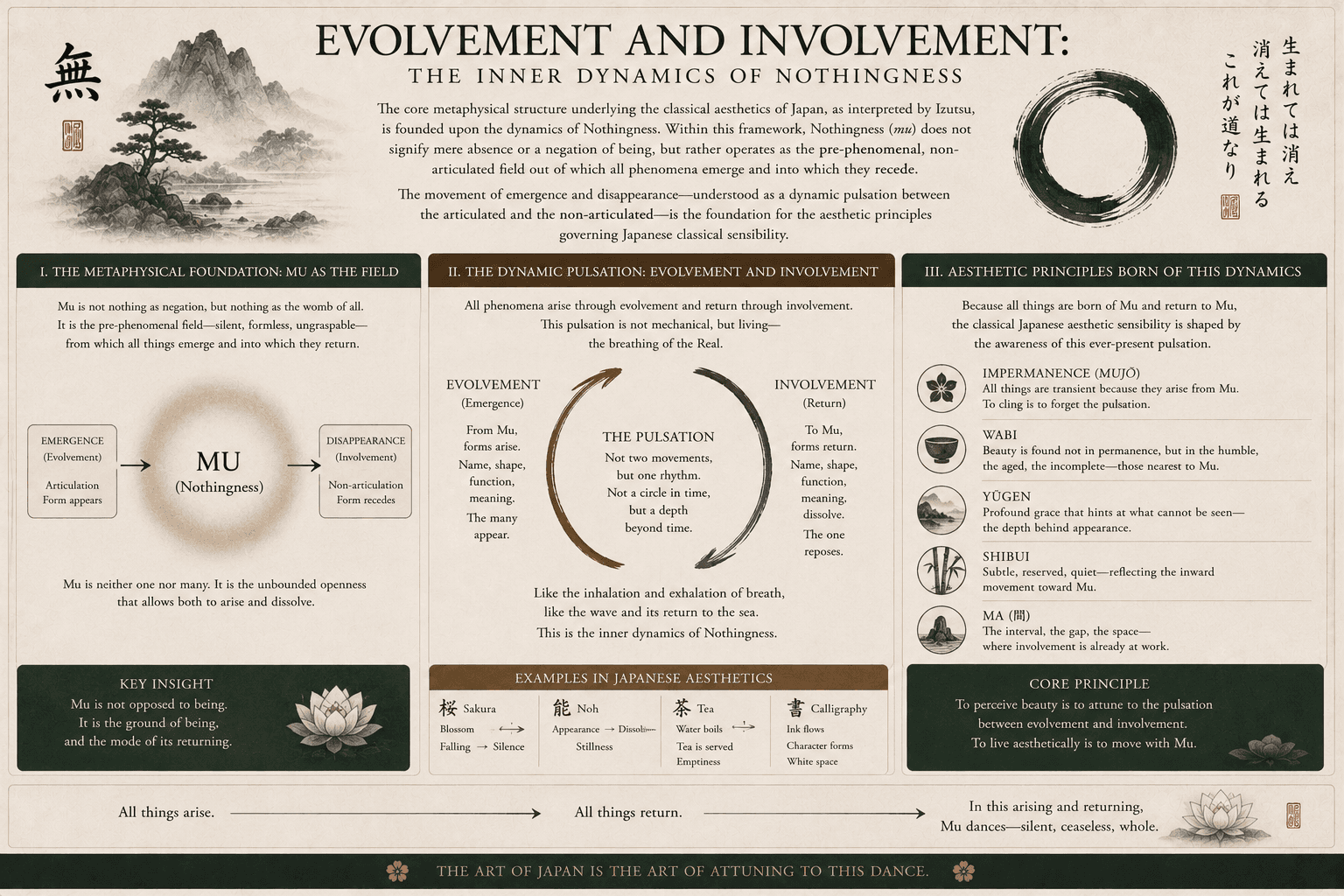
The core metaphysical structure underlying the classical aesthetics of Japan, as interpreted by Izutsu, is founded upon the dynamics of Nothingness. Within this framework, Nothingness (mu) does not signify mere absence or a negation of being, but rather operates as the pre-phenomenal, non-articulated field out of which all phenomena emerge and into which they recede. The movement of emergence and disappearance -understood as a dynamic pulsation between the articulated and the non-articulated- is the foundation for the aesthetic principles governing Japanese classical sensibility.
Izutsu identifies two complementary motions within this dynamic: what may be termed, in structural terms, evolvement (i.e. emergence) -the movement of “exiting into existence”- and involvement (i.e. return) -the movement of “exiting existence.” These are not temporal processes but metaphysical dynamics, occurring within the non-temporal structure of Nothingness. They are not sequences in time but structural articulations of being itself, where the phenomenal arises and withdraws in rhythm with the deeper, ungraspable ground of its own possibility.
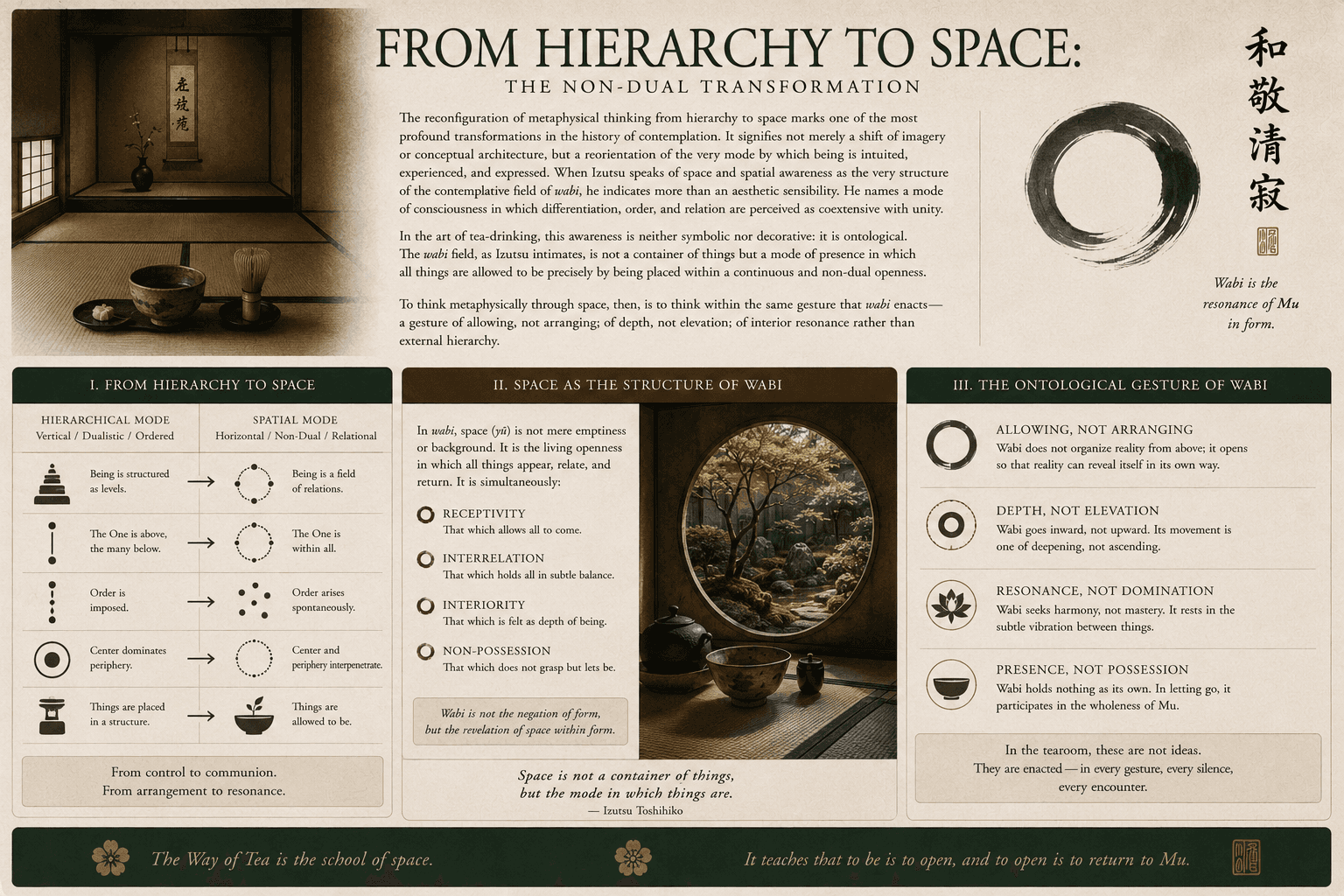
The aesthetic structure of wabi reveals this rhythm with clarity. Wabi, as Izutsu explains, refers to a metaphysical or existential region located between the phenomenal and the pre-phenomenal, between the articulated and the non-articulated whole. It is the zone in which the structure of evolvement and involvement is manifest not conceptually but aesthetically. The beauty of wabi does not consist in form itself, but in the way form bears the trace of that which is not yet form, or that which has already begun to recede from form. The worn surface of an object, the asymmetry of its construction, or its stillness amid impermanence are not symbolic but structural: they embody the silent movement from the non-articulated to the articulated and back.
Evolvement, in this sense, is not an act of creation or appearance in the conventional sense, but a structural exit from Nothingness into temporary articulation. It is the way in which the un-manifest enters into phenomenality without fully departing from its origin. The phenomenal object, therefore, is never complete. It is always in a state of passage -from the non-temporal into the temporal, from non-being into being- but without ever solidifying into a self-contained entity. This half-presence is the signature of evolvement as Izutsu understands it: a movement without arrival, a becoming that bears the imprint of its origin.
Involvement, by contrast, is the return movement: the “exiting existence” through which the articulated re-enters the non-articulated whole. This movement is not destruction or disappearance but withdrawal. The object, the gesture, or the sound dissolves back into the metaphysical field of Nothingness, leaving behind only a residue—a trace of its having been. In aesthetic terms, this trace is perceived not in what is present but in what is no longer fully present. The beauty does not reside in the object but in the emptiness it begins to open within itself. This is the aesthetic structure visible in the fading echo of yūgen, in the vanishing gesture of Noh, or in the still air surrounding a tea bowl after it has been set down.
The process of evolvement and involvement, therefore, is not a dialectic between being and non-being, but a single pulsation, a non-dual rhythm through which being arises and subsides without rupture. The phenomenal world, in this structure, is not opposed to Nothingness but is its temporal reflexion. It is the place where the dynamics of the non-temporal inscribe themselves through successive forms that never fully conceal their source. Each form carries within it the memory of its emergence and the anticipation of its return.
Izutsu’s metaphysical interpretation shows that Japanese aesthetics does not isolate beauty within the form itself but conceives it as the trace of this double movement. The object is beautiful to the extent that it is transparent to this deeper rhythm. What appears in form is only momentarily stabilized; the more subtle the form, the more it opens onto its own non-form. Thus, evolvement and involvement are not movements in time but the ontological logic of appearance and disappearance as a unified field.
This unity is not symmetrical. The movement is not from nothing to something and back, but from a non-dual field in which the distinction between something and nothing has not yet arisen. Evolvement is not a leap from absence to presence but a quiet articulation; involvement is not a negation but a re-absorption. In both, Nothingness remains -not as a background but as the very condition for the possibility of appearance. What emerges never severs from its origin, and what recedes never ceases to resonate.
In this sense, Izutsu’s reading shows that the aesthetic sensibility of classical Japan does not rest on representation but on revelation on the revelation of that which cannot be fully shown. Evolvement and involvement are not phenomena but the metaphysical conditions that render phenomena expressive. To sense beauty in this framework is to intuit the silent pulse of being and non-being as they articulate themselves through the temporal reflexion of a non-temporal ground.