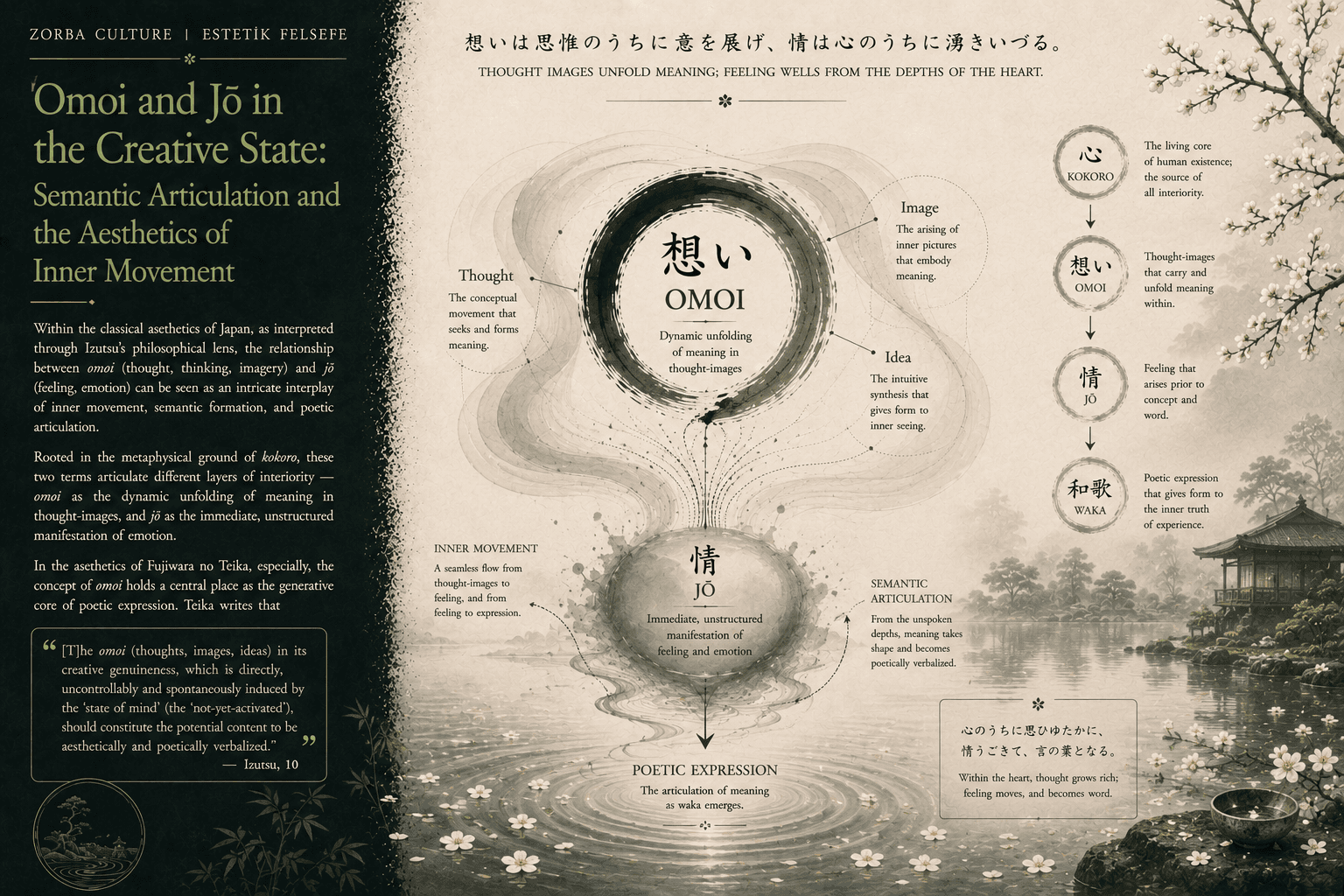
The classical aesthetics of Japan, as illuminated by Izutsu, offers a profound vision of human consciousness and artistic creation rooted not in conceptual elaboration but in the immediate, non-articulated depths of being. Central to this vision is the notion of kokoro -the living, dynamic core of human existence, encompassing thought, feeling, intuition, and imagination as a unified, undivided source. In Izutsu’s philosophical interpretation, the rectification of kokoro in its ideal form demands a radical movement: a transcendence of the entire domain of linguistic phenomena, both internal (semantic articulation) and external (verbal communication), culminating in a return to the primordial, “not-yet-activated” kokoro. Only through such a return can authentic, creative semantic articulation arise anew.
In the aesthetic worldview of classical Japan, the ultimate aim of art, poetry, and contemplative life is not the mere communication of formulated meanings but the manifestation of a deeper, pre-semantic reality. Kokoro, in its primordial purity, exists prior to any articulation; it is a silent ground from which images, feelings, and thoughts may eventually emerge, but which itself remains untouched by the divisions and fixations inherent to language. Izutsu stresses that the process of linguistic articulation, while necessary for expression, inherently introduces a certain hardening and fragmentation into the original, fluid unity of kokoro. Thus, even inner semantic activity -the silent shaping of imagery and thought prior to verbalization- already constitutes a movement away from kokoro's pristine state.
To rectify kokoro, therefore, is not simply to refine linguistic expression, nor even to cultivate more subtle or profound inner images. It requires a transcendence: an existential and cognitive shift beyond all levels of articulation. This transcendence is not a negation of language per se, but a return to the wellspring from which language and meaning authentically arise. It is a movement back to the non-articulated whole being of kokoro before it is cleaved into articulated forms.
In this light, the “genuine creative semantic articulation” that Izutsu describes is not the production of new concepts or images through deliberate effort. Rather, it is the spontaneous, unforced manifestation of meaning from the depth of the “not-yet-activated” kokoro. Here, creativity is understood as an act of re-originating: not imposing form upon formlessness, but allowing the silent fullness of kokoro to unfold itself naturally into forms that remain transparent to their source. This mode of articulation, arising from the rectified kokoro, preserves the freshness, depth, and mystery of the original unity even as it takes on the necessary structures of linguistic expression.
This vision aligns deeply with the aesthetic ideals of yūgen (mystery and depth) and wabi (austere simplicity), which pervade the classical arts of waka, Noh, and the way of tea. In each of these traditions, the highest beauty is not in the explicit statement, but in the subtle evocation of what lies beyond words. The poet, the actor, the tea master must not merely compose or perform; they must first attune their kokoro to the silent reality beyond articulation, allowing their expression to emerge as a natural flowering of that inner stillness.
Thus, in the practice of waka, for instance, the poet seeks not to "create" an image in the ordinary sense but to capture a moment in which kokoro, resonating with nature and being, gives rise to an image spontaneously. In the Noh drama, the actor does not "interpret" a role through psychological analysis but becomes transparent to the deeper flow of feeling that underlies all human existence. In the way of tea, the host does not arrange the setting to impress, but cultivates a space where the silent spirit of simplicity and impermanence may reveal itself.
In all these cases, rectifying kokoro entails more than personal refinement; it demands a kind of ontological humility -a willingness to let go of the dominance of inner articulation and to stand quietly before the mystery of being itself. In Izutsu’s terms, this is the point at which the poetical consciousness (ishiki) becomes fully aligned with the ultimate reality (genjitsu) that underlies all things.
The rectification of kokoro, therefore, is not an aesthetic technique but a profound spiritual and existential act. It restores the original mode of being in which human consciousness, nature, and the expressive act are united in a single, seamless reality. It is only by thus transcending the inner and outer domains of linguistic phenomena that true beauty -characterized by depth, simplicity, and resonance with the inexpressible- can emerge in art and life.
In short, Izutsu’s vision of the rectification of kokoro reveals a radically non-dualistic understanding of creativity and beauty. It teaches that true expression is not achieved by mastery over language, but by transcending language altogether and returning to the silent fullness of kokoro. From this purified source, a new articulation can begin -one that is fresh, authentic, and radiant with the mystery of existence itself.