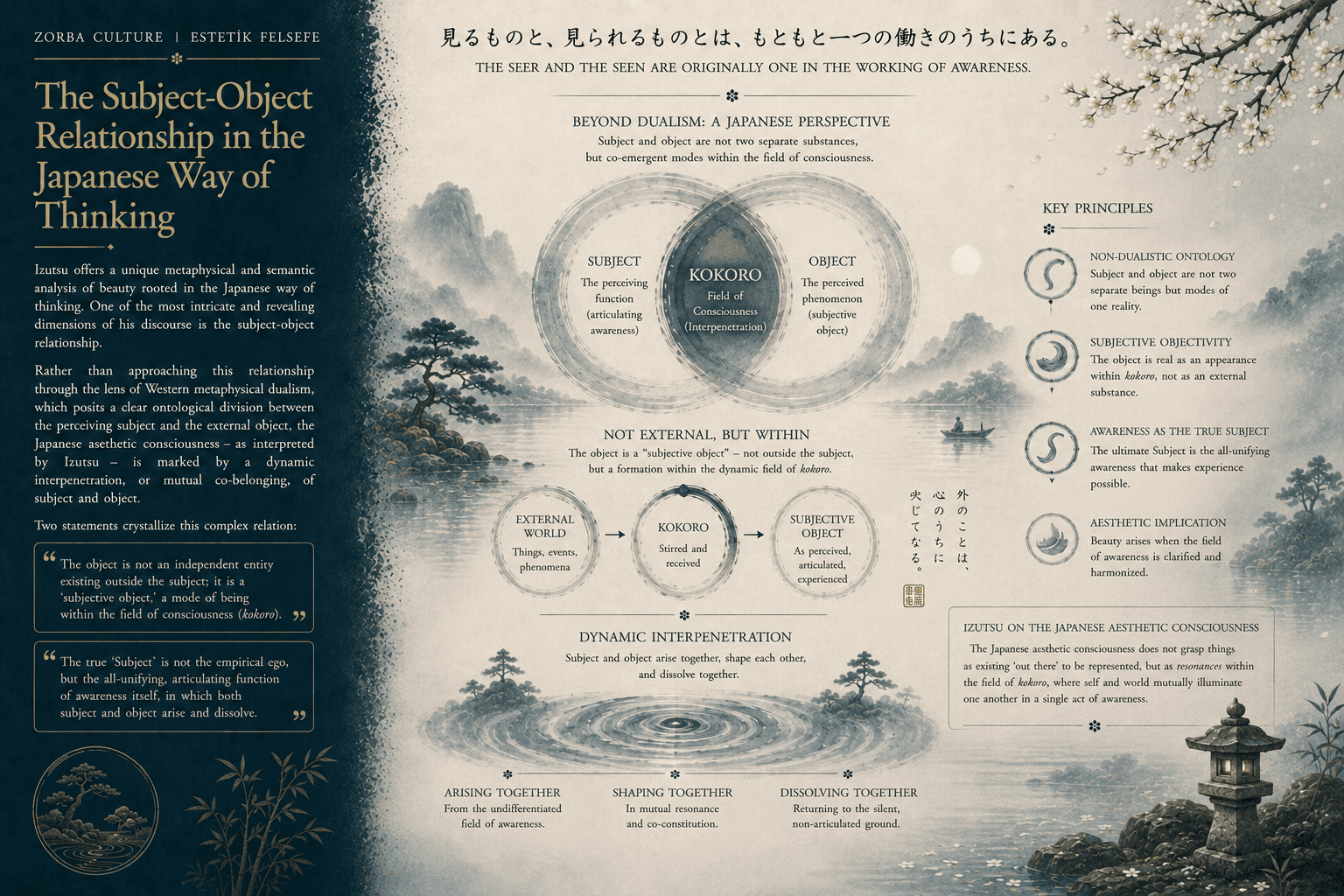
Izutsu offers a unique metaphysical and semantic analysis of beauty rooted in the Japanese way of thinking. One of the most intricate and revealing dimensions of his discourse is the subject-object relationship. Rather than approaching this relationship through the lens of Western metaphysical dualism, which posits a clear ontological division between the perceiving subject and the external object, the Japanese aesthetic consciousness -as interpreted by Izutsu- is marked by a dynamic interpenetration, or mutual co-belonging, of subject and object. Two statements crystallize this complex relation:
“Whatever is articulated by the cognitive subject and is posited as an object, that is to say, whatever is named or nameable, has no validity of its own except in the capacity of a ‘subjective object’.” (Ibid., 30)
“The subject, by completely identifying itself with its own articulating function, establishes itself as the Subject, i.e. the all-unifying consciousness comprising both the subject and object as ordinarily understood.” (Ibid., 30)
Izutsu’s statement that “whatever is named or nameable has no validity of its own except in the capacity of a ‘subjective object’” introduces a radical ontological position: objects, as they are articulated and thus brought into semantic clarity by a subject, do not possess any absolute independent being. Instead, they exist within the field of kokoro, or the unified field of consciousness, as projections or formations of the subject’s own act of articulation. This idea resonates with the classical Japanese sensitivity to the ephemeral, the ungraspable, and the non-substantiality of form, exemplified in mono no aware—the pathos of things.
Izutsu interprets the act of naming as not merely linguistic but ontological -it is the moment the world becomes segmented into discrete objects from a primordial continuum. However, in the Japanese aesthetic mode, this segmentation is never finalized or reified. In waka poetry, for example, a named element such as yamazakura (mountain cherry blossom) is never treated as a fixed object external to the poet but as a transient evocation of feeling (jō) -a subjective object that emerges within the poet’s own heart-mind (kokoro). The cherry blossom does not exist as a separate ontological entity but as something drawn into the poet’s inner world, transfigured by seasonal emotion, remembrance, and suggestion.
Thus, in the Japanese mode of thinking, the object is valid only insofar as it participates in the inner rhythm of the subject. This is the logic of the subjective object -an ontological condition wherein objects arise only in relation to the subject’s act of semantic articulation (bunsetsu), and even then, only within a provisional and poetic field of meaning. The world is not a set of independently existing entities but a constellation of inner-outer resonances, constantly re-formed by feeling, thought, and silent awareness.
The second formulation -that the subject “by completely identifying itself with its own articulating function, establishes itself as the Subject, i.e. the all-unifying consciousness comprising both the subject and object as ordinarily understood” marks a turning point. Here, the cognitive subject is not merely a perceiver or thinker standing opposite to an object, but becomes the total field of articulation itself. This is not a subject that observes from without, but one that dissolves its boundary with what is observed, achieving a metaphysical unity.
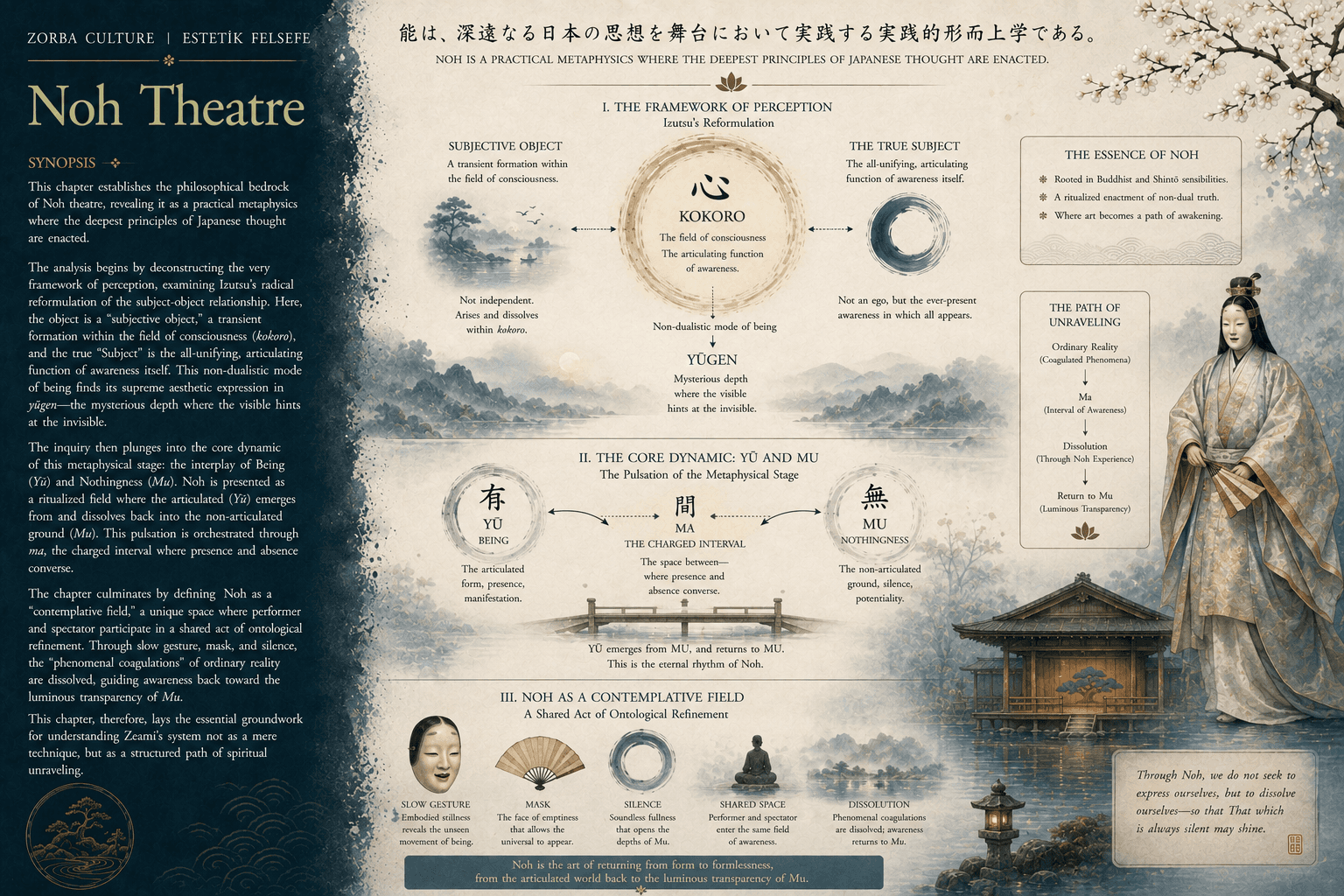
Izutsu draws from Zen and Daoist traditions to formulate this view: when the subject becomes one with its own act of articulation, it becomes tōtai -the all-encompassing unity that holds within it both poles of subject and object. This is the “metaphysical Subject,” which is not a personal ego but the ground of all poetic and aesthetic consciousness. This idea finds exquisite expression in Noh, where the actor does not act “as” a character but becomes the spirit or essence of the figure being portrayed. In this process, the actor-subject loses its separateness and becomes the very field in which form (katachi) and spirit (kokoro) merge. The result is not a representation of the object (the character) but a revelation of its inner essence through the total dissolution of the performer’s subjectivity.
This aesthetic unification mirrors the Zen experience of satori, where the boundary between self and other collapses, and the world is perceived not in its multiplicity but as a singular, resonant field of being. Thus, the “Subject” in this deeper sense is not a position within a dualistic frame, but a mode of consciousness that reveals the world as an internally articulated Whole. Izutsu refers to this as “aesthetical consciousness,” in which the world manifests itself not through conceptual opposition but through a silent unfolding of inter-being.
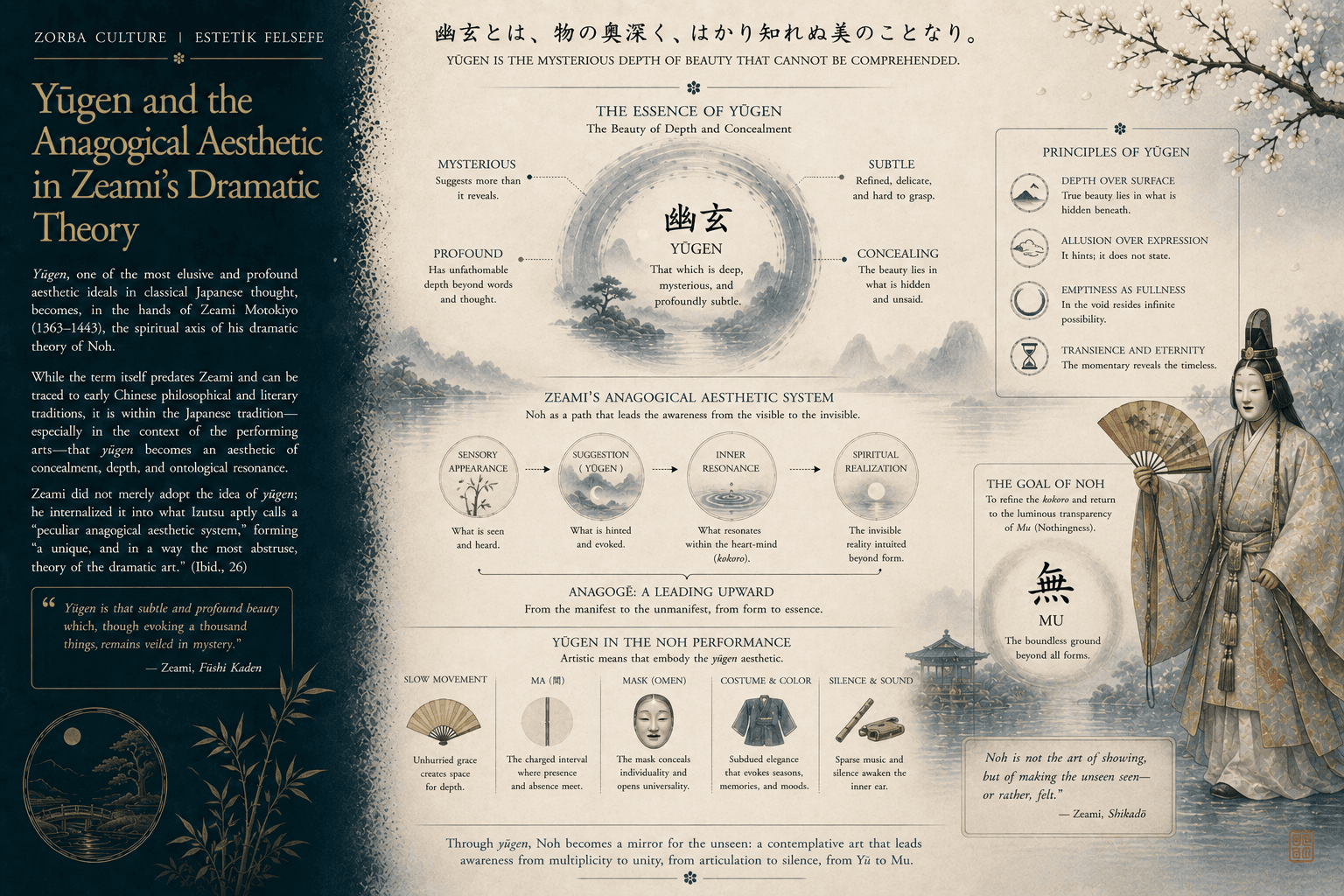
To reconcile the two statements -one emphasizing the subjective formation of objects through articulation, the other affirming a metaphysical unity in the act of articulation itself- we must understand that Izutsu’s theory of beauty is founded on a paradoxical logic. The moment of articulation (bunsetsu) is both a movement away from the non-articulated Whole (mubunsetsu) and a movement within it. Each act of naming or poetic expression is a re-entry into unity, but through fragmentation. This is why Japanese aesthetic forms so often favour suggestion (yūgen), silence, and incomplete expression -the beauty of the fragment lies in its power to evoke the unspoken Whole.
In haiku, for instance, the object is never merely described. The falling of a leaf or the cry of a bird is not an external event, but a moment of existential resonance. The poet, the image, and the atmosphere all emerge together within a unified field of consciousness. The subject articulates, but this articulation is not domination -it is surrender. Through kokoro, the subject allows the world to emerge as itself. It is not that the object is appropriated into the subject, but that the distinction itself becomes transparent.
Izutsu shows that in the Japanese way of thinking, beauty arises precisely at the point where the distinction between subject and object is simultaneously articulated and overcome. The subject articulates the object, but in doing so, realizes its own nature as the total field of articulation. This unity is not conceptual but ontological -it is lived and expressed in the poetic, the silent, the suggested.
Through the lens of Izutsu’s metaphysical aesthetics, the subject-object relationship in the Japanese tradition is revealed not as a dichotomy, but as a movement within a deeper unity. The object has no autonomous being apart from the subject’s act of articulation, and the subject becomes itself only by becoming one with this very function. The result is a uniquely poetic mode of thinking, where beauty is not found in objects or in subjects, but in the interplay—the ma—between them.
This interpenetration is not merely aesthetic but metaphysical: it reflects the Japanese understanding of reality itself as a continuously unfolding Whole, in which all distinctions are ultimately provisional. The poetic act, whether in waka, haiku, or Noh, becomes the very site where subject and object dissolve into one another, and beauty is revealed not as form but as the luminous, living rhythm of unity.