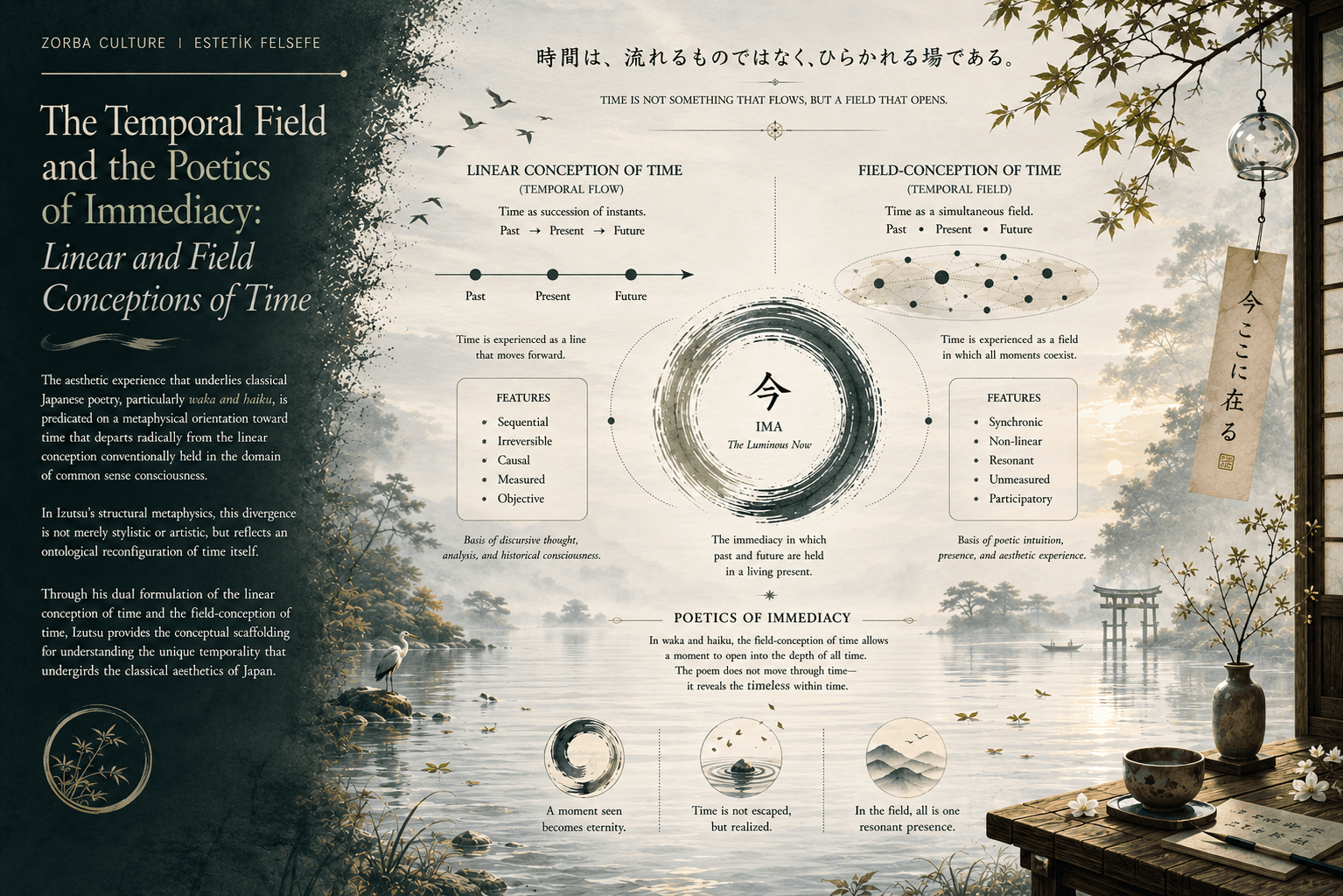
The aesthetic experience that underlies classical Japanese poetry, particularly waka and haiku, is predicated on a metaphysical orientation toward time that departs radically from the linear conception conventionally held in the domain of common sense consciousness. In Izutsu’s structural metaphysics, this divergence is not merely stylistic or artistic, but reflects an ontological reconfiguration of time itself. Through his dual formulation of the linear conception of time and the field-conception of time, Izutsu provides the conceptual scaffolding for understanding the unique temporality that undergirds the classical aesthetics of Japan.
In its most familiar form, time is understood linearly -as a continuous extension marked by the successive ordering of past, present, and future. This model presupposes a temporal trajectory which flows, like a river, from an unknowable past to an unforeseeable future, passing through the narrow corridor of the present. Izutsu emphasizes that in this conception, time is vacant -a framework devoid of intrinsic content, yet absolutely necessary for organizing ontic experiences. All empirical events are inscribed into this linear grid, and the passage of time is understood as obliteration: what was is no longer, what is will soon cease to be, and what will be is not yet.
This mode of temporality constitutes what Izutsu calls “the most basic framework of experience,” (The Field structure of Time in Zen Buddhism, The Collected Papers of Eranos Conferences, Volume II, 1978) but it is also, he notes, a structure that flattens the ontological depth of reality. Time here is homogeneous and exterior to existence; it structures phenomena, but it does not itself participate in the dynamic of being. It is a chronological abstraction.
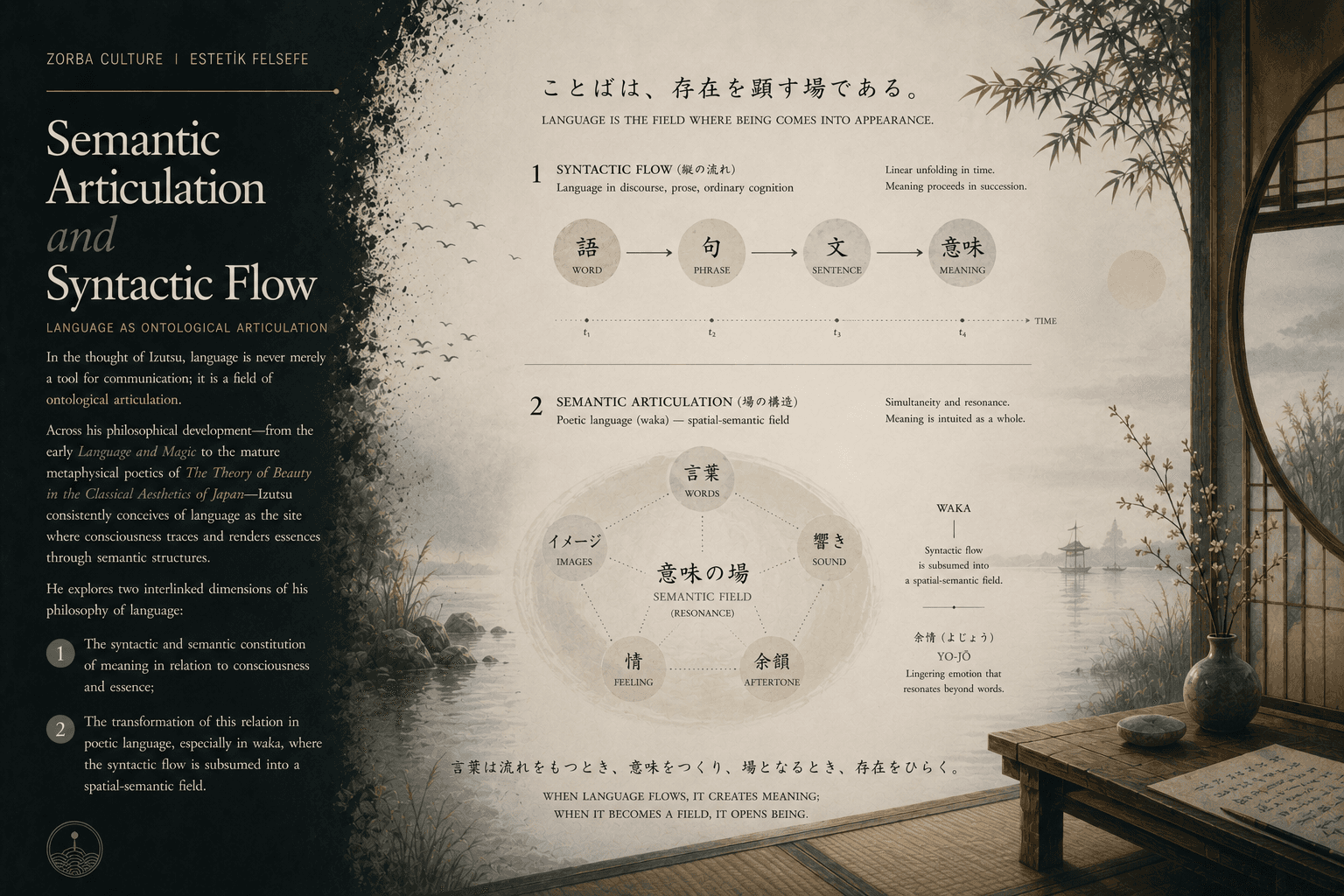
Against this background, Izutsu introduces the unique temporality inherent in waka poetry as an act of metaphysical resistance to this linear modality. The waka poet, he writes, “seems to go against the intrinsic nature of language” by attempting to suspend the successive unfolding of linguistic expression. In ordinary speech or prose, words follow one another in time, each successive unit of meaning effacing the previous. But in waka, a poem of merely thirty-one syllables, this linear progression is transcended. The poem forms a synchronic field, in which the semantic content of each word is held in suspension alongside the others in a spatially unified whole. The poem becomes not a sequence, but a simultaneity.
This is only possible, Izutsu notes, within the narrow confines of a short poem, where the cognitive field of the reader is not compelled to temporally process a long chain of elements. The poetic form imposes an ontological compression, where the distinction between earlier and later words is dissolved into a total field of mutual presence. The poem, in this sense, is not read in time, but is given all at once -as a stillness that reveals being in a single gesture.
Izutsu's formulation of the field-conception of time in his work on Zen Buddhist metaphysics provides the deeper philosophical ground for the temporal experience found in waka and haiku. In this view, time does not exist as a line of discrete and separated moments, but as a concentration point -a present that is not merely an instant in the succession of instants, but an ontological field in which the past, present, and future mutually interpenetrate. Each temporal moment is internal to the others: the past is not left behind, the future is not yet to come -they all are, within the structural depth of the present.
This interpenetration is not metaphorical but ontological. The now is not a zero-point but a field of being in which temporal distinctions are maintained in their logical form yet annulled in their existential separation. As Izutsu writes, the present “has, as it were, an ontological thickness.” (The Field structure of Time in Zen Buddhism, The Collected Papers of Eranos Conferences, Volume II, 1978) It is within this structure that beauty, in the Japanese aesthetic sense, emerges -not as something perceived in time, but as something arising from the collapse of temporal succession into a field of simultaneity.
It is in this metaphysical context that the act of poetic creation in waka and haiku can be understood as an event of ontological transparency. The poem becomes the field wherein the metaphysical depth of time is disclosed in its synchronic entirety. The aesthetic experience does not arise from the narrative accumulation of meanings across time, but from the sudden revelation of a total structure. Beauty is not temporalized; it is immediate, non-linear, and field-like.
The poetic moment thus mirrors the Zen experience of satori, where insight occurs not through sequential reasoning but through instantaneous apprehension. The poem does not unfold -it appears, and in appearing, suspends the forward rush of time. Here the aesthetic act and the metaphysical structure are in perfect isomorphism.
From Izutsu’s standpoint, language is not a passive medium of expression but an active structure that both reflects and determines modes of thought. The grammatical and syntactic fabric of ordinary language follows the logic of linear time. But the syntax of poetic language in waka defies this grammar by establishing a field in which meaning becomes topological rather than temporal. The relation of words is no longer determined by succession but by mutual presence.
The field-structure of time thus finds its expression in a corresponding field-structure of language. In waka, the very act of articulation generates an ontological field. The poem becomes a temporal stillness, a field-event in which the entirety of existence reveals itself not as progression but as presence.
Izutsu’s articulation of the field-conception of time is not merely a speculative metaphysical idea; it is concretely embodied in the aesthetic practices of classical Japanese poetry. The structure of waka and haiku provides a formal field within which time is arrested and the poetic moment becomes a site of ontological revelation. In contrast to the vacuous linearity of common sense temporality, the poetic field offers an experience of time as a luminous simultaneity. In this, the classical aesthetics of Japan reveals its deepest metaphysical orientation: time is not a line but a field; not a stream but a stillness; not obliteration but interpenetration. Through poetry, being becomes visible -not in duration, but in the eternity of the present.