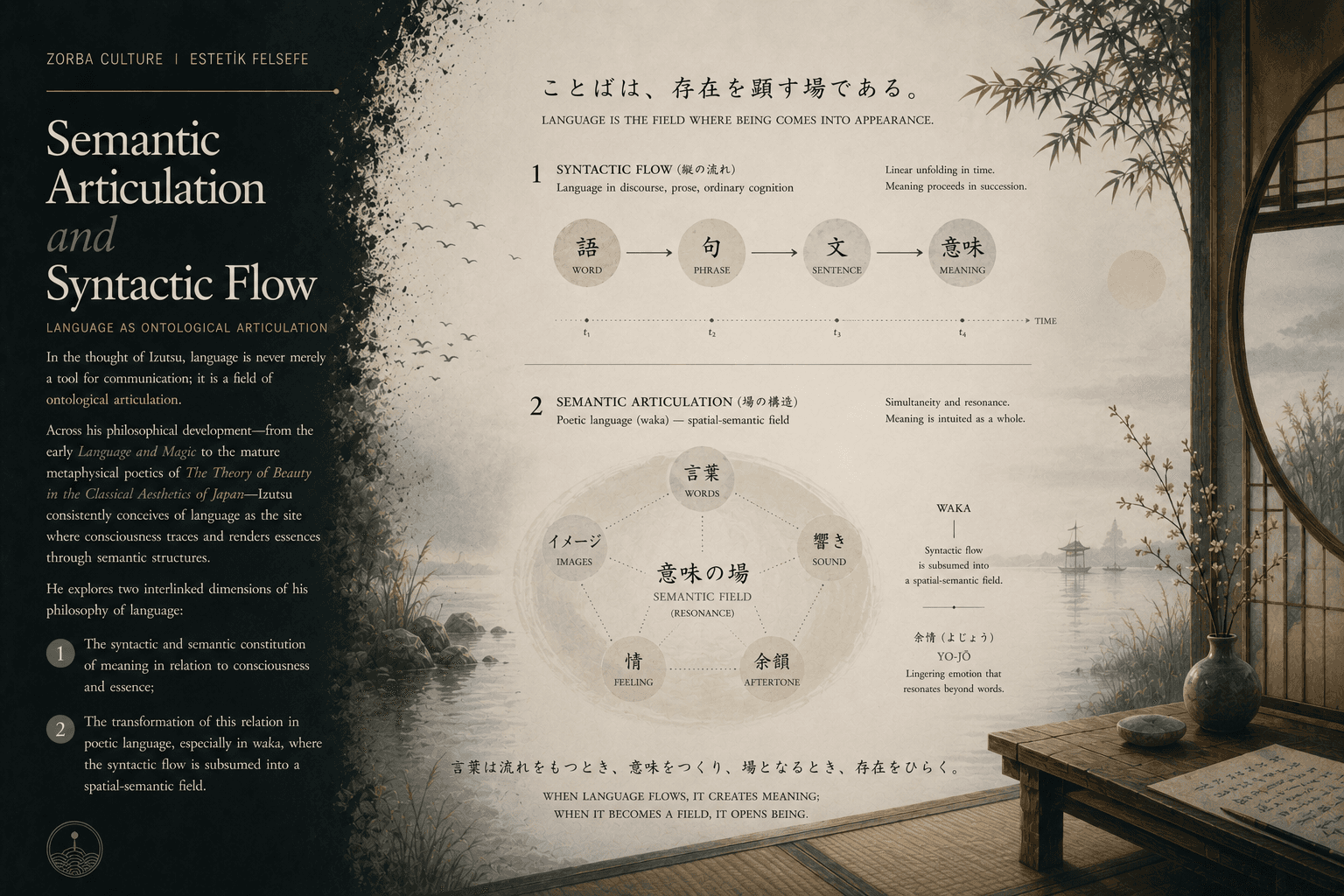
In the thought of Izutsu, language is never merely a tool for communication; it is a field of ontological articulation. Across his philosophical development -from the early Language and Magic to the mature metaphysical poetics of The Theory of Beauty in the Classical Aesthetics of Japan- Izutsu consistently conceives of language as the site where consciousness traces and renders essences through semantic structures. He explores two interlinked dimensions of his philosophy of language: first, the syntactic and semantic constitution of meaning in relation to consciousness and essence; and second, the transformation of this relation in poetic language, especially in waka, where the syntactic flow is subsumed into a spatial-semantic field.
In Language and Magic, Izutsu articulates the foundational idea that the grammatical and syntactic structure of language is not a neutral medium, but a metaphysical framework that conditions the way we perceive and organize reality. Each language, through its syntax- the rules that govern the linear arrangement of words- constructs a particular mode of experience. But more deeply, it is the semantic function of language -its power to designate, indicate, and reveal- that becomes the axis along which the structure of consciousness aligns itself toward what Izutsu calls “essences” .
The “articulative function of language” is central here. This function does not merely refer to syntax as a formal rule-based order, but rather to the capacity of language to cut, trace, and draw lines within the otherwise undifferentiated continuum of experience. This process of articulation is intimately connected to what Izutsu identifies as the intentional structure of consciousness: the directedness toward meaning. Language is not external to this directedness, but is its very expression—an extension of consciousness that performs its ontological function by semantic indication. Words, in their semantic activity, serve as loci of articulation: they bring forth a structure, not simply by naming things, but by tracing networks of meaning that open up ontological contours within experience.
Izutsu thus radicalizes the traditional philosophical account of language by fusing semantic indication with ontological articulation. Meaning is not referential in a simplistic sense. Rather, language, by virtue of its internal structure, is a principle of disclosure. The essence of a thing emerges as a result of this articulation—not as something behind or beyond language, but as a semantic phenomenon internal to the multi-layered consciousness that language both expresses and configures. Hence, the syntax of language -its temporal, linear unfolding- provides the formal basis for this operation, while its semantic field points toward the depth structures of consciousness.
In The Theory of Beauty in the Classical Aesthetics of Japan, Izutsu’s philosophical orientation takes a decisive aesthetic turn, though without abandoning the earlier ontological concerns. The work of classical Japanese poetry, especially waka, leads him to a profound insight: poetic language, unlike ordinary language, suspends the syntactic flow in order to construct a semantic field -a spatially conceived structure of meaning rather than a temporally sequenced one.
In Izutsu’s terms, waka does not aim to convey meaning through the syntactic succession of words -through narrative or logical progression- but instead through an associative network of semantic articulations. What results is a non-temporal space of semantic saturation: a poetic field where each word resonates with multiple layers of meaning, creating a latticework of significations that transcend linear syntax.
This poetic field arises from the deliberate minimization of syntactic continuity, what Izutsu refers to as “the coagulative basis of the poetic sentence.” In other words, syntax is not eliminated, but is reduced to a minimum, serving only as a coagulation point where semantic energies are momentarily held together. The real operation of poetic meaning occurs not in the syntactic flow but in the silent spaces between words, where metaphor, suggestion (yūgen), and allusion unfold. This shift from syntactic to semantic primacy mirrors the shift from temporal unfolding to spatial presence.
What Izutsu identifies here is a fundamental reorientation of language’s function: from articulation as division to articulation as resonance. In philosophical language, we might say that the syntactic operation of language divides and sequences, while the semantic field in poetry gathers and constellates. The poetic word is not an index in a chain but a node in a semantic constellation. This corresponds to what Izutsu elsewhere calls the “field-structure” of Japanese consciousness: non-dual, holistic, and receptive to the simultaneous presence of multiple meanings.
These two dimensions of Izutsu’s philosophy of language -the early focus on articulation as the ontological function of semantics, and the later focus on the poetic suspension of syntax- are not separate stages but complementary expressions of a deeper metaphysical insight. The articulative function of language, in its full scope, includes both the dividing clarity of syntax and the gathering ambiguity of poetic semantics. In both cases, language performs a function of ontological disclosure: it allows essences to appear, not as static entities, but as semantic formations emerging through the internal dynamics of consciousness and speech.
What makes Izutsu’s contribution singular is that he refuses to reduce this process to either psychological subjectivity or objective referentialism. Language, in his view, is not a mirror of thought nor a mirror of reality -it is the dynamic point of intersection where consciousness articulates the real. His notion of essence is therefore not metaphysical in the traditional Western sense of substance or noumenon, but rather semantic-phenomenological: the inner configuration of meaning as revealed through articulative structures.
Thus, when Izutsu analyses waka, he is not merely doing literary criticism; he is drawing out the ontological potential of poetic language to enact a different mode of being-in-the-world -one where language is no longer a conveyor of thoughts but a space of semantic intensity, a field in which being is felt as a vibration of meaning.
Izutsu’s syntactic and semantic analysis of language reveals a profound metaphysical structure: language is the act of articulation through which consciousness shapes and discloses reality. In his early philosophy, syntax and semantics function together to generate essences through directed articulation. In his later aesthetics, particularly through waka, syntax is suspended in favour of a semantic field, allowing multiple resonances to appear simultaneously in a poetic space of meaning. Across both, language remains the medium through which reality is internally structured and disclosed—not by representation, but by articulation. In this sense, Izutsu’s philosophy of language is ultimately a philosophy of being through meaning.