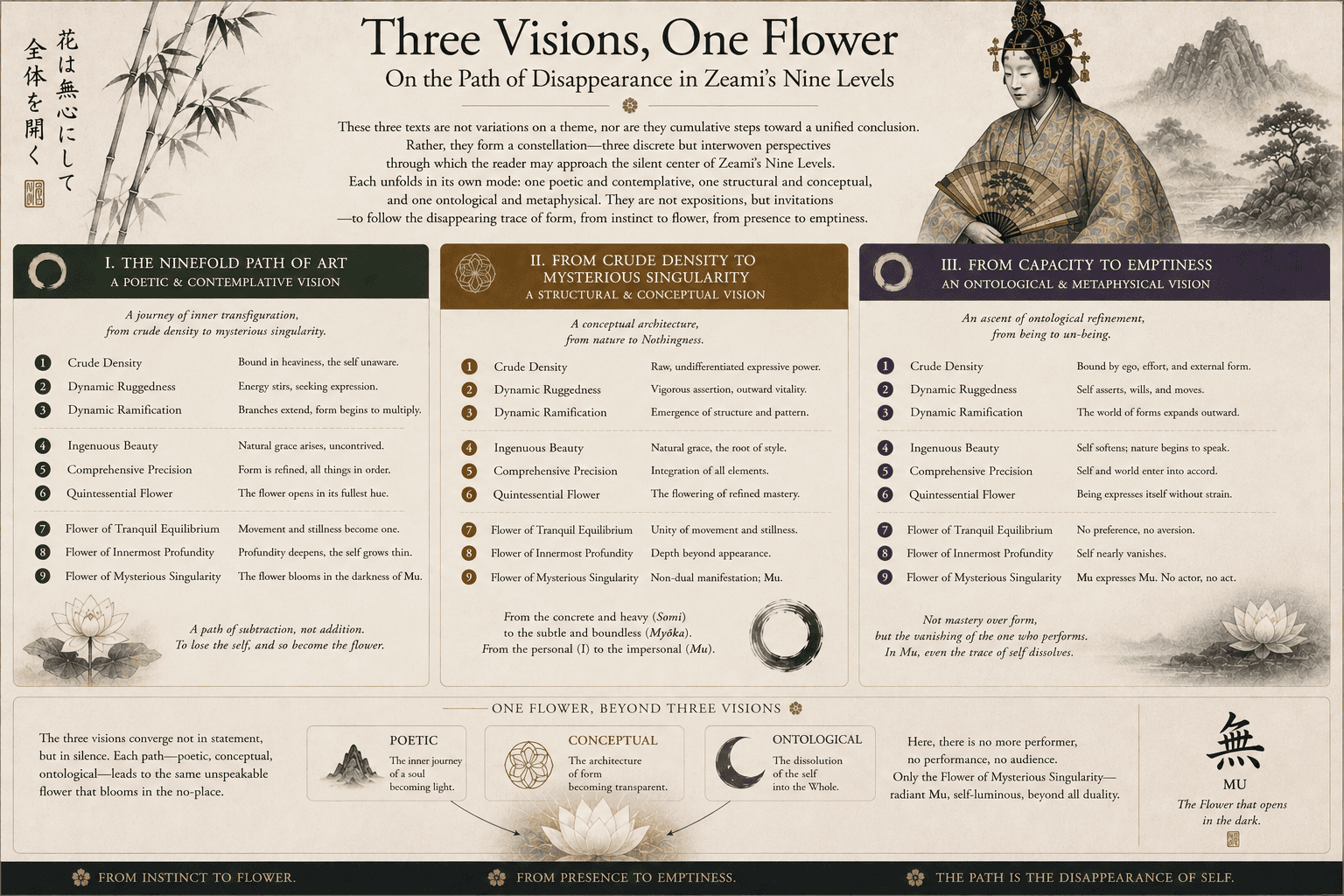
These three texts are not variations on a theme, nor are they cumulative steps toward a unified conclusion. Rather, they form a constellation -three discrete but interwoven perspectives through which the reader may approach the silent center of Zeami’s Nine Levels. Each unfolds in its own mode: one poetic and contemplative, one structural and conceptual, and one ontological and metaphysical. They are not expositions, but invitations -to follow the disappearing trace of form, from instinct to flower, from presence to emptiness.
The Ninefold Path of Art: Zeami’s Modes in Essence, Meaning, and Significance, is an aesthetic and philosophical unfolding. It traces each of the Nine Levels as a movement not of artistic progression, but of inner transfiguration. Technical form is encountered, then surpassed. Spiritual resonance appears not as an effect, but as the essence of performance itself. In this reading, the Nine Levels are neither pedagogical stages nor stylistic categories—they are thresholds in the journey from crude density to metaphysical radiance.
From Crude Density to Mysterious Singularity: A Conceptual Approach to the Nine Levels, treats the titles of the Nine Modes as philosophical signs. Each phrase—Crude Density, Dynamic Ramification, Ingenuous Beauty, Flower of Mysterious Singularity—is not merely a poetic flourish, but a condensation of aesthetic insight. This text maps the architecture of the path from an analytic vantage: how the naming of the Levels itself encodes a metaphysical progression, from natural capacity to ontological dissolution.
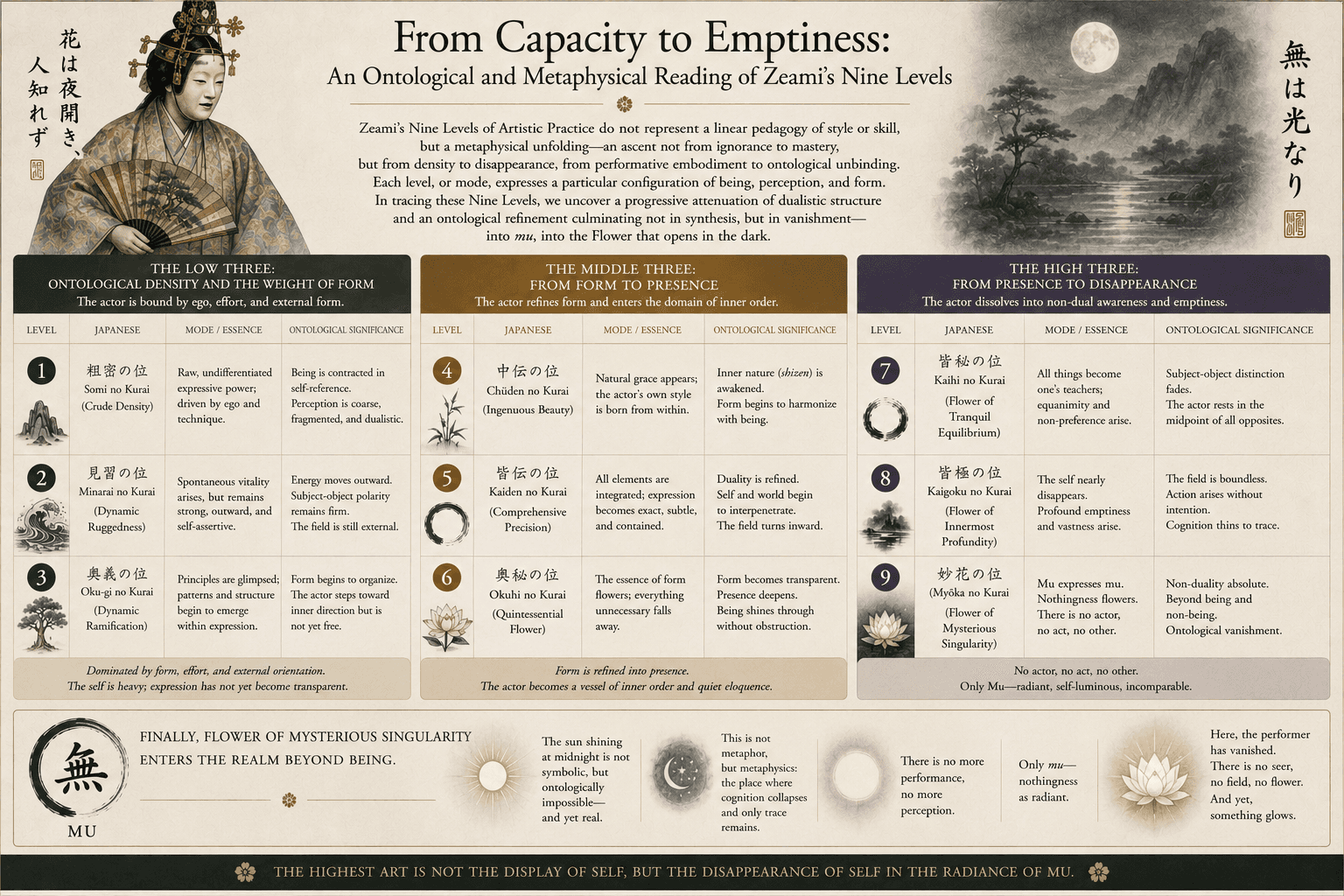
From Capacity to Emptiness: An Ontological and Metaphysical Reading of Zeami’s Nine Levels, enters directly into the being of the performer. Here, the Nine Levels are read as ontological configurations: not what a performer does, but what a performer is. Crude Density is not crude because it lacks polish—it is dense because it is heavy with self. Mysterious Singularity is not mysterious because it eludes understanding—it is singular because no trace of duality remains. This final reading dissolves the aesthetic into the metaphysical: what is performed is not art, but vanishing.
Across all three, the thread remains unbroken: Zeami’s path is not dialectical, but subtractive. There is no synthesis, no overcoming, no arrival. There is only a softening, a disappearance, a return. These texts do not seek to explain Zeami’s thought—they seek to echo it. What opens at the end is not a conclusion, but a flower. Not as symbol, but as trace.