The Way of Tea-Chapter VI
The Way of Tea
The Way of Tea
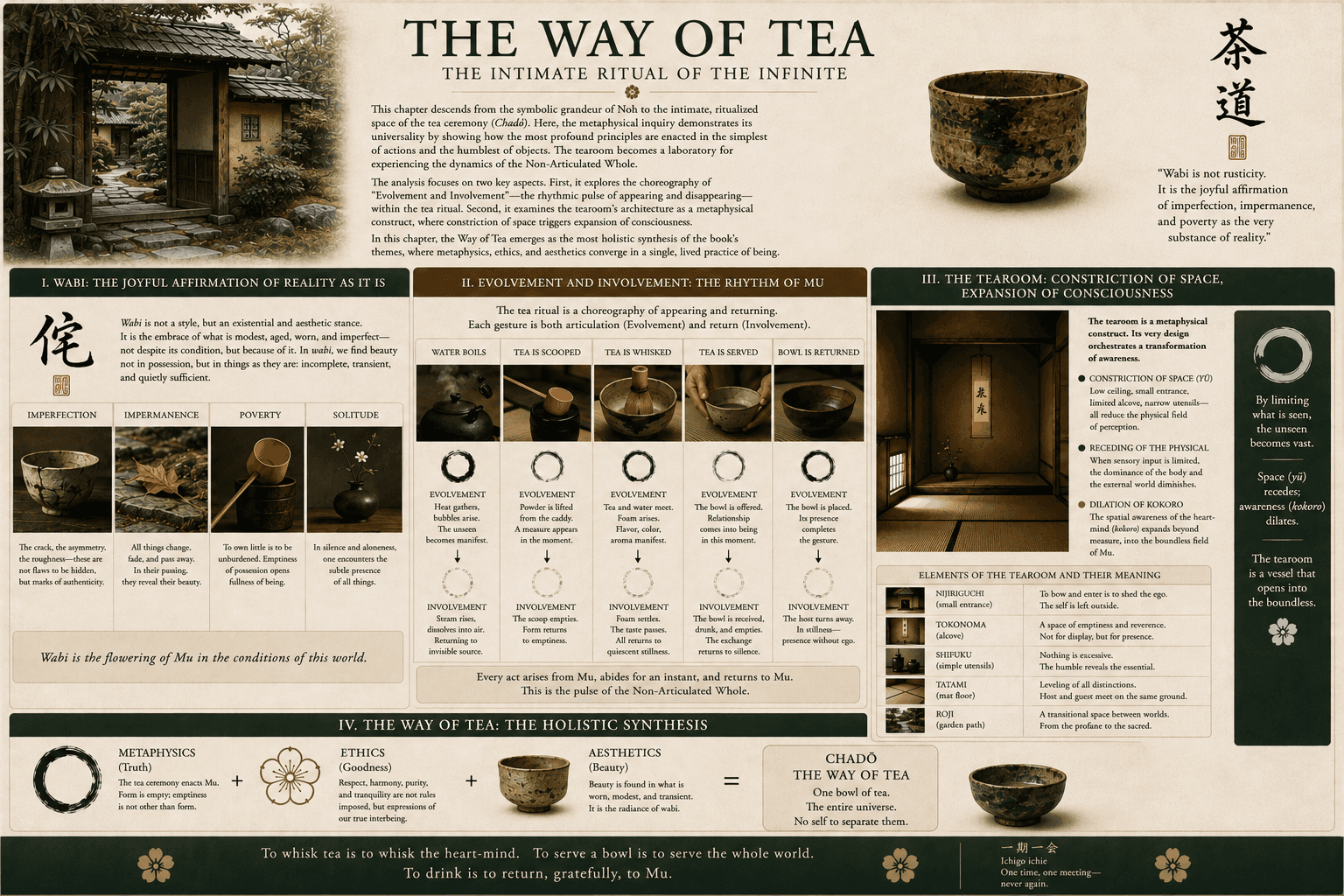
Synopsys: This chapter descends from the symbolic grandeur of Noh to the intimate, ritualized space of the tea ceremony (Chadō). Here, the metaphysical inquiry demonstrates its universality by showing how the most profound principles are enacted in the simplest of actions and the humblest of objects. The tearoom becomes a laboratory for experiencing the dynamics of the Non-Articulated Whole. The chapter performs a deep philosophical excavation of wabi, liberating it from modern misappropriations as mere “rustic simplicity.” Instead, wabi is presented as a profound existential and aesthetic stance: the joyful affirmation of imperfection, impermanence, and poverty as the very substance of reality.
The analysis focuses on two key aspects. First, it explores the choreography of “Evolvement and Involvement”—the rhythmic pulse of appearing and disappearing—within the tea ritual. The boiling water, the whisking of tea, the handling of the bowl: each gesture is a momentary articulation (Evolvement) that is simultaneously a gesture of return (Involvement) to the silent ground of Mu. Second, it examines the tearoom’s architecture as a metaphysical construct. The famous constriction of space is revealed as a deliberate strategy to trigger an expansion of consciousness. By limiting sensory input, the physical space (yū) recedes, allowing the spatial awareness of kokoro to dilate into the boundless field of mu. In this chapter, the Way of Tea emerges as the most holistic synthesis of the book’s themes, where metaphysics, ethics, and aesthetics converge in a single, lived practice of being.