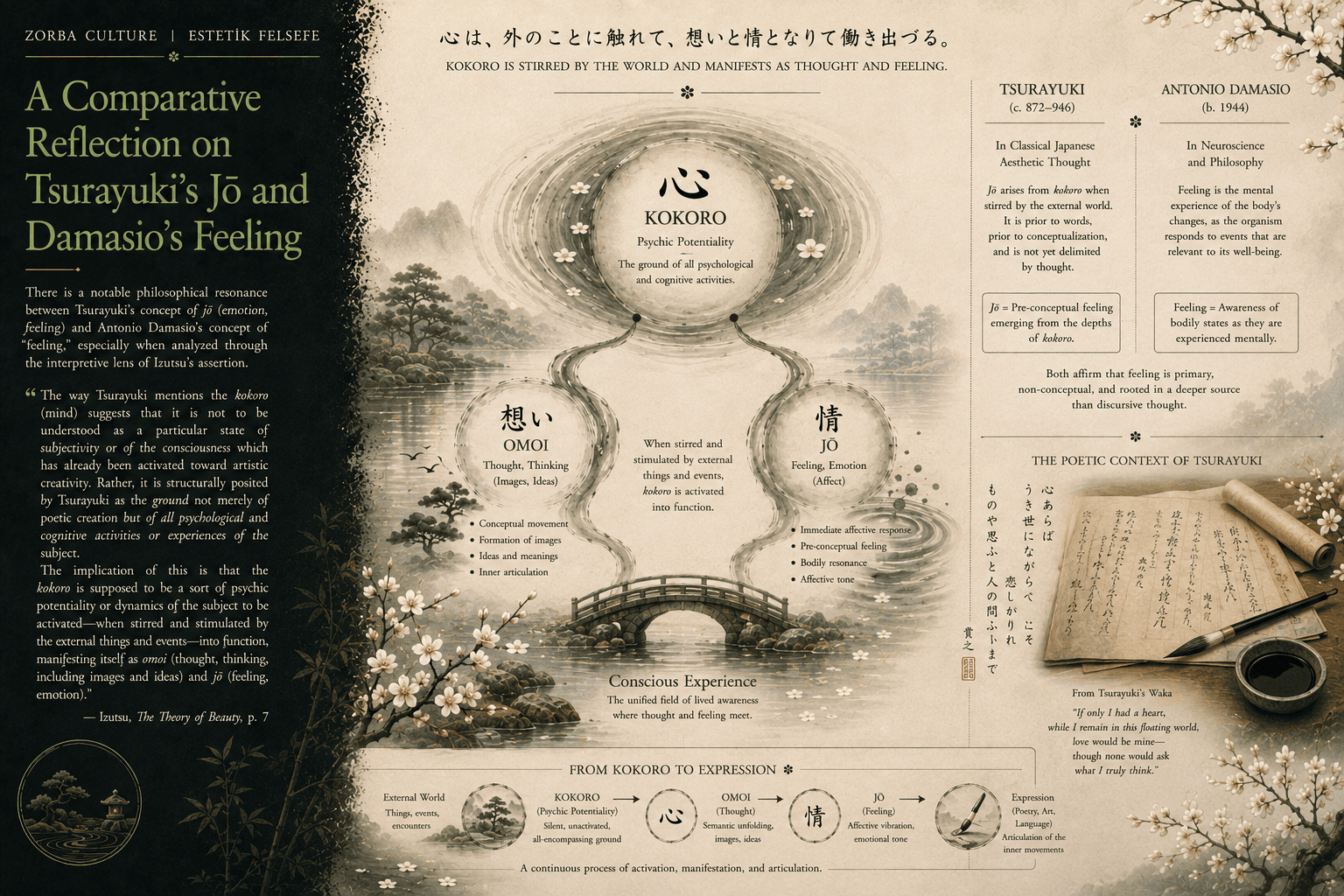
There is a notable philosophical resonance between Tsurayuki’s ( - 946) concept of jō (emotion, feeling) and Antonio Damasio’s concept of “feeling,” especially when analyzed through the interpretive lens of the paragraph Izutsu asserts in The Theory of Beauty in the Classical Aesthetic of Japan:
“The way Tsurayuki mentions the kokoro (mind) suggests that it is not to be understood as a particular state of subjectivity or of the consciousness which has already been activated toward artistic creativity. Rather, it is structurally posited by Tsurayuki as the ground not merely of poetic creation but of all psychological and cognitive activities or experiences of the subject. The implication of this is that the kokoro is supposed to be a sort of psychic potentiality or dynamics of the subject to be activated-when stirred and stimulated by the external things and events-into function, manifesting itself as omoi (thought, thinking, including images and ideas) and jo (feeling, emotion). (Ibid., 7)
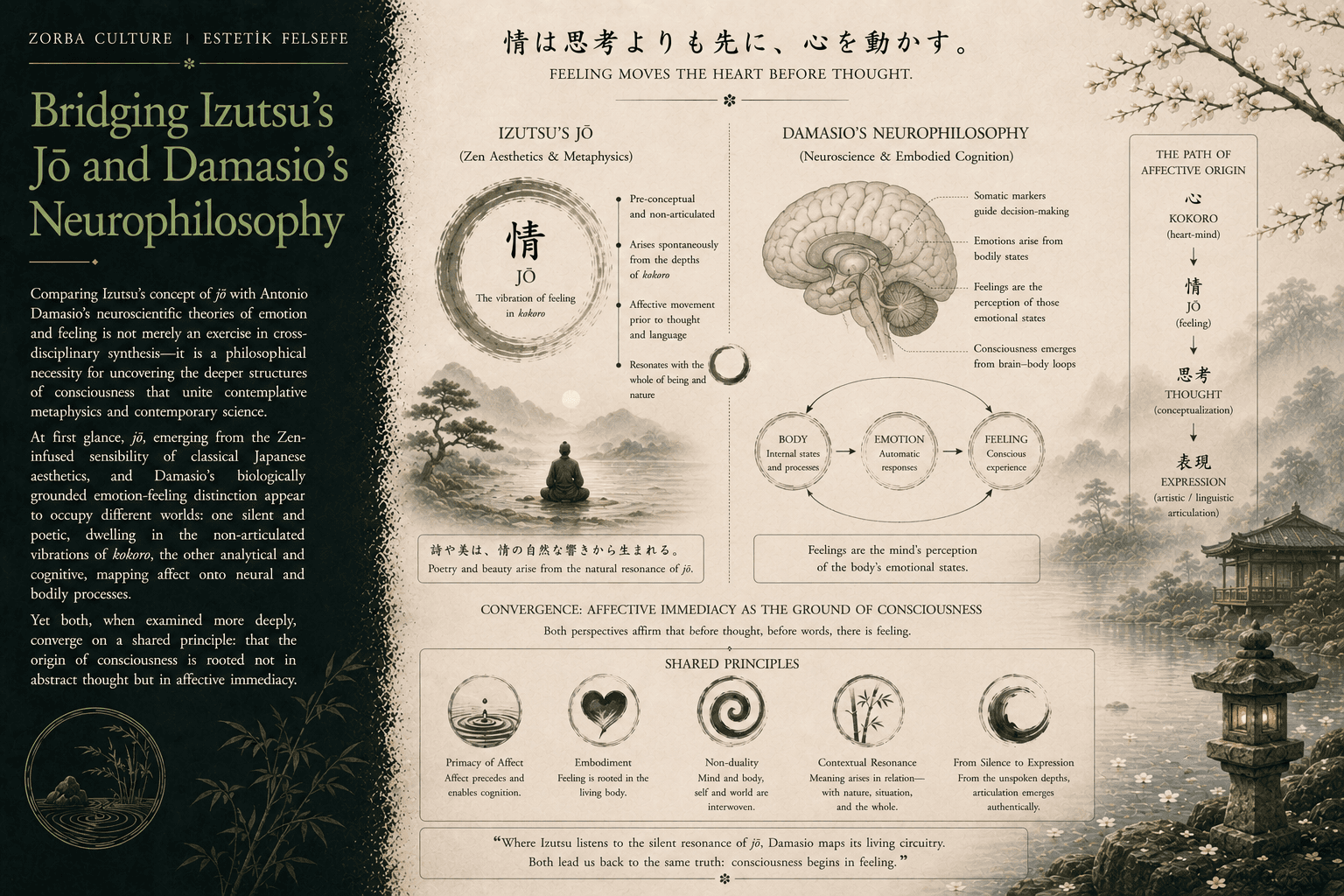
The concept of jō in Tsurayuki’s celebrated Preface to the Kokin-shu and Antonio Damasio’s scientific account of feeling converge in a subtle yet profound understanding of emotion as a dynamic, emergent phenomenon. Both thinkers reject a static or merely subjective view of feeling, instead positing it as a manifestation of a deeper internal ground actualized through interaction with the world.
Tsurayuki describes kokoro not as an already activated consciousness but as a latent psychic potential -a structural ground underlying all cognitive and affective activity. When stimulated by external events, this kokoro gives rise to omoi (thought, imagery) and jō (feeling, emotion). Feeling, then, is not a fixed inner state but an event-like unfolding, a response that arises from the stirring of this inner depth.
Damasio’s theory of emotion and feeling mirrors this framework. In his neurobiological account, feelings are not pre-formed contents of consciousness but emergent representations of bodily states, shaped by external stimuli. Feelings arise when emotional responses -rooted in the body’s homeostasis- are mapped into conscious awareness. Like Tsurayuki’s jō, Damasio’s feeling is the surfacing of an internal dynamic, intimately linked to the body’s relation to the world.
Moreover, both thinkers emphasize the continuity between emotion and thought. In Tsurayuki’s view, jō and omoi are twin manifestations of kokoro, dissolving the boundary between affect and cognition. Damasio similarly argues that feeling is integral to reason, suggesting that cognitive processes are guided and informed by affective states.
In both frameworks, feeling is not an isolated mental phenomenon but a relational, expressive unfolding of a deeper inner ground -kokoro in Tsurayuki, and core consciousness in Damasio. What links them is a shared metaphysical insight: that feeling is the bridge between inner potential and the world, a dynamic actualization of life’s inward depth.
Through the perspectives of Tsurayuki, Izutsu, and Antonio Damasio, jō emerges as a concept that transcends disciplinary boundaries -bridging classical aesthetics, metaphysical philosophy, and neuroscience. For Tsurayuki, jō is a manifestation of kokoro, activated by the external world and inseparable from the poetic structure of feeling. Izutsu deepens this view by interpreting jō within a metaphysical framework, where it is not merely an emotion but a luminous expression of the inner dynamics of kokoro -a spontaneous mode of being that reflects the non-dual unity between the self and nature. Damasio, from a scientific standpoint, articulates feeling as the conscious mapping of affective bodily states, rooted in homeostatic and cognitive structures.
Despite their different epistemologies, all three converge on the view that jō is not a static psychological state but a dynamic event -a relational unfolding that arises from the interaction between the internal ground of consciousness and the external world. Whether seen as poetic emotion, metaphysical expression, or neurobiological feeling, jō signifies the moment when the invisible interior becomes sensibly and meaningfully articulated. It is, ultimately, the very rhythm of inner life as it enters into form.