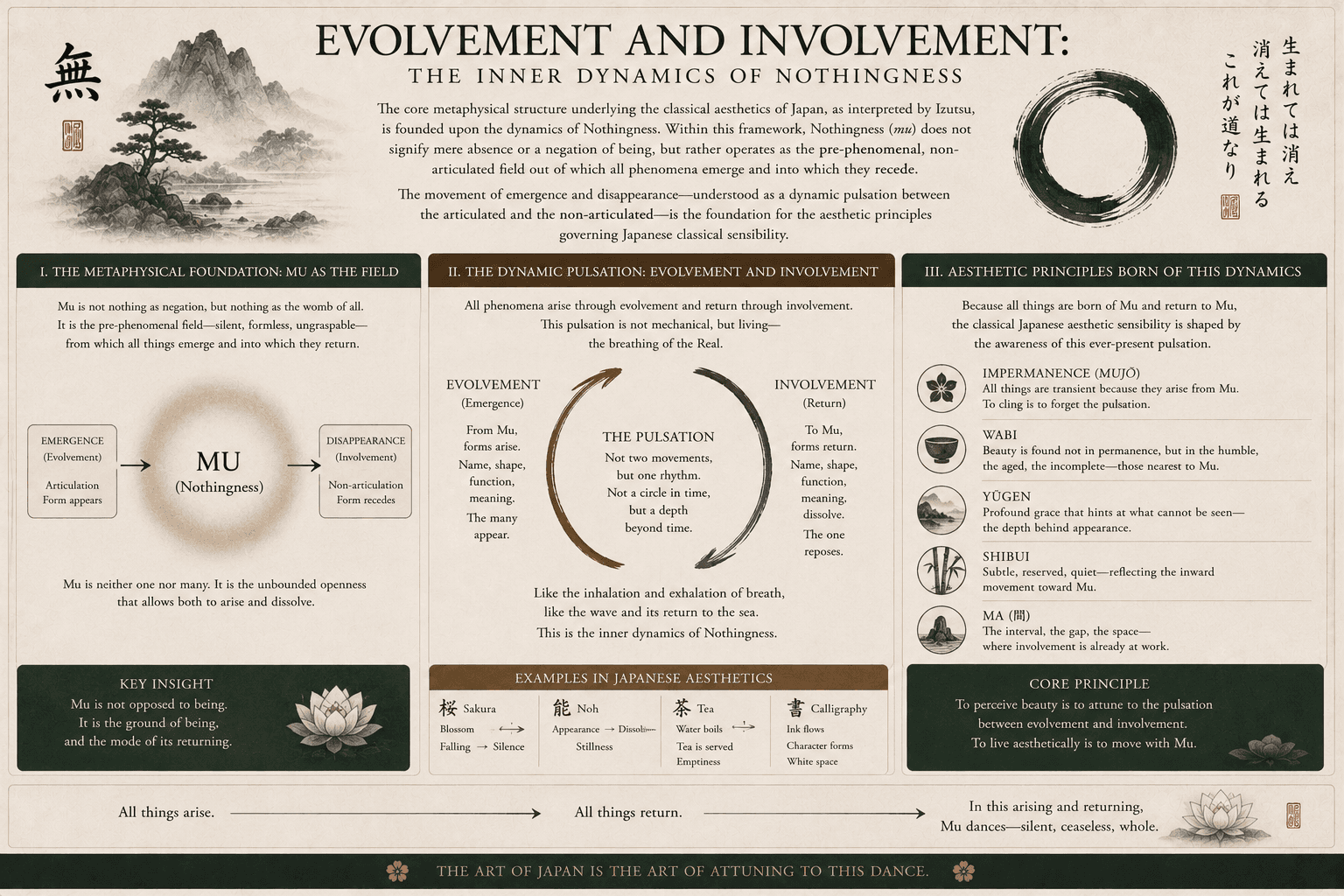
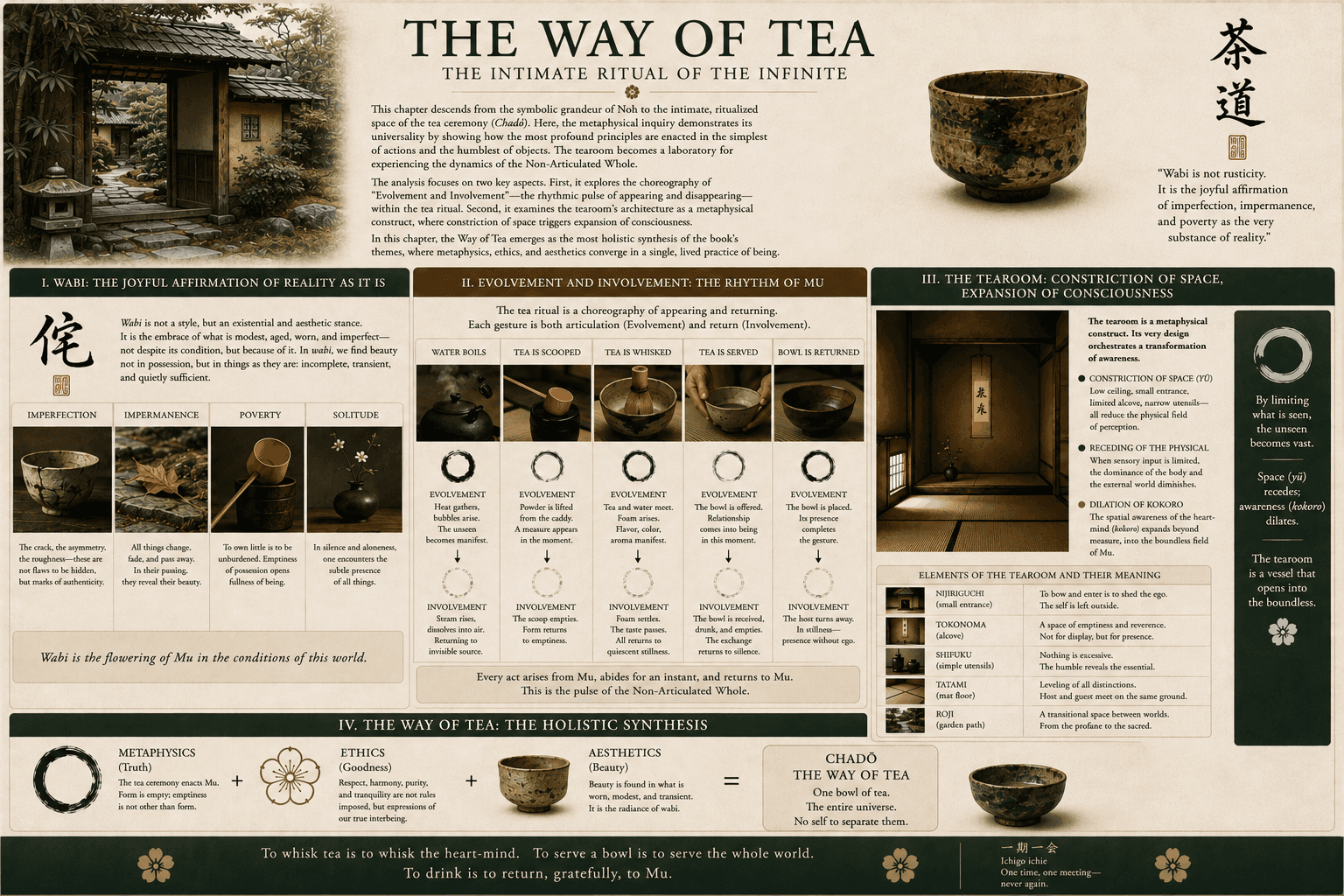
From Hierarchy to Space: The Non-Dual Transformation
The reconfiguration of metaphysical thinking from hierarchy to space marks one of the most profound transformations in the history of contemplation.
The reconfiguration of metaphysical thinking from hierarchy to space marks one of the most profound transformations in the history of contemplation.
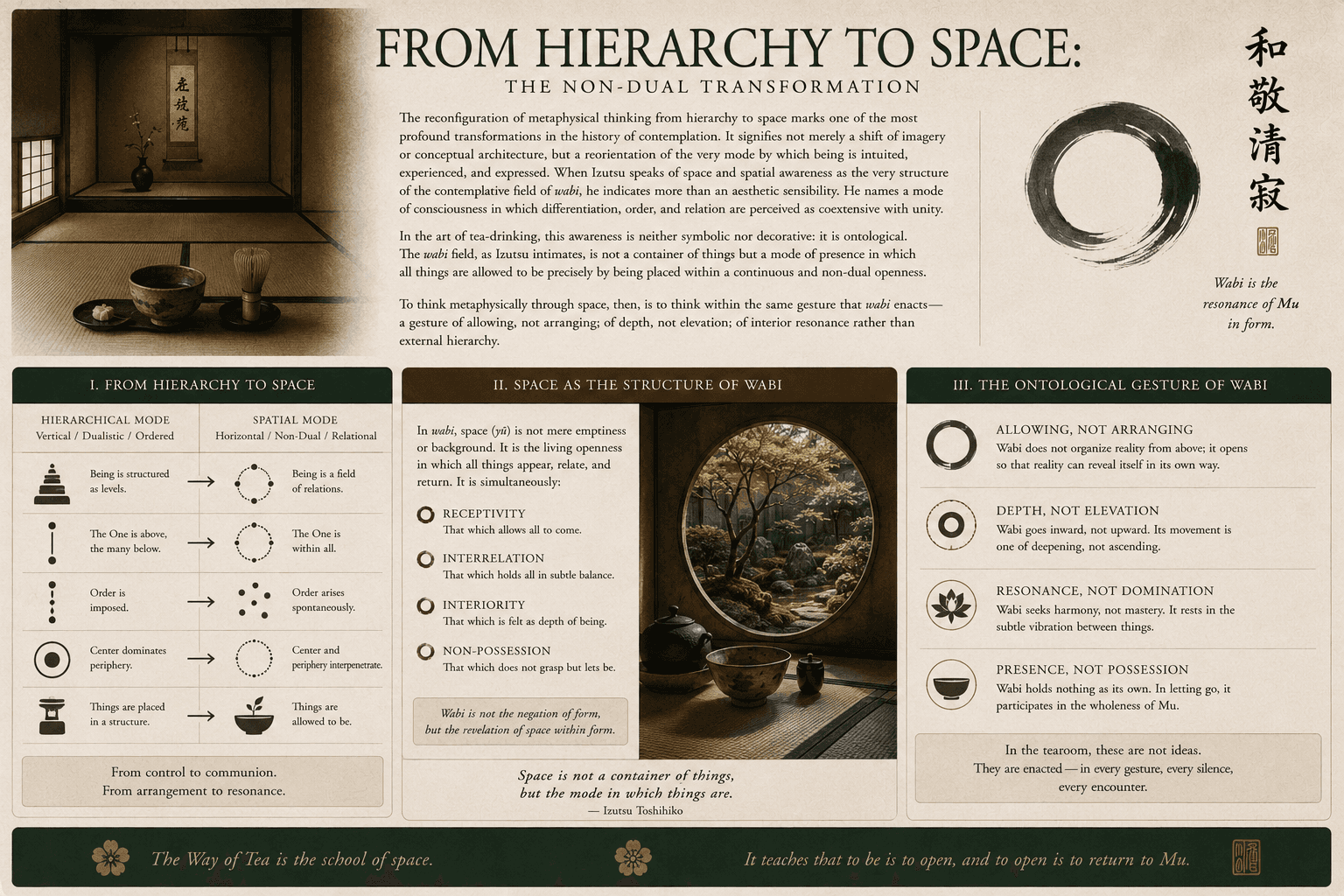
The reconfiguration of metaphysical thinking from hierarchy to space marks one of the most profound transformations in the history of contemplation. It signifies not merely a shift of imagery or conceptual architecture, but a reorientation of the very mode by which being is intuited, experienced, and expressed. When Izutsu speaks of space and spatial awareness as the very structure of the contemplative field of wabi, he indicates more than an aesthetic sensibility. He names a mode of consciousness in which differentiation, order, and relation are perceived as coextensive with unity. In the art of tea-drinking, this awareness is neither symbolic nor decorative: it is ontological. The wabi field, as Izutsu intimates, is not a container of things but a mode of presence in which all things are allowed to be precisely by being placed within a continuous and non-dual openness. To think metaphysically through space, then, is to think within the same gesture that wabi enacts — a gesture of allowing, not arranging; of depth, not elevation; of interior resonance rather than external hierarchy.
The hierarchical imagination has long provided the foundational grammar of metaphysical thought. It envisions reality as a vertical order of being, descending from the undivided One through successive degrees of determination to the manifold world of phenomena. The image of a ladder or chain of being, spanning from the ineffable source to the finite multiplicity, expresses the rational necessity of order. The higher generates, sustains, and contains the lower, while the lower reflects and depends upon the higher. Within this framework, unity stands as origin, multiplicity as derivation, and the movement of the Real appears as a cascade of emanations — an unbroken but directional process of descent.
Such architecture gives intelligibility to the cosmos. It maps the structure of manifestation, allowing thought to follow the thread of derivation from the summit to the base. Yet, for all its power, the hierarchical image retains an implicit dualism: it divides the continuum of being into levels of greater and lesser proximity to the source. Transcendence appears as spatial distance, and the Absolute seems to reside above the world rather than within it. Ontological value becomes a function of position. Even when the metaphysician affirms that all proceeds from the One, the very language of “proceeding” implies a separation — a movement outward from a hidden centre. The Absolute thus risks becoming an absent origin, the world a diminishing echo of its light.
The hierarchical model reaches its limit when one asks what kind of relation actually holds between the One and the many. If the Absolute is truly non-dual, then no distance, no external sequence, can stand between it and its manifestations. The descent of being cannot be a motion from one point to another, for all points already subsist within the total presence of the Real. The “higher” and the “lower” cannot exist as discrete domains but must co-inhere as aspects of one continuous field. Thus, the ladder of being, though necessary as an analytical scheme, must be interiorized. Its steps fold inward, transforming the vertical into the concentric, the hierarchical into the spatial.
As Izutsu writes:
“Space and spatial awareness play an unusually important role not only in the whole process of the art of tea-drinking but also in the very structure of the contemplative field of wabi, as a whole. As a matter of fact, in the art of tea-drinking in particular, the wabi expresses itself in a peculiar form of spatial awareness.” (Ibıd., 55)
It is precisely here that Izutsu’s notion of spatial awareness becomes metaphysically illuminating. The art of tea-drinking, he writes, embodies a peculiar form of spatial consciousness through which wabi manifests itself. In this art, the relation between host, guest, utensils, and silence is not hierarchical but coexistent. Each element finds its meaning not by standing above or below another, but by being placed within the same subtle continuum of presence. The empty alcove, the sound of boiling water, the stillness of the surrounding air — these do not derive from one another; they belong together in a field of mutual resonance. Space is not an interval separating them but the very condition of their communion. Similarly, in metaphysical reflection, when hierarchy yields to space, being itself is perceived not as a stratified chain but as a field of simultaneous inclusion. Each degree of reality is a mode of the same whole, distinct yet inseparable.
Spatial awareness, as Izutsu suggests, is not the awareness of space as object but awareness as space — an openness that allows multiplicity to manifest without fragmentation. The contemplative field of wabi is a metaphor of this openness: it is not defined by the objects within it but by the quality of the emptiness that sustains them. This emptiness is not negation; it is the non-dual fullness in which form arises as expression. In the same way, the Absolute, understood spatially, is not a distant principle but the interior depth of being — the unbounded “place” in which all differentiation occurs as self-disclosure.
When metaphysics adopts the logic of space, transcendence ceases to be exterior. The higher is no longer “above” but “within.” The ground is not a remote foundation but the encompassing presence that pervades every particular. To speak of the Absolute as “place” is to recognize that every being subsists within its context as within its own depth. The movement of the Real is not a trajectory from unity to multiplicity but an intensification of presence — a deepening of context. To ascend spiritually or intellectually is not to move away from the world but to penetrate more fully into the same world, to perceive it as the interior of the Absolute itself.
The shift from hierarchy to space redefines the structure of relation. What appeared, under the symbol of descent, as a sequence of derivations now reveals itself as a system of nested containments. The higher is not a prior cause but an encompassing context; the lower is not an effect but an expression. Every form contains the trace of the whole and, in turn, is contained by it. Reality becomes a series of concentric wholes, each mirroring the total structure. The Absolute is not the first term in a chain but the continuous curvature that holds all terms together. In this curvature, there is neither beginning nor end, only gradations of interiority — deeper and shallower articulations of the same presence.
In the wabi field, this curvature is visible in the way spatial awareness integrates contrast without conflict. The rough texture of an old tea bowl, the asymmetry of a flower arrangement, the simplicity of a small room — these are not imperfections to be overcome but the precise articulations through which the wholeness of space reveals itself. Each element, by its particularity, evokes the total field. The aesthetic of wabi thus performs the very logic that metaphysics discovers: the whole is present in every part, and the part exists as the luminous face of the whole. What hierarchical thought arranges vertically, wabi displays horizontally — as coexisting intensities within the same emptiness.
To conceive transcendence as interior depth is to replace the geometry of position with a geometry of openness. The Absolute is not situated “beyond” but is the very within of all things — the invisible context through which visible form subsists. In this vision, creation or emanation is no longer a process in time but an eternal relation of mutual immanence. Every being stands simultaneously as finite in expression and infinite in depth. The divine is not the summit reached after ascent but the silent presence already given in the immediacy of each form.
This conception transforms the act of contemplation itself. To perceive a phenomenon — a gesture, a sound, a space — is to perceive through it into its invisible ground. The contemplative does not rise above the world but sees the world as transparent to its origin. In the wabi experience, such transparency is cultivated through simplicity and emptiness: the removal of all that distracts from the awareness of space. When the room is almost bare, when the light is soft, when silence fills the interstices between gestures, space becomes palpable. This palpable emptiness is not absence; it is the fullness of being felt from within. Metaphysically, the same principle holds: the more inward the gaze, the more encompassing the awareness. Transcendence becomes the intimacy of presence — an infinite interiority rather than a distant height.
In the hierarchical worldview, beauty signifies order — the harmonious proportion of parts under an ideal unity. The ideal stands apart, and the beautiful participates in it by imitation. The space of beauty is vertical: the form points upward toward a perfection beyond itself. In the spatial or non-dual understanding, however, beauty arises not from imitation but from transparency. A form is beautiful when it allows its ground to shine through — when the invisible order becomes perceptible as presence. Beauty is thus the aesthetic mode of non-duality: the moment when unity and multiplicity become mutually luminous.
Izutsu’s description of wabi corresponds exactly to this transparency. The rustic, the imperfect, the asymmetrical — all become sites of beauty precisely because they do not conceal their ground in perfection. The worn surface of a vessel, the silence between sounds, the interval of light and shadow — each reveals the unbroken continuity of the field. Beauty, in this sense, is the experience of the space itself, the recognition that all forms arise and subside within the same openness. The contemplative does not admire the object; he enters into the space that allows the object to be. This spatial awareness is metaphysical seeing: the realization that being is not a collection of entities but a field of relations, each resonating with the total whole.
Once the Real is conceived as space, order no longer signifies a hierarchy of precedence but a coherence of resonance. The universe becomes a living articulation of one field of presence, whose differences are not separations but rhythms of expression. Each being occupies its “place” not as a position in a scale but as a unique vibration within the same continuum. The Absolute, as the total “place,” is both immanent and transcendent: immanent as the ground in which all forms arise, transcendent as the inexhaustible depth that no form can exhaust.
This order is self-generating. It arises from within rather than being imposed from above. The apparent structure of levels is an image of how the whole communicates itself — an internal differentiation that preserves unity. The hierarchy of forms, when reinterpreted spatially, becomes a rhythm of manifestation and return, a pulse of the Real that perpetually unfolds and gathers itself. The metaphysical cosmos thus appears not as a pyramid but as a sphere — an all-encompassing openness where every point is centre and circumference at once.
In the aesthetic analogy, the tea-room provides a microcosmic representation of this living order. Every element, from the placement of utensils to the relation of guest and host, is situated so that the whole is felt through the part. The measure of proportion is not symmetry but resonance. A single flower may balance an entire empty wall because the space between them vibrates with silent coherence. This silent coherence is precisely the manifestation of non-dual order — the order of the Real as living space.
When hierarchy is interiorized into space, the relation between the Absolute and the world becomes reciprocal. The Absolute is not only the ground of manifestation; it realizes itself through manifestation. The many are not external projections but the very modes by which the One knows itself. Manifestation is thus not a fall or diminution but a self-revelation — the Real becoming conscious of its own depth through differentiation. This reciprocity abolishes the need for any ultimate dualism between divine and cosmic, transcendental and empirical. Both are polar expressions of one self-articulating continuum.
In wabi, this reciprocity appears as the relation between emptiness and form. The empty space of the tea-room does not negate the utensils or gestures; it allows them to be themselves by giving them context. Likewise, the utensils and gestures make the emptiness perceptible by tracing its boundaries. Each reveals the other. The ceremony thus becomes a lived enactment of non-dual ontology: emptiness and form, stillness and movement, silence and sound — all co-inhere in a field where no term can be isolated. The metaphysical insight underlying this is that reality itself functions in the same way: the Absolute expresses itself through multiplicity, and multiplicity discloses the Absolute. To perceive this is to perceive the world as place — a single, all-containing openness in which nothing stands outside the whole.
Though space replaces hierarchy as the dominant image, the transformation does not abolish temporality. Rather, it redefines it. In hierarchical cosmology, time follows the sequence of descent and return — a linear movement from origin to manifestation and back. In the spatial vision, time becomes curvature: an ever-present rhythm of unfolding within the same field. The moment is not a point on a line but a pulse within a continuum. Every instant contains the total past and future as its depth; every movement is a modulation of the same presence.
In aesthetic terms, the experience of wabi time mirrors this curvature. The tea ceremony unfolds in deliberate slowness, yet each act contains the entire ceremony. The lifting of the bowl, the pouring of water, the shared silence — each moment is complete, self-sufficient, and infinite in depth. The awareness of space transforms duration into presence. Time ceases to flow; it opens. The metaphysical analogue is clear: when hierarchy becomes space, eternity is no longer beyond time but within it — the stillness that pervades all movement. Non-duality thus encompasses both time and eternity as two modes of the same spatial awareness.
The passage from hierarchy to space does not destroy the architectural image of reality; it fulfils it. Architecture remains as the articulation of order, but its meaning is now interiorized. The “levels” of being become degrees of interiority within the same whole. The structure of the cosmos persists, yet its axes have been curved inward. What once appeared as ascent and descent now appears as depth and transparency. The Absolute is both the foundation and the openness, both the ground and the manifestation. The metaphysical ladder has not vanished; it has turned upon itself, forming a continuous circle of inclusion.
This completion is also aesthetic. The classical notion of beauty as harmony between parts and whole finds its final expression not in proportion but in presence. Beauty no longer imitates order; it is order made visible. The field of wabi demonstrates this with unsurpassed subtlety. There, space itself becomes the form of beauty — a form without boundaries, a presence without dominance. What the hierarchical mind conceived as the summit of perfection, the spatial mind perceives as the immediacy of emptiness. The highest is not above but within; the ideal is not transcendent but immanent in the simplest gesture, the quietest sound, the most ordinary thing.
To inhabit this non-dual awareness is to think and see spatially. The contemplative field is not a system of objects but a horizon of relations. Awareness itself becomes the medium in which being discloses its unity. In this sense, spatial awareness is not merely aesthetic but epistemological: it is the mode through which the Real knows itself. Just as in the tea ceremony every movement arises from silence and returns to it, so in the contemplative act every thought arises from and returns to the openness of awareness. The self that contemplates and the world contemplated are both contained within the same space of knowing. The distance between subject and object collapses into the intimacy of presence. This is the philosophical essence of Izutsu’s observation: that space is not only the structure of wabi but the very form of contemplative consciousness itself.
The non-dual transformation, then, is nothing other than the internalization of hierarchy into space. The metaphysical ladder folds into a field of mutual containment; the Absolute becomes the depth of every phenomenon; transcendence turns inward as the intimacy of immanence. Difference persists, but as rhythm, not separation. The world ceases to be a shadow of its source and becomes its immediate radiance. In this vision, every being is both particular and universal, finite and infinite — a precise articulation of the same inexhaustible whole.
Such transformation is not only conceptual but experiential. It alters the mode of presence itself. Where the hierarchical mind perceives the world from a point of view, the spatial mind perceives it from within — as participation. To live within space is to dwell in openness, to let things be as expressions of their own place within the total order. The contemplative awareness of wabi is the living manifestation of this transformation: it is metaphysics enacted through simplicity, philosophy translated into space.
In the end, the transition from hierarchy to space reveals not two visions but two aspects of one truth. Architecture provides the form; space provides the life. Architecture gives the framework by which the mind discerns the order of manifestation; space gives the experiential depth through which that order becomes real. The Absolute is both — the structure and its openness, the silent origin and the speaking world. The cosmos, thus understood, is not a hierarchy of levels but a field of resonance, an infinite place where every being reflects the totality and every moment contains eternity.
Izutsu’s reflection on spatial awareness in wabi offers a profound key to this understanding. The peculiar form of awareness that the art of tea embodies is not limited to aesthetics; it is the metaphysical intuition of non-duality itself. In the stillness of the tea-room, where each sound, each gesture, each pause belongs inseparably to the whole, one perceives how being itself unfolds — not as a descent from the One, but as the self-articulation of unity within space. The emptiness that holds all forms is not void but plenitude; the silence that pervades every act is not absence but presence. To perceive this is to realize that the Absolute is not beyond the world but the very space of its being.
Thus, the metaphysical architecture finds its completion in the spatial vision. The ladder of being turns inward and becomes a sphere of presence; hierarchy becomes resonance; transcendence becomes depth. The Real reveals itself not as distant light but as the immediate clarity of space. And in that space — as in the contemplative field of wabi — beauty, awareness, and being coincide. The non-dual transformation is complete: the architecture of the Real has become the space of the Real, where every form is transparency, every difference is inclusion, and every place is the whole.