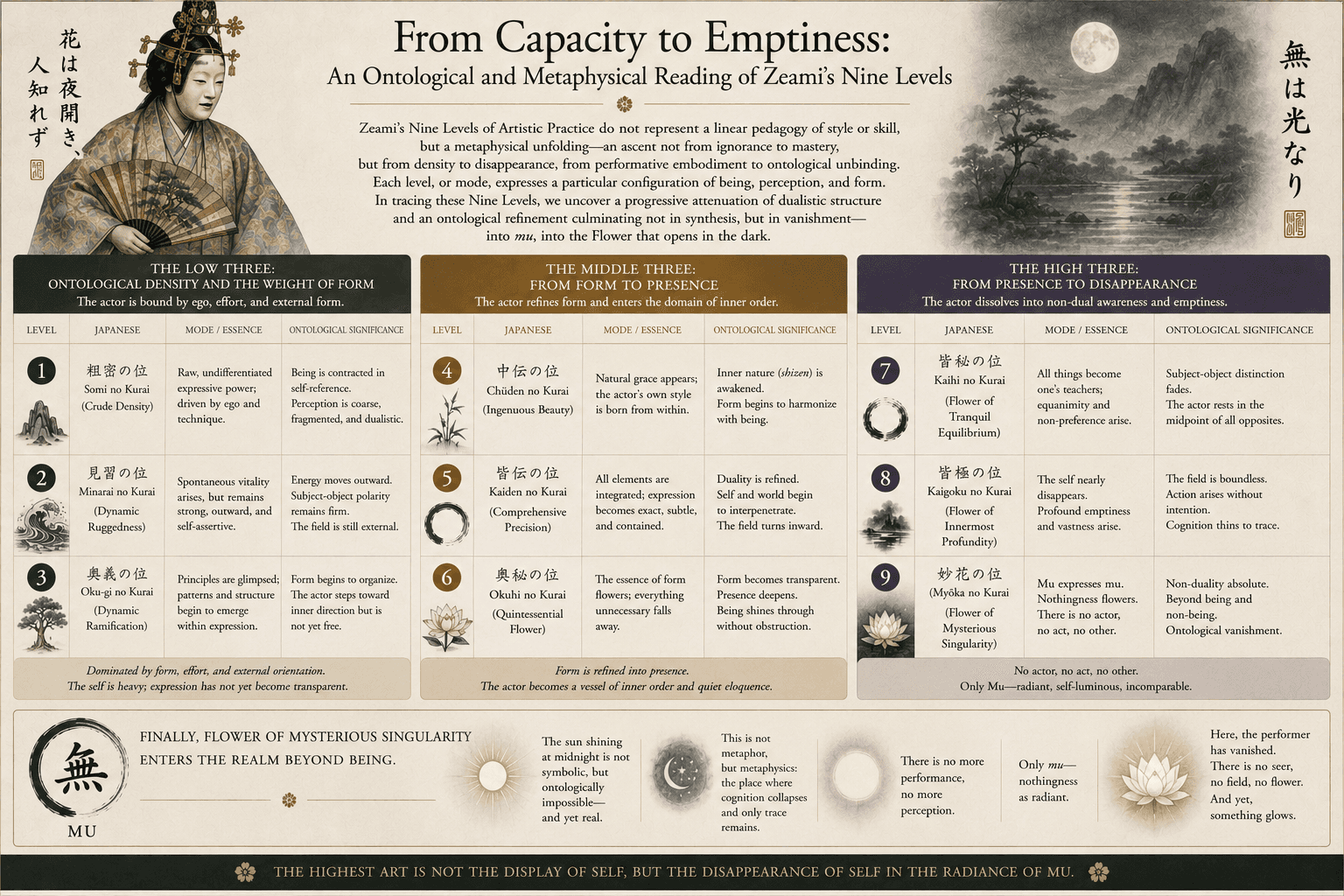
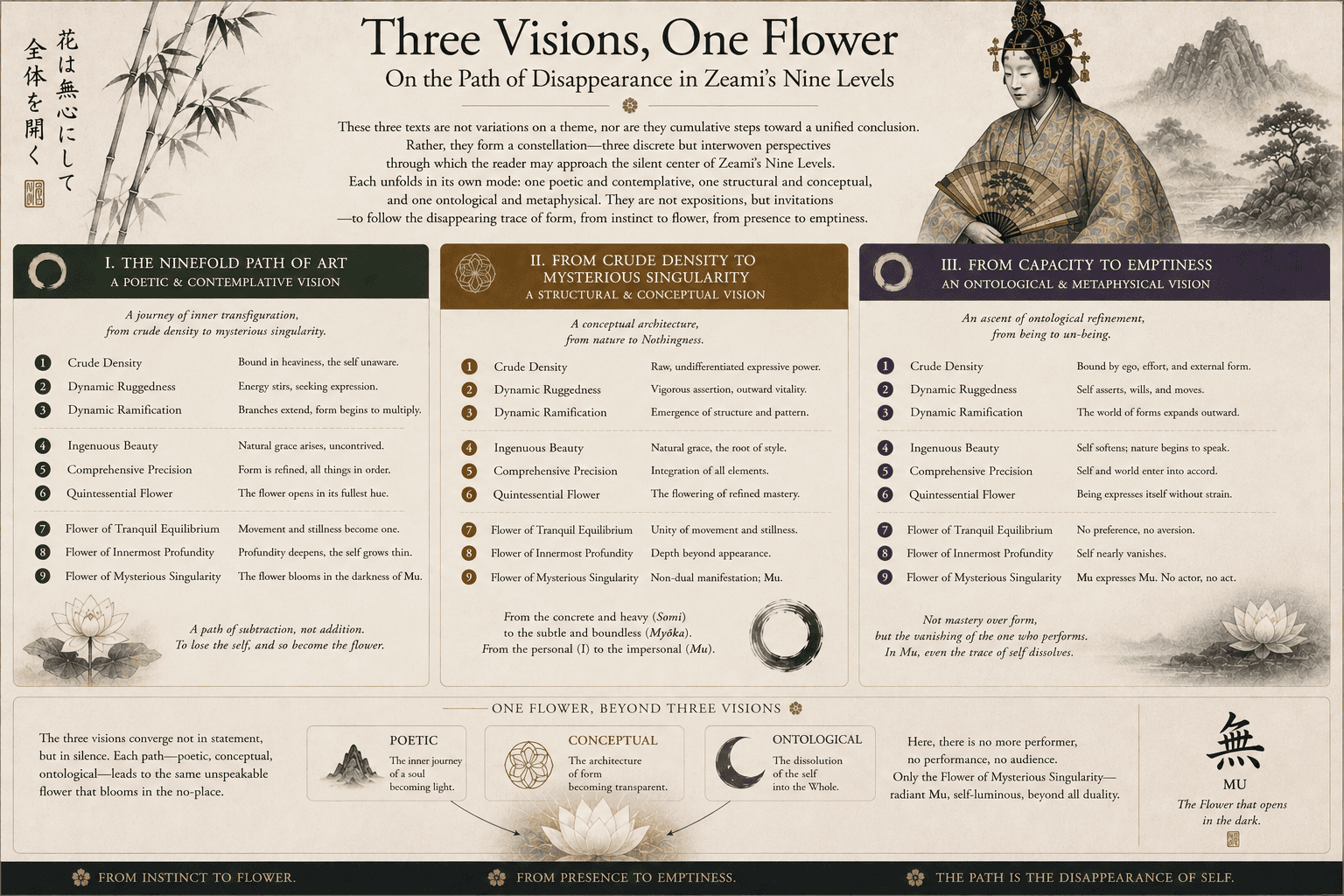
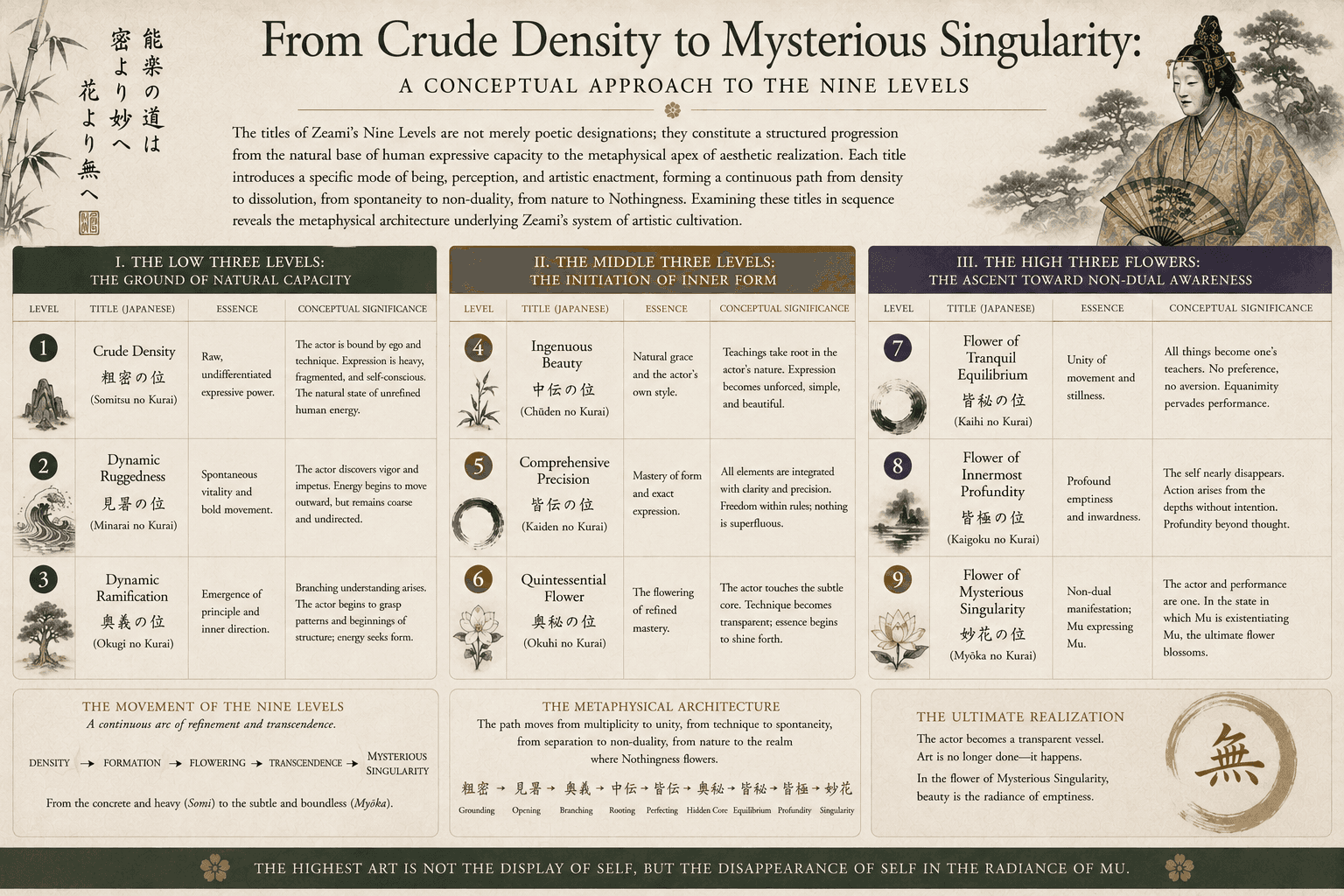
Zeami’s Nine Levels of Artistic Practice do not represent a linear pedagogy of style or skill, but a metaphysical unfolding—an ascent not from ignorance to mastery, but from density to disappearance, from performative embodiment to ontological unbinding. Each level, or mode, expresses a particular configuration of being, perception, and form. In tracing these Nine Levels, we uncover a progressive attenuation of dualistic structure and an ontological refinement culminating not in synthesis, but in vanishment—into mu, into the Flower that opens in the dark.
The Low Three: Ontological Density and the Weight of Form
The first three modes—Crude Density, Dynamic Ruggedness, and Dynamic Ramification—are marked by ontological heaviness. In Crude Density, the flying squirrel, competent in many faculties but refined in none, exemplifies being as mere capacity. The performer exists as multiplicity-without-integration. Ontologically, this is a state of dispersion. There is no inner centre, only biological motion. No art yet appears; the performer exists, but does not yet present.
In Dynamic Ruggedness, symbolized by the tiger, vitality emerges—but is wild and unformed. This mode is ontologically transitional: from inert capacity toward self-asserting will. Yet this will is still bound in the thrum of ego-force. Ruggedness is not just lack of polish, but ontological resistance—a density that pushes outward but lacks relational subtlety. The performer is still divided from the field, acting upon rather than with it.
In Dynamic Ramification, there is precision and form. The “golden hammer” and “sacred sword” indicate mastery of execution—form has become fluent, and expression sharp. Yet the coldness remains. This is the height of dualistic aesthetics: subject and object are refined, but remain separate. Art is performed on the stage, not from within being. Here lies the paradox of brilliance without depth: the mode radiates—but does not yet resonate.
The Middle Three: From Form to Presence
Ingenuous Beauty initiates a metaphysical shift. The Confucian axiom—“The Way worthy to be called the way is not the ordinary way”—signals an ontological redirection: from outer practice toward inner presence. The mode is still immature technically, but the performer now intuits the Way not through structure, but through sincerity. Being begins to reveal itself. It is here that the principle of yūgen first stirs: the radiance of what cannot be grasped, only revealed.
Comprehensive Precision marks a state of fullness. The performer comprehends the entire field: clouds, mountains, moon, ocean—all phenomena enter the scope of perception. Ontologically, this is the moment of total cognitive luminosity. Yet it remains comprehensive, not unitive. The performer sees everything, but still stands apart from it. The division between field and seer persists. This is not yet dissolution, but saturation.
In Quintessential Flower, this separation dissolves. Phenomena reveal themselves symbolically. The sun in the haze, mountains in crimson dusk—image and seer blur. Ontologically, the world and the self cohere in contemplative presence. There is no synthesis here—no higher-order resolution of opposites—but a vanishing of opposition altogether. The aesthetic field becomes non-dual: it is not seen, but is-seeing. This is the awakening of ma, of the interval where presence and absence converge.
The High Three: From Presence to Disappearance
The Flower of Tranquil Equilibrium evokes a still vision: snow heaped in a silver bowl. Harmony is no longer achieved but is simply present. This is pure ontological equilibrium—subject and object no longer oscillate, but rest. Nothing moves, yet everything is. Here, art becomes a field of being rather than expression. Gei-dō has shifted from way-as-discipline to way-as-presence.
Flower of Innermost Profundity deepens this presence into paradox. The image of the solitary peak untouched by snow disrupts the uniformity of the visible. The sublime lies not in height, but in depth—profundity rather than transcendence. This mode operates in what cannot be resolved: an ontological resonance that is neither presence nor absence, but the trembling interval between them. The snowless mountain is not exception, but essence: it reflects the invisible that sustains the visible. This is senuhima—the non-space in which art breathes.
Finally, Flower of Mysterious Singularity enters the realm beyond being. The sun shining at midnight is not symbolic, but ontologically impossible—and yet real. This is not metaphor, but metaphysics: the place where cognition collapses and only trace remains. There is no more performance, no more perception. Only mu—nothingness as radiant. Here, the performer has vanished. There is no seer, no field, no flower. And yet, something glows.
Non-Dual Flow, Not Dialectical Progression
At no point in this path does Zeami posit a Hegelian dialectic of opposition and resolution. Rather, there is gradual attenuation a letting-go of form, technique, and self. The Nine Levels do not accumulate; they subtract. Each mode reveals the previous one not as error, but as necessary opacity—a condensation of being that must be passed through, not eliminated.
In this sense, the Nine Levels are not pedagogical steps, but ontological configurations. The path from Crude Density to Mysterious Singularity is not about becoming more—but becoming less: less divided, less dense, less self-possessed. It is the movement from multiplicity to unicity—not synthesis of parts, but the disappearance of partition. In place of dialectic, Zeami offers a path of unbinding: not the overcoming of opposites, but the vanishing of opposition altogether.
To practice art in Zeami’s vision is to trace the subtle stages by which performance ceases to be performance, and becomes trace: the luminous residue of that which no longer asserts itself. The flower does not bloom from effort, but from disappearance. In this lies the metaphysical power of the Nine Levels: they name the ontological dissolutions through which the performer must pass—not to master art, but to disappear into it.
Where dialectic seeks synthesis, Zeami reveals stillness. Where thought seeks concept, Zeami reveals trace. And where the self seeks to act, Zeami dissolves it in the gesture that leaves no remainder. This is not dialectical progress—but metaphysical return: from being to nothingness, from form to flower.