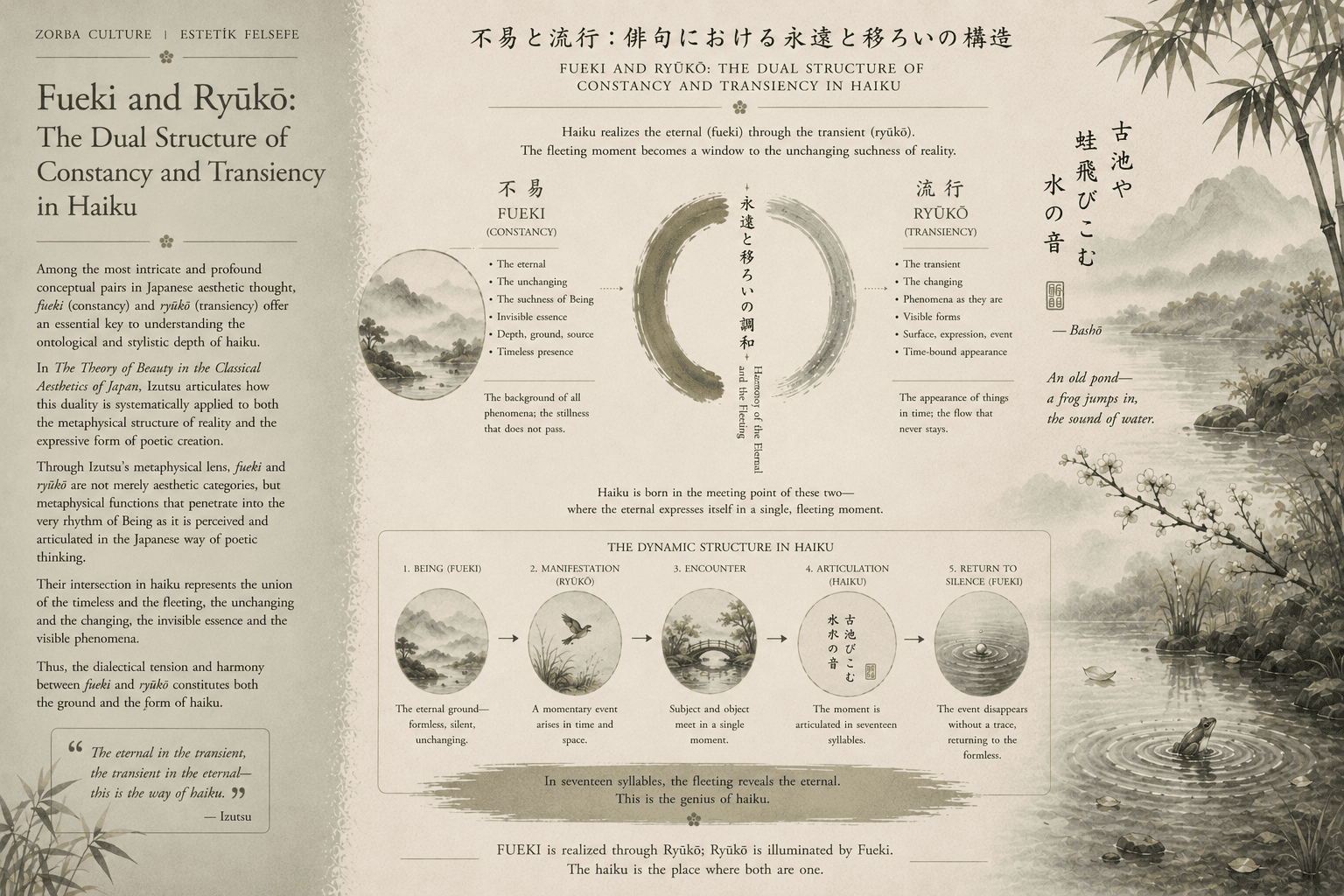
Among the most intricate and profound conceptual pairs in Japanese aesthetic thought, fueki (constancy) and ryūkō (transiency) offer an essential key to understanding the ontological and stylistic depth of haiku. In The Theory of Beauty in the Classical Aesthetics of Japan, Izutsu articulates how this duality is systematically applied to both the metaphysical structure of reality and the expressive form of poetic creation. Through Izutsu’s metaphysical lens, fueki and ryūkō are not merely aesthetic categories, but metaphysical functions that penetrate into the very rhythm of Being as it is perceived and articulated in the Japanese way of poetic thinking. Their intersection in haiku represents the union of the timeless and the fleeting, the unchanging and the changing, the invisible essence and the visible phenomena. Thus, the dialectical tension and harmony between fueki and ryūkō constitutes both the ground and the form of haiku.
In the ontological context, Izutsu explains ryūkō as the “phenomenal transiency” of the world -mono no aware, the pathos of all things, the fragility of forms, the ceaseless flow of appearances that rise and vanish. It is the cherry blossom falling, the frog’s leap into water, the passing of clouds in the spring sky. Ryūkō is the flux of phenomenal events, each one concrete, sensory, and irreversibly bound to time. Yet, according to Izutsu, behind this endless motion lies fueki -“non-phenomenal constancy.” This refers not to a metaphysical substance in the Western sense, but to an unchanging suchness that permeates the ever-changing world. It is not what appears, but that which allows appearance to be what it is. Fueki is the silent ground, the invisible field of Being (yū) in which all transient forms emerge, resonate, and return into stillness. In this sense, every haiku is a metaphysical gesture: an evanescent image revealing the presence of what does not change through the figure of what inevitably vanishes.
This can be seen in Bashō’s philosophy of poetic creation. Bashō wrote: “The eternal and the momentary (fueki ryūkō) are not two.” Here, the distinction is not a dualism but a polarity within a single metaphysical rhythm. The haiku, in its brevity, captures a momentary flash, but through it, opens onto the timeless depth. For example:
“Summer grasses-
all that remains
of soldiers’ dreams.”
The summer grasses are ephemeral phenomena, the seasonal traces of time. Yet they stand in as figures of fueki -not merely of death, but of the unchanging truth that all glory, all ambition, all human striving return to dreamlike evanescence. The poetic consciousness (ishiki) activated in such a haiku is one that does not merely reflect upon the world, but attunes itself to this dual rhythm of time and timelessness. The moment, through poetic intuition, becomes a gateway to Being.
In the stylistic context, Izutsu draws a parallel structure. Here, ryūkō refers to the modish, the fashionable, the transient trends of poetic taste. It is the play of novelty, the changing aesthetic surface of poetic expression. Fueki, in contrast, refers to a standardized aesthetic norm—a deep style that endures across shifting trends. This is not standardization in a formal or technical sense, but a profound inner principle of beauty rooted in the contemplative orientation of the Japanese poetic mind. In Bashō’s work, the balance between stylistic ryūkō and fueki is evident in his insistence on both creative innovation and spiritual constancy. While encouraging experimentation and engagement with contemporary realities, he also emphasized the return to inner depth, to fūga no makoto -the authentic spirit of poetic elegance.
Thus, on the stylistic level, fueki functions as the metaphysical underpinning of form c-a spiritual grammar of aesthetic intuition- while ryūkō functions as its playful elaboration, the surface articulation of that inner grammar in response to the ever-shifting world. To write haiku is to enter this double structure: to dwell within fueki, and yet speak through ryūkō; to preserve the metaphysical norm while allowing its expression to dance upon the wave of the moment.
Izutsu’s theory ultimately reveals that the double application of fueki and ryūkō to both ontology and style is not a coincidence but a profound structural isomorphism between the nature of Being and the nature of Beauty in Japanese thought. Beauty in haiku is not simply aesthetic pleasure; it is the manifestation of Being through form, the invisible expressing itself through the visible, the unchanging revealed in the changing. The haiku is the temporal expression of the timeless, the articulated emergence of what lies beyond articulation.
Through Izutsu’s metaphysical framework, fueki and ryūkō appear not as opposites but as twin functions of poetic consciousness. In the structure of haiku, they mark the inseparability of transiency and constancy, surface and depth, image and essence. The poet does not choose between them but must dwell precisely at their intersection -where the falling petal opens onto eternity, and where the most fleeting moment becomes the vessel of unchanging truth. Haiku, in this sense, is not merely an art of concision, but a metaphysical art: a way of expressing the eternal through the momentary, and of seeing in every phenomenon the quiet glow of the real.