


Japanese Way of Thinking-Chapter II
This chapter introduces the specific cognitive actor who inhabits it: the Japanese mode of thinking, which Izutsu characterizes as inherently “poetico-aesthetic” and contemplative.
This chapter introduces the specific cognitive actor who inhabits it: the Japanese mode of thinking, which Izutsu characterizes as inherently “poetico-aesthetic” and contemplative.
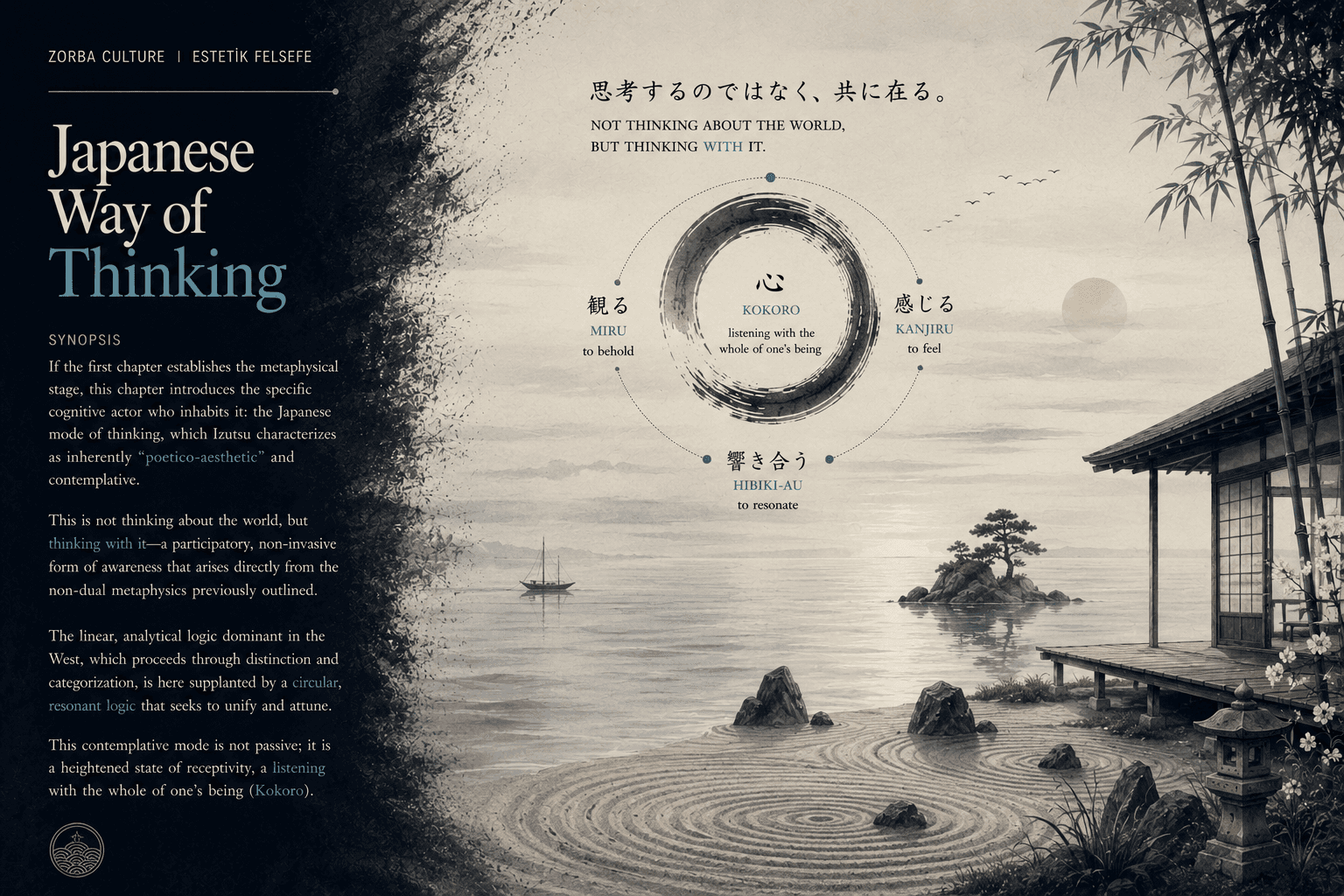
Synopsys: If the first chapter establishes the metaphysical stage, this chapter introduces the specific cognitive actor who inhabits it: the Japanese mode of thinking, which Izutsu characterizes as inherently “poetico-aesthetic” and contemplative. This is not thinking about the world, but thinking with it—a participatory, non-invasive form of awareness that arises directly from the non-dual metaphysics previously outlined. The linear, analytical logic dominant in the West, which proceeds through distinction and categorization, is here supplanted by a circular, resonant logic that seeks to unify and attune. This contemplative mode is not passive; it is a heightened state of receptivity, a listening with the whole of one’s being (Kokoro).
Central to this cognitive mode is the concept of ma, the interval or pause. Far from being mere emptiness, ma is a metaphysical principle of spacing that structures both time and perception. It is the silence between sounds that gives music its rhythm, the blank space in a painting that gives form its weight, and the pause in a Noh performance that charges the atmosphere with unspoken meaning. In the realm of language, this manifests as a “semantic style of restraint,” where words are chosen not for declarative power but for their capacity to suggest, to evoke, and to point toward the vast semantic horizon of the unspoken. This linguistic tendency cultivates a contemplative thought that dwells in ambiguity and openness, refusing the closure of fixed definitions. The temporal experience associated with this mode is likewise transformed, shifting from a linear progression to a field-like “now” where past and future interpenetrate. Thus, this chapter argues that to understand Japanese art, one must first understand the unique structure of consciousness that produces and apprehends it—a consciousness for which beauty is not an object of thought, but the very medium in which thought moves.

