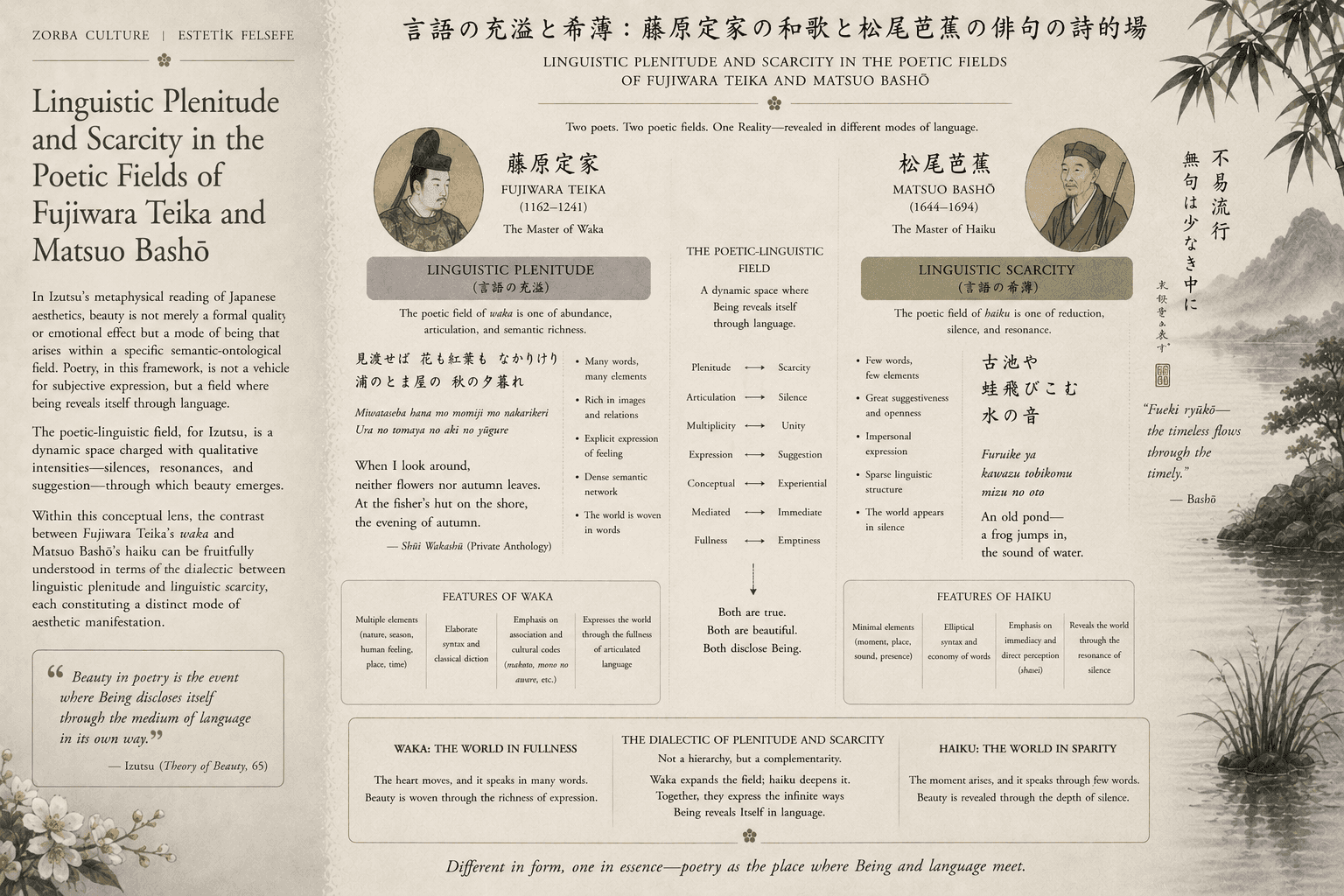
In Izutsu’s metaphysical reading of Japanese aesthetics, beauty is not merely a formal quality or emotional effect but a mode of being that arises within a specific semantic-ontological field. Poetry, in this framework, is not a vehicle for subjective expression, but a field where being reveals itself through language. The poetic-linguistic field, for Izutsu, is a dynamic space charged with qualitative intensities -silences, resonances, and suggestion- through which beauty emerges. Within this conceptual lens, the contrast between Fujiwara Teika’s waka and Matsuo Bashō’s haiku can be fruitfully understood in terms of the dialectic between linguistic plenitude and linguistic scarcity, each constituting a distinct mode of aesthetic manifestation.
Fujiwara Teika’s waka embodies a field of linguistic plenitude, characterized by semantic density, allusive richness, and emotional layering. The field is filled with overtones of the classical tradition, drawing on a vast repertoire of poetic diction, seasonal imagery, and intertextual reference. Izutsu interprets this fullness not as rhetorical excess but as a structural quality of depth. Beauty, in Teika’s waka, is located in the convergence of refined language and inner feeling -a convergence that produces yūgen, the mysteriously profound. The words do not merely describe nature or emotion; they veil and reveal simultaneously, creating an atmosphere in which meaning is intuitively intuited rather than intellectually grasped.
Teika’s poetic plenitude is not ornamental but ontological: it aims to evoke the invisible dimension of reality by saturating the linguistic field with reverberations. Language here becomes an echo chamber of cultural and emotional memory. The plenitude of expression sustains a resonant silence behind words, enabling beauty to appear as that which exceeds articulation. In Izutsu’s terms, this is a semantic fullness that discloses hidden being through the richness of suggestion.
By contrast, Matsuo Bashō’s haiku operates within a field of linguistic scarcity. The seventeen syllables of haiku impose a radical economy of expression, but this scarcity is not a limitation -it is the very condition for a different mode of beauty to arise. Bashō’s poetics, influenced deeply by Zen thought, privileges austere solitude, subtle suggestion, and emptiness. Within such a field, beauty is not a product of semantic accumulation but of ontological exposure: the haiku presents the world in its suchness, unobstructed by interpretive layering.
Izutsu interprets this scarcity as a reduction to essence. The few words of a haiku, precisely chosen, function like a koan -opening a space of contemplative stillness. The field of language is thinned to the point where silence becomes audible, and it is through this silence that beauty discloses itself. The scarcity of linguistic material heightens the presence of what remains unsaid. Beauty, in Bashō, is not layered but bare, not hidden in semantic folds but revealed in the immediacy of being.
In this contrast, linguistic plenitude and linguistic scarcity do not simply oppose each other as abundance and lack; rather, they delineate two distinct configurations of the poetic-linguistic field as theorized by Izutsu. Teika’s plenitude draws the reader into a web of suggestive meaning, where beauty emerges through the semantic pressure of accumulated cultural resonance. Bashō’s scarcity empties the field of such pressure, allowing beauty to appear in the stillness that surrounds a single image or moment. One gathers meaning through reverberation; the other through cessation.
Yet in both cases, beauty is not located in the text as an object but is realized phenomenologically in the reader’s encounter with the field of language. In Teika, the reader moves inward toward emotional and cultural depths; in Bashō, the reader moves outward -or rather, toward a dissolution of self- in the face of the world’s stark immediacy. Both paths lead to what Izutsu would describe as the metaphysical intuition of being, each via a different linguistic modality.
Thus, Teika’s poetic-linguistic plenitude and Bashō’s poetic-linguistic scarcity represent not merely stylistic preferences but ontological attitudes. Each constructs a distinct field in which the world is permitted to disclose its beauty: the former through fullness and reverberation, the latter through emptiness and stillness. Seen through Izutsu’s theory, these fields are not aesthetic surfaces but sites of ontological disclosure, where language, silence, and suggestion converge to allow beauty to appear—not as something said, but as something intuited in the silent space where words fall away.