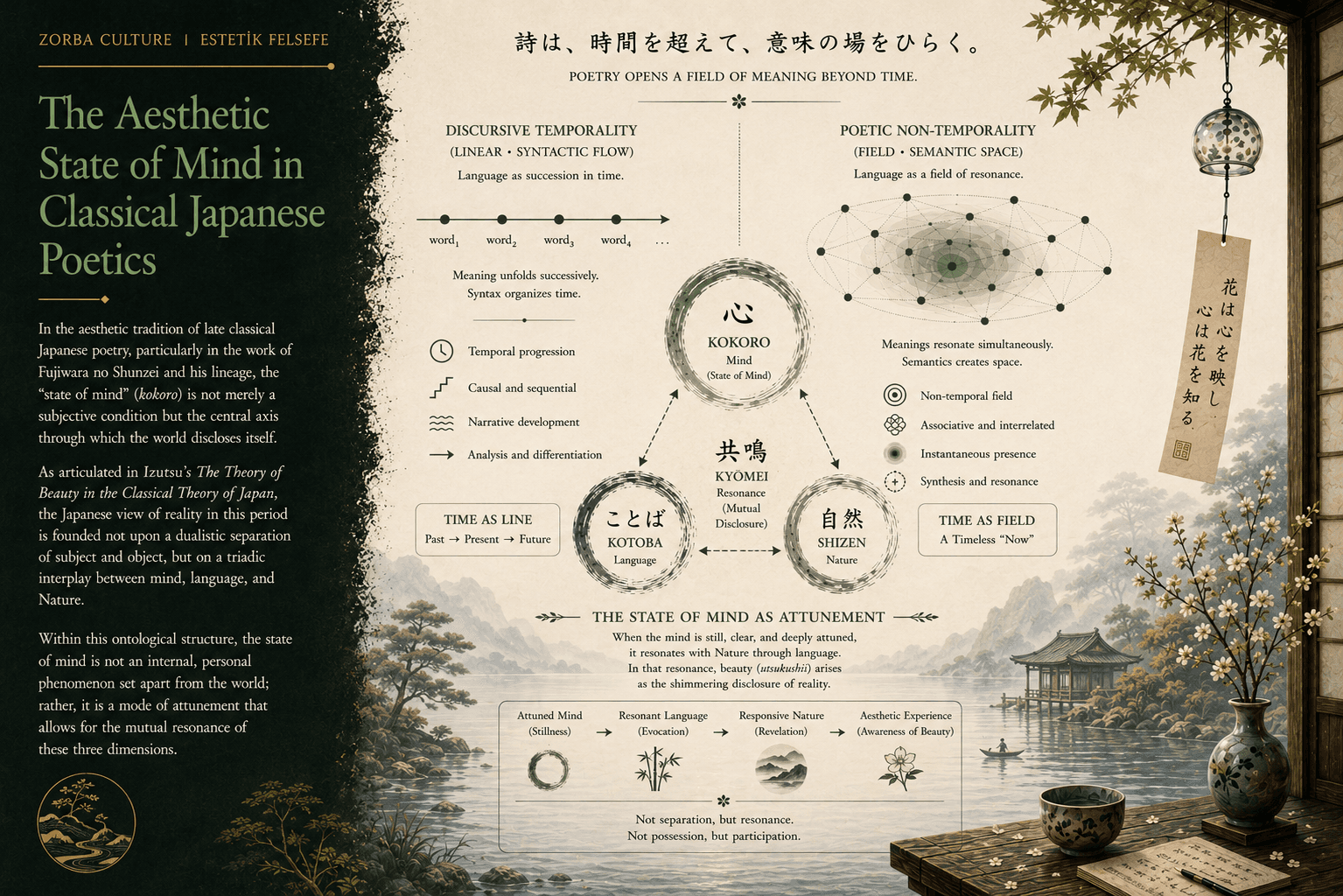
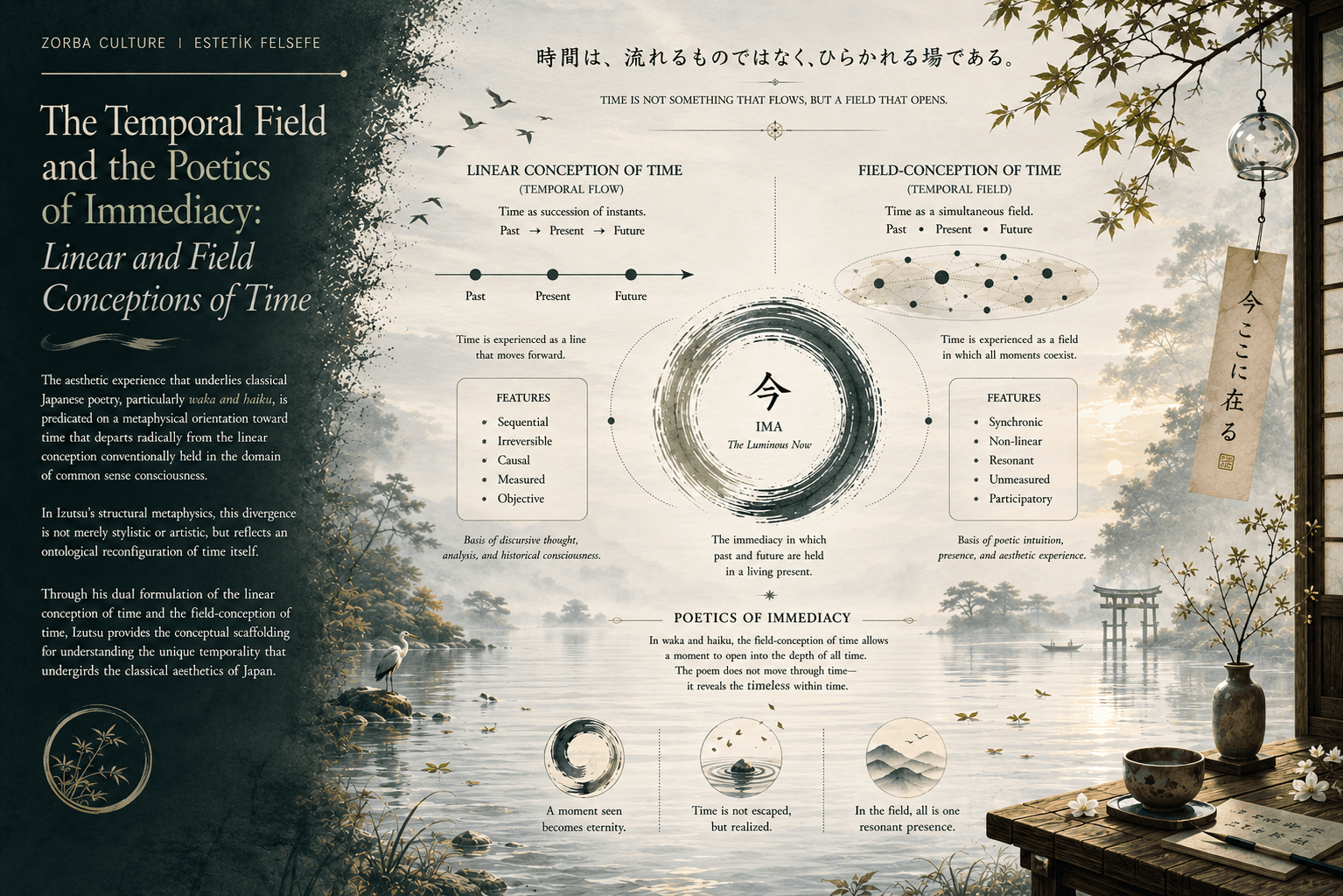
Izutsu’s statement that “Waka, in other words, tries to create a linguistic 'field', an associative network of semantic articulations, i.e. a non-temporal 'space' of semantic saturation, instead of a linear, temporal succession of words, a syntactic flow, the latter being utilized merely as the coagulative basis of the poetic sentence.” (Ibid., 5) presents a philosophical distinction between poetic non-temporality and discursive temporality.
The quote posits that poetic language seeks not a narrative progression -an unfolding of meaning over time- but instead a semantic field, an associative network dense with interrelation. This shift from syntax (temporal flow) to semantics (spatial saturation) transforms poetry into a kind of static totality -a space where meanings resonate simultaneously, not successively.
Izutsu’s reading of classical Japanese aesthetics -notably in The Theory of Beauty in the Classical Aesthetics of Japan- offers an essential philosophical mirror to this idea. He emphasizes that beauty in Japanese thought is not bound to formal structure or conceptual clarity, but rather to suggestiveness, atmosphere, and evanescence -what he calls yūgen, aware, and ma. These are aesthetic categories that dislocate the primacy of chronological time and direct meaning in favour of depth, resonance, and interconnection. In this regard, Izutsu aligns with the quote’s proposition of poetry as a field -a non-temporal aesthetic space where the reader does not proceed through time, but rather lingers in presence.
In Izutsu’s formulation, the most sublime form of beauty is that which defies capture. For example, yūgen refers to a subtle, mysterious depth that cannot be entirely spoken but only hinted at. Similarly, aware evokes a bittersweet awareness of the ephemeral -again, not through temporal unfolding, but through an instantaneous immersion in a moment’s emotional intensity.
Thus, poetic language in Japanese tradition functions non-temporally, even when embedded in time-bound structures like the waka or haiku. Izutsu makes clear that Japanese poetry is less concerned with narrative succession than with a compression of experience -where one image or word infinitely expands through suggestion. This accords with the idea of poetry as a semantic saturation: a space where meanings radiate outward in all directions, not forward in time.
Indeed, the haiku -a minimal form- exemplifies this. It functions not as a miniature narrative but as a semantic instant, a field of inter-referential depth. The frog jumping into an old pond in Bashō’s haiku is not simply an event in time; it’s an entry point into a whole atmospheric reality, one that evokes the eternal through the ephemeral.
In contrast, the quote assigns syntactic temporality -successive, linear language- a secondary, "coagulative" function. This is reminiscent of Izutsu’s idea of linguistic minimalism: the notion that language is merely the veil through which the non-linguistic, the ineffable, is suggested. The temporal order of words is necessary, but it is not the locus of beauty; rather, it provides the formal infrastructure that allows the semantic field to emerge.
This echoes the Japanese aesthetic concept of ma -the interval or negative space between things. Izutsu interprets ma not as mere emptiness, but as the resonant silence that makes meaning possible. The syntactic flow of poetic language functions like ma: its value lies not in its temporal sequence, but in the semantic reverberation it makes possible.
Hence, temporality in poetry, viewed through Izutsu, is functional but not foundational. It enables -but does not contain- the poetic experience. The reader is meant to pass through the temporal flow only to enter into a non-temporal state of aesthetic contemplation, where meanings exist in plural simultaneity.
Izutsu also draws upon Zen Buddhism and Daoism to frame Japanese aesthetics. These traditions privilege intuition over logic, and association over causality. Poetic beauty arises not from rational progression but from spontaneous insight, from satori -a flash of non-dual awareness. This again supports the quote’s image of a semantic field: an intuitive, simultaneous grasp of interrelations, unmediated by temporal sequence.
This is not an abandonment of structure, but a transcendence of it. Classical Japanese poetry operates within strict forms (like 5-7-5 or 5-7-5-7-7), but these forms are vessels for something larger: the timeless resonance of feeling and meaning. Izutsu shows that in classical Japanese aesthetics, moments of everyday perception are not merely ordinary; they become vessels of profound meaning, where beauty emerges not through abstraction, but through deep presence within the transient.