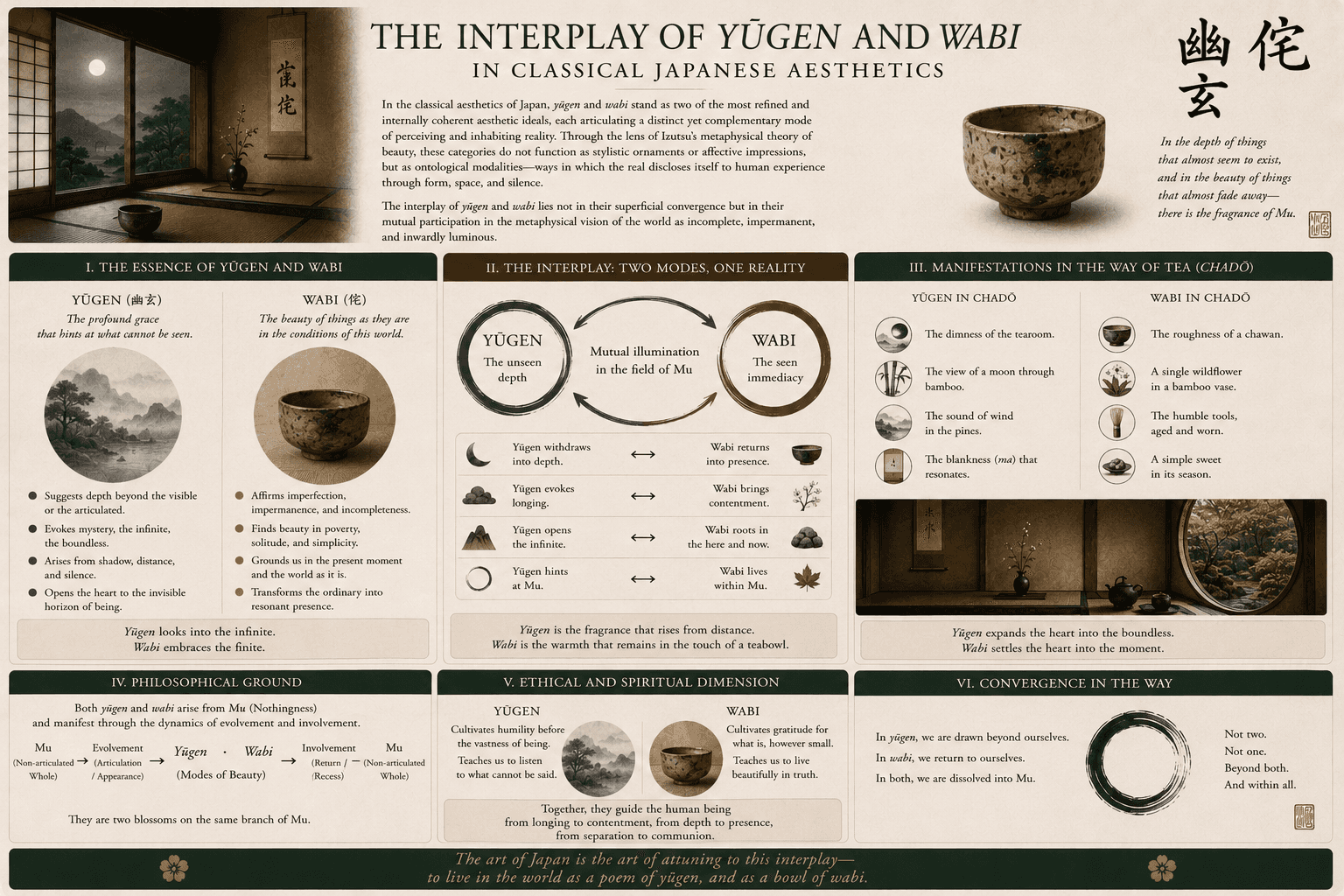
In the classical aesthetics of Japan, yūgen and wabi stand as two of the most refined and internally coherent aesthetic ideals, each articulating a distinct yet complementary mode of perceiving and inhabiting reality. Through the lens of Izutsu’s metaphysical theory of beauty, these categories do not function as stylistic ornaments or affective impressions, but as ontological modalities -ways in which the real discloses itself to human experience through form, space, and silence. The interplay of yūgen and wabi lies not in their superficial convergence but in their mutual participation in the metaphysical vision of the world as incomplete, impermanent, and inwardly luminous.
Yūgen is the more ancient of the two, emerging from Heian-period court culture as an aesthetic of subtle profundity, shadowed elegance, and veiled depth. It is not a quality that appears on the surface; it alludes to what lies beyond the seen, what is never fully revealed, but intimated. In the framework Izutsu develops, yūgen is aligned with a metaphysics of concealment, where the beautiful is not that which is clearly present, but that which withholds itself in order to suggest a depth beyond form. It is a modality of beauty grounded in hints -in the invisible that can only be felt through the visible.
By contrast, wabi arises in a different cultural register: not from the opulence of the court but from the ascetic solitude of the hermitage, the hut, the remote temple. It carries connotations of poverty, simplicity, and a deliberate detachment from worldly splendour. Yet, as Izutsu’s framework affirms, wabi is not a negation of beauty but its transfiguration. The beauty of wabi is that of the real as it is, unadorned, incomplete, and worn. In wabi, there is no veil of elegance to suggest depth. Rather, depth is encountered in the very bareness of the world. It is an aesthetic of presence, not concealment -a metaphysical affirmation of the quiet that remains when all else has been removed.
The interplay of yūgen and wabi lies in the tension and harmony between these two movements: concealment and exposure, depth through veiling and depth through stripping away. In classical Japanese art and poetics, this interplay can be traced in the shift from the layered elegance of yūgen in Noh drama and waka poetry to the radical simplicity of wabi in the Way of tea and haiku. And yet, this movement is not a historical succession but a deepening internal dialogue.
In the Way of tea (chadō), the two modes meet most fully. The aesthetic structure of the tea ritual is thoroughly wabi in its material form -weathered objects, asymmetrical spaces, muted color. But the experience it evokes, especially in its silent gestures, its intentional pauses, and its atmosphere of stillness, enters the domain of yūgen. The rusted iron kettle and the unfinished clay bowl do not merely show beauty; they hint at something beyond themselves. They are fully present, yet their presence gestures toward absence. In this, the wabi object is the bearer of yūgen experience.
Izutsu’s interpretation allows for this convergence by understanding beauty as the appearance of Being in particular modes. Yūgen is the mode in which Being appears as depth-within-form, as the mysterious luminosity behind the shadows. Wabi is the mode in which Being appears as radical simplicity, as the authenticity of things when they are no longer masked by utility, polish, or convention. Both dissolve the separation between subject and object—not through sensory stimulation, but through metaphysical quietude.
In poetic expression, too, the interplay is evident. A yūgen-infused poem evokes an emotion too vast for words by describing the smallest of gestures -a distant flute, a fading light, a drifting mist. A wabi poem, by contrast, may describe the same scene with blunt, minimal language, allowing the bareness of the image to speak. Yet both do not express the world; they let the world reveal itself. Both silence the ego in favour of an inner seeing.
In their convergence, yūgen and wabi affirm the highest aesthetic intuition of classical Japanese thought: that beauty is not in the object but in the mode of being the object discloses. Whether through depth withheld or form exposed, the beautiful in both cases is the real seen in its subtle clarity.