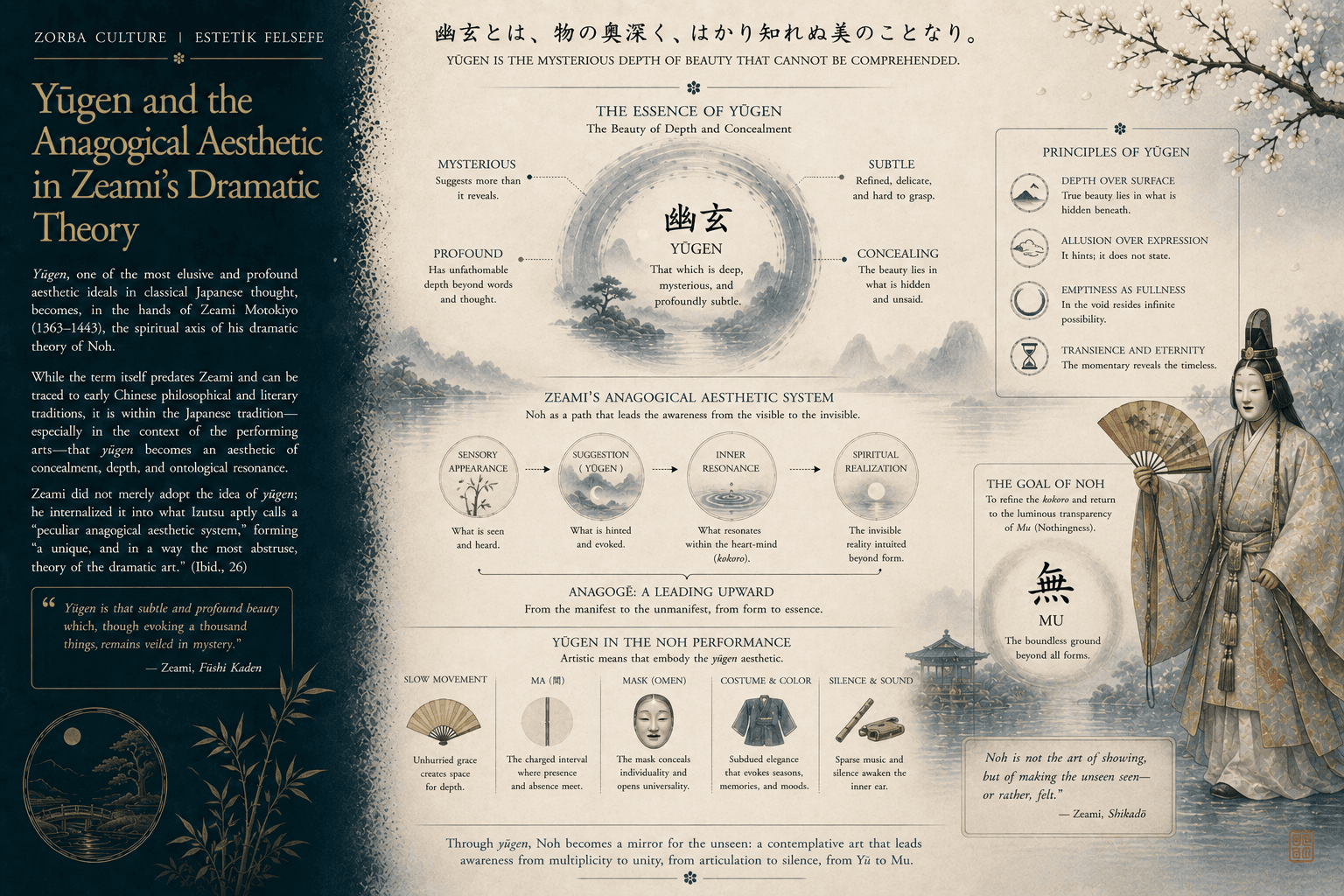
Yūgen, one of the most elusive and profound aesthetic ideals in classical Japanese thought, becomes, in the hands of Zeami Motokiyo (1363–1443), the spiritual axis of his dramatic theory of Noh. While the term itself predates Zeami and can be traced to early Chinese philosophical and literary traditions, it is within the Japanese tradition -especially in the context of the performing arts- that yūgen becomes an aesthetic of concealment, depth, and ontological resonance. Zeami did not merely adopt the idea of yūgen; he internalized it into what Izutsu aptly calls a “peculiar anagogical aesthetic system,” forming “a unique, and in a way the most abstruse, theory of the dramatic art.” (Ibid., 26)
In The Theory of Beauty in the Classical Aesthetics of Japan, Izutsu defines yūgen as a mode of beauty that arises from the mysterious, the obscure, the profound -that which is “not immediately given in the form of a clearly perceptible image,” but emerges subtly from the veiled depths of being. Yūgen thus belongs to what Izutsu calls “the non-articulated whole,” the level of aesthetic apprehension where the object is not yet dissected or conceptually grasped, but is intuited in its totality as a resonance of inner depth. This mode of beauty transcends visuality and touches upon a metaphysical horizon where the object of beauty points beyond itself toward a hidden ontological dimension.
Zeami's adoption of yūgen is not merely stylistic. It is metaphysical and anagogical in the strictest sense of the word: it aims to raise the soul of the spectator from the visible to the invisible, from the outer form of performance to the inner world of contemplation. Yūgen becomes the vessel through which the actor-poet creates a presence that is more real than reality -a presence Izutsu would describe as metaphysically deepened through symbolic evocation rather than direct representation.
Izutsu’s concept of tōtai -the total manifestation of the metaphysical whole in a finite, partial phenomenon- is essential to understanding yūgen in Zeami’s Noh. The actor, in embodying a role, does not merely imitate character or narrative. Instead, through gesture, voice, costume, and stillness, he allows the totality of the character's inner being, including that which is invisible, to disclose itself. Yūgen, then, is the mode through which tōtai occurs subtly, through veiled beauty and indirect articulation.
Zeami’s famous doctrine of hana (the flower) is deeply related to this. The flower, in its transience and suggestion, is not beautiful because of overt flamboyance but because it suggests a whole world of feeling, memory, and ontological pathos. The true hana of performance, as Zeami insists, arises not from technique alone, but from the actor's internalization of yūgen -his capacity to render visible the invisible, to evoke a world beyond the spoken and the seen.
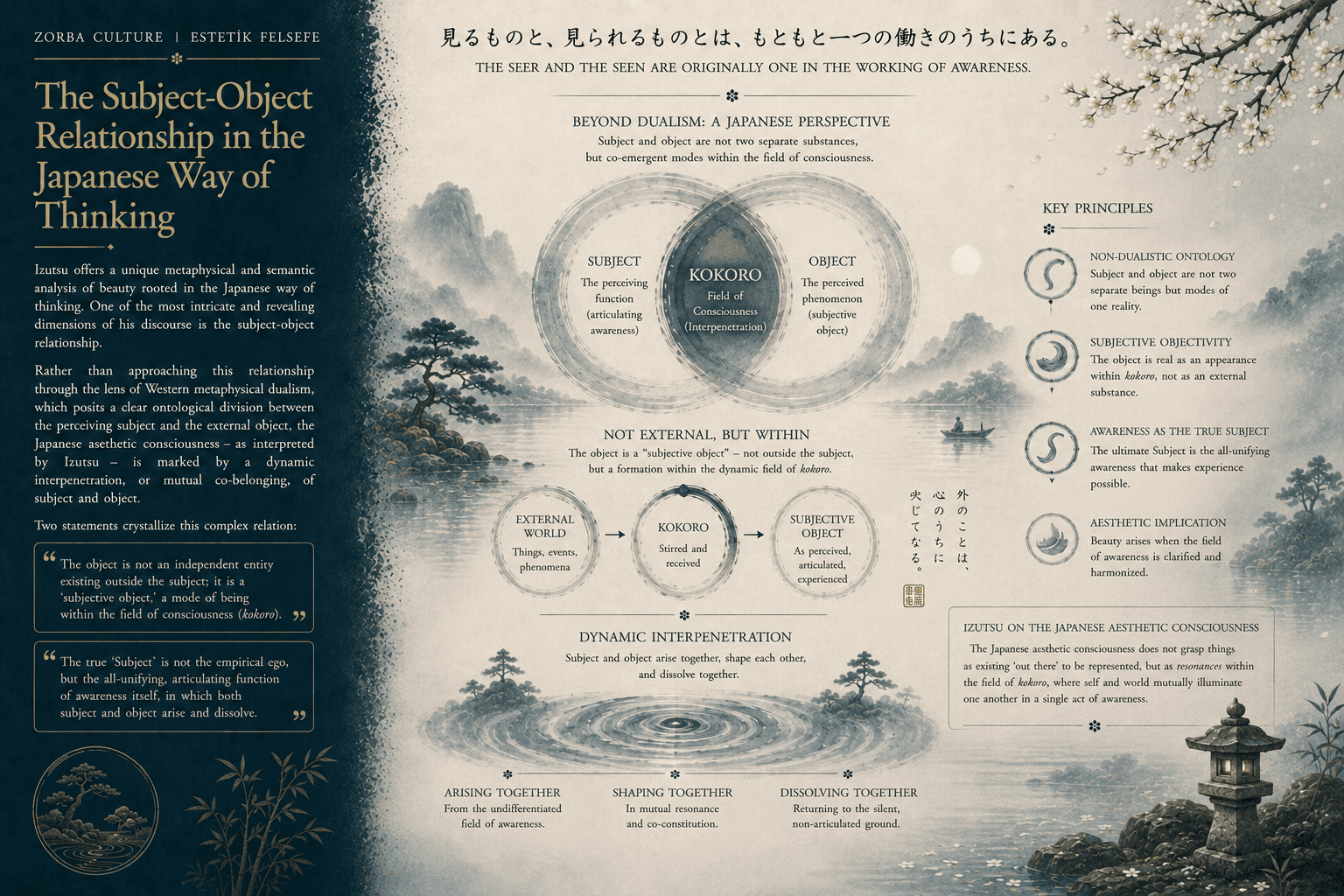
Central to Izutsu’s interpretation of Japanese aesthetics is the idea that beauty is not in the object per se but in the mode of consciousness that apprehends it. This consciousness (kokoro) is not merely cognitive but poetico-metaphysical: it sees, feels, and intuits the world as a living, vibrating whole. In the context of Zeami’s yūgen, this means that the actor must possess a deep kokoro -one that is quiet, contemplative, and inwardly attuned to the rhythms of being.
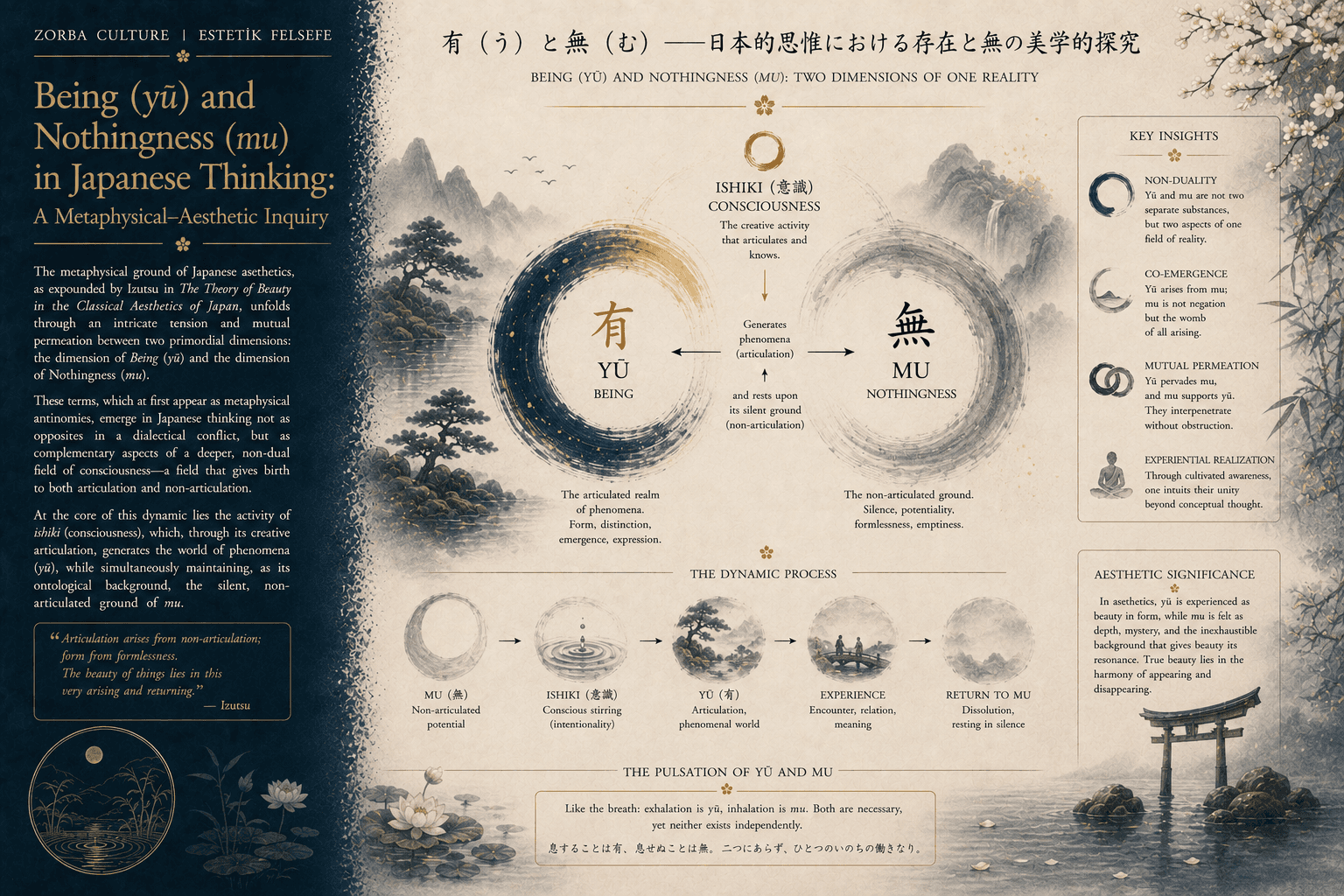
This links to the Japanese spatial concept of ma -the interval, the pause, the silence between movements or sounds. Yūgen unfolds in these ma, where nothing is articulated yet everything is felt. In a Noh performance, it is often the silent moment, the poised gesture, or the slow turning of the actor that opens the space for yūgen to emerge. This is not emptiness in the Western sense but the fullness of nothingness (mu) -a metaphysical fullness that Izutsu identifies as central to Japanese thinking.
Zeami’s theory of performance is fundamentally non-dualistic, much like the metaphysical undercurrent Izutsu finds in Japanese aesthetic consciousness. The performer and the performed, the actor and the role, subject and object -these dualities dissolve in the moment of true yūgen. When the actor achieves the “state of no-self” (muga), the performance becomes transparent, a vehicle for the deeper ontological reality to manifest. Yūgen here functions as a non-dual aesthetic, where beauty is not created but revealed as already present in the structure of reality.
This aligns with Izutsu’s vision of Japanese beauty as contemplative rather than expressive, where the aesthetic act is a spiritual operation of seeing into the thing itself, rather than imposing meaning or form. Yūgen is not an ornament; it is the spiritual atmosphere in which Being (yū) and Nothingness (mu) resonate as one.
Izutsu’s use of the term “anagogical” to describe Zeami’s aesthetic system points to a philosophical mysticism embedded in Noh. The actor, like the mystic, must descend into silence, erase his personal ego, and become a transparent vessel for the flow of something beyond. Yūgen is the sign of this spiritual operation: a beauty that draws the spectator’s soul upward, from the visible form of the performance to an intuition of the invisible essence.
Thus, yūgen is not only an aesthetic category but a metaphysical bridge. It is the veil that simultaneously hides and reveals the Real. Through the medium of Noh, it becomes a way of thinking, of seeing, and ultimately of being.